
- Hubble Home
- Overview
- About Hubble
- The History of Hubble
- Hubble Timeline
- Why Have a Telescope in Space?
- Hubble by the Numbers
- At the Museum
- FAQs
- Impact & Benefits
- Hubble’s Impact & Benefits
- Science Impacts
- Cultural Impact
- Technology Benefits
- Impact on Human Spaceflight
- Astro Community Impacts
- Science
- Hubble Science
- Science Themes
- Science Highlights
- Science Behind Discoveries
- Universe Uncovered
- Hubble’s Partners in Science
- Hubble & Citizen Science
- AI & Hubble Science
- Explore the Night Sky
- Observatory
- Hubble Observatory
- Hubble Design
- Mission Operations
- Science Operations
- Astronaut Missions to Hubble
- Hubble vs. Webb
- Hubble vs. Roman
- Team
- Hubble Team
- Career Aspirations
- Hubble Astronauts
- Multimedia
- Images
- Videos
- Online Activities
- e-Books
- Sonifications
- Podcasts
- 3D Hubble Models
- Lithographs
- Fact Sheets
- Posters
- Hubble on the NASA App
- Glossary
- News
- Hubble News
- Social Media
- Media Resources
- 35th Anniversary
- More
- Online Activities
3 min read
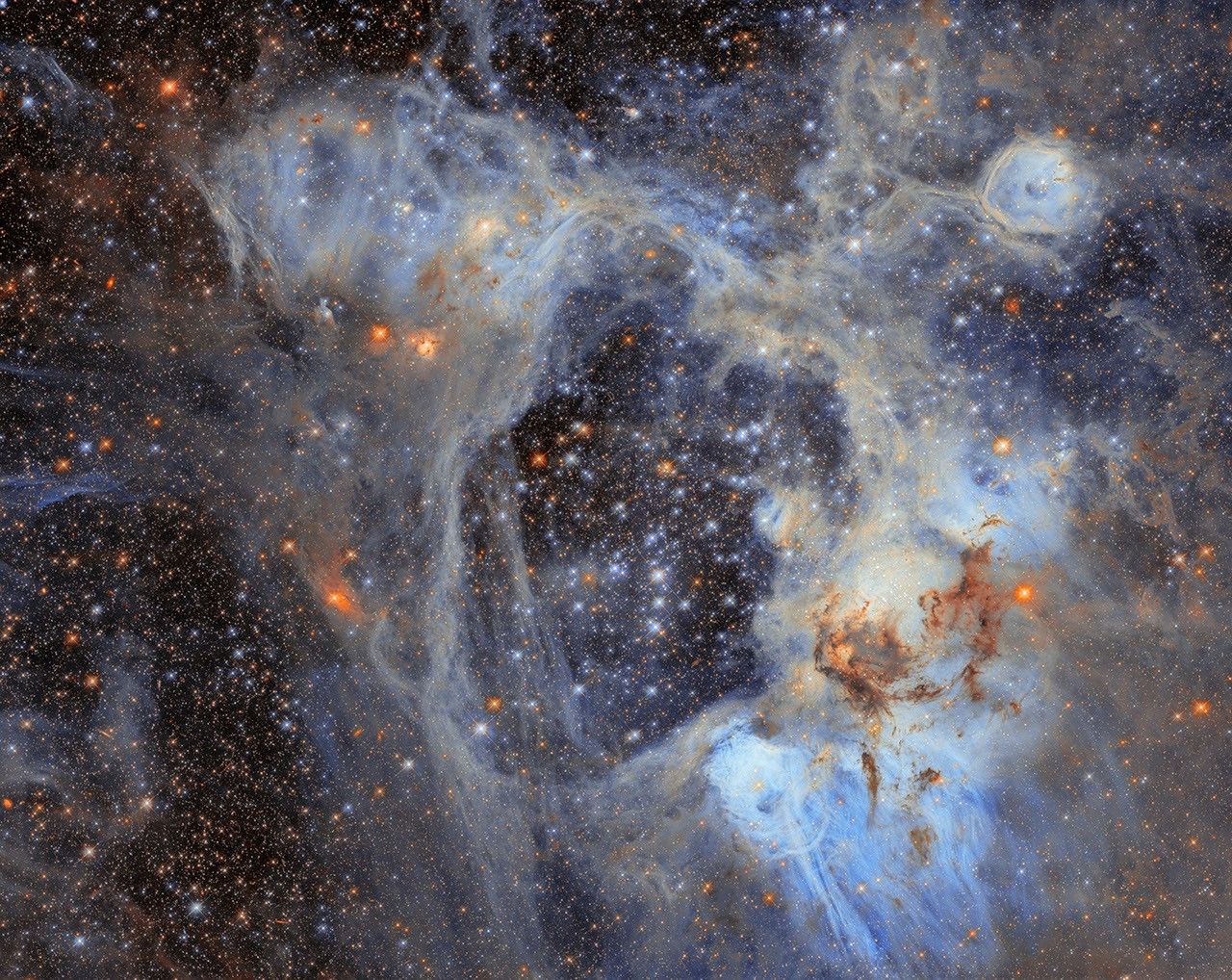
NASA’s Hubble Spies Superbubble Scene This Hubble Space Telescope image features the picturesque nebula LHA 120-N44, or N44. NASA, ESA/Hubble, D. GouliermisThis NASA/ESA Hubble Space Telescope image features a sprawling cosmic vista in the Large Magellanic Cloud, or LMC, the largest of the small galaxies that orbit our Milky Way galaxy. At just 160,000 light-years away, the LMC offers a close look at highly active star birth sites like the one in this image. This photogenic nebula, named LHA 120-N44, or N44, is in the constellation Dorado.
N44 is dominated by two features: a vast central void and a shell of dense, dusty gas. The central void is a ‘superbubble’ spanning roughly 210 by 140 light-years across. The glittering stars at the center of the void are responsible for its creation; through their powerful stellar winds and explosive supernovae, these stars expelled much of the gas from which they were born.
When the stars of N44’s central star cluster swept away this gas, the expelled gas compressed and formed a shell around the superbubble. New stars are forming in this compressed gas shell, making N44 an interesting target for astronomers who are using the nebula to study how stars form in this environment. Their goal is to understand how long it takes from the collapse of cold gas clouds into dense knots to the moment nuclear fusion ignites in the heart of a newborn star.
The data in this image is from an observing program (#14689; PI: Gouliermis) that used Hubble to survey N44 and take a census of its stars, cataloging nearly half a million stars within the cluster as well as interlopers drifting in front of it. Of the stars surveyed, nearly 30,000 are what astronomers call pre-main-sequence stars, which have yet to begin fusing hydrogen into helium in their cores. Astronomers discovered this treasure trove of baby stars thanks to the high sensitivity and fine spatial resolution of Hubble’s instruments that can pick out faint objects in crowded clusters.
The gas shell surrounding the superbubble is energized by ultraviolet radiation from massive stars, causing it to glow and highlighting several distinct features. Each feature within the broader N44 star-forming complex was cataloged by astronomer Karl Henize in the 1950s. One feature is a smaller bubble, cataloged as N44F, that is located near the upper-right corner of this image. N44F is an interstellar bubble blown by the intense stellar winds of a single hot and massive star. As this previously released Hubble closeup shows, the star’s furious winds and radiation have sculpted the surrounding bubble and created pillars of dusty gas.
Hubble’s sensitive observations of the lowest-mass stars in this region open a new window onto star formation in regions that, like the LMC or the galaxies in the early universe, are poor in elements heavier than helium.
Text Credit: ESA/Hubble
Facebook logo @NASAHubble @NASAHubble Instagram logo @NASAHubbleMedia Contact:
Claire Andreoli
NASA’s Goddard Space Flight Center, Greenbelt, MD
claire.andreoli@nasa.gov
In this YouTube video, Dr. Ken Carpenter takes us on a journey through the Nebula, teaching us some of the interesting science behind this famous Hubble image.
Hubble Views N44 Superbubble
N44 is a complex nebula filled with glowing hydrogen gas, dark lanes of dust, massive stars, and many populations of stars of different ages. One of its most distinctive features, however, is the dark, starry gap called a “superbubble,” visible in this Hubble image in the upper central region.
Large N44 Mosaic Image
Download various sizes of Hubble’s large N44 mosaic, including a high resolution, 14,478 x 19,908 pixel (1.6 GB) image
Share
- Hubble Space Telescope
- Astrophysics
- Astrophysics Division
- Emission Nebulae
- Goddard Space Flight Center
- Nebulae
- Star-forming Nebulae
- Supernovae
- The Universe
Hubble Space Telescope
Since its 1990 launch, the Hubble Space Telescope has changed our fundamental understanding of the universe.
Name That Nebula
What do you see in the cosmic clouds? Play this game to match nebulae with their names.
Hubble’s Nebulae
These ethereal veils of gas and dust tell the story of star birth and death.
Hubble Focus: The Lives of Stars
This e-book highlights the mission’s recent discoveries and observations related to the birth, evolution, and death of stars.