
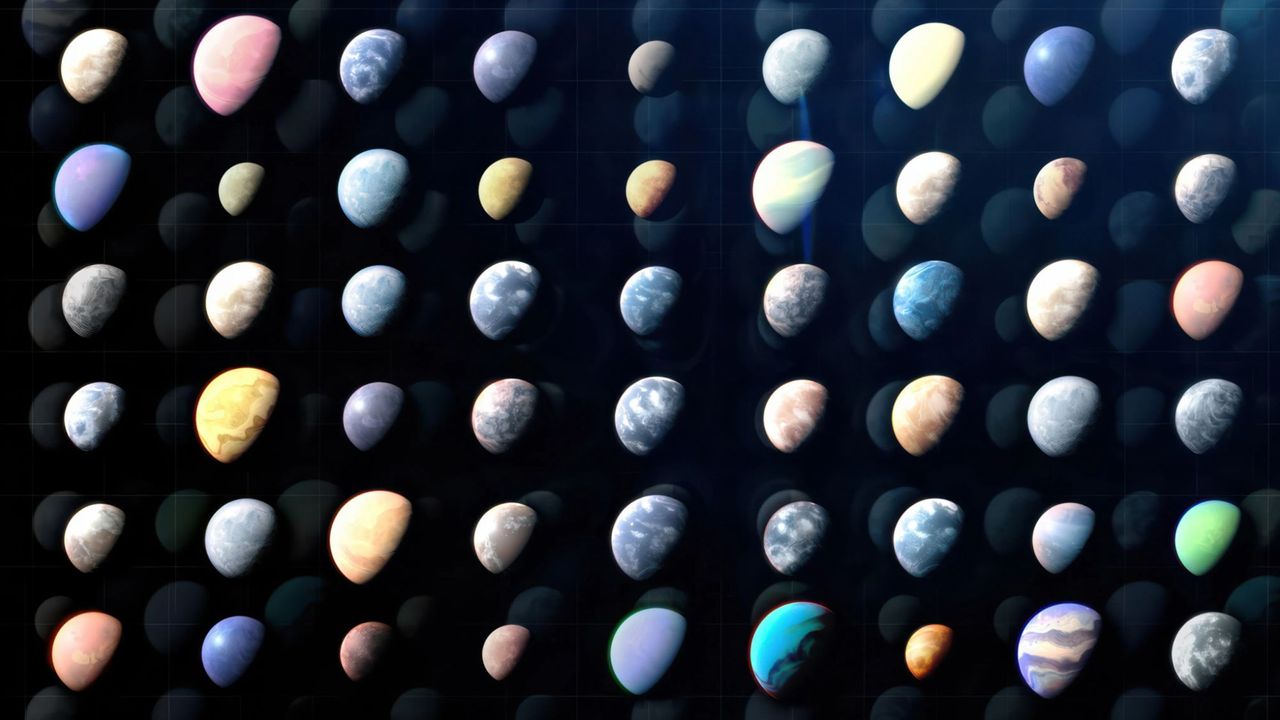
A brand new observatory began its tenure on Aug. 30 — it's called the Nancy Grace Roman Space Telescope, and it's equipped with a high-tech tool that can directly photograph planets beyond our solar system.
The tool is called a coronagraph; in simple terms, a coronagraph is a device that can be affixed to a telescope and block out the light of a star the telescope is looking at to study features around that star. Without such a device, starlight can be so overpowering that it outshines details nearby. You can think of a coronagraph as a way to recreate a total solar eclipse, except instead of the moon blocking out the sun it's a humanmade mask of sorts that does that trick.
But while coronagraphs have been used many times before, the one that just launched toward the stars is unprecedented. "The Roman Space Telescope is carrying the most advanced coronagraph that humanity has ever put into space," Dominic Benford, the telescope's program scientist, told Space.com.
If you can remember the striking "Pale Blue Dot" image of Earth that NASA's Voyager 1 spacecraft captured while floating about 3.7 billion miles (6 billion kilometers) from the sun, this is the kind of thing scientists expect to see with Roman's coronagraph. A menagerie of Pale Brown Dots should soon make us feel the weight of our existence.
"I love the feeling of smallness that comes from understanding you're not alone in the universe," Vanessa Bailey, Roman's coronagraph instrument scientist, told Space.com.
Earth as a "pale blue dot" seen by Voyager 1 in 1990. (Image credit: NASA/JPL-Caltech)How does it work?Coronagraphs aren't really a new thing. Often, they're even used to study our own sun.
For example, NASA's PUNCH mission — which stands for Polarimeter to Unify the Corona and Heliosphere — launched in 2025 and consists of four spacecraft, one of which holds a coronagraph. This coronagraph blocks out the light of our sun in order to reveal the wispy tendrils of the sun's outer atmosphere, or corona.
"In fact, more than 100 years ago, astronomers used coronagraphs to create an artificial eclipse to study the sun's corona," Bailey said during a press briefing on Aug. 29, a day before Roman launched to space. "That's the reason for the name."
But when it comes to other stars, coronagraphs hold another purpose. They can block out a star's light in such a way that planets actually orbiting that star come into view.
"We can block that starlight until we have only a few parts per billion of the light of the star remaining," Benford said of Roman's coronagraph. As a result, he explained, "we can directly see the light bouncing off something like a Jupiter around another star, which we've never been able to do before."
NASA's Solar and Heliospheric Observatory, or SOHO, constantly observes the outer regions of the sun's corona using a coronagraph, which blocks the bright solar disk. (Image credit: ESA/NASA/SOHO)This process will surely give us our Pale Brown Dots — but to take things a step further, scientists will also be able to dissect the light bouncing off the theoretical Jupiter to reveal what the atmosphere of the world is like, too.
To be clear, Roman isn't the only astronomy tool we have that utilizes a coronagraph while looking beyond our solar system. Even the James Webb Space Telescope and Hubble Space Telescope have their own, for that matter. However, Roman's is far more complex.
For one, the Roman's coronagraph doesn't exactly "block" out starlight like a standard coronagraph does. For the "moon" in its artificial eclipses, it uses a combination of patterned disks and special filters to create destructive interference with the light of a target star. Destructive interference means competing waves of light cancel one another out, leading to a zeroed amplitude. In effect, this blocks out the starlight as necessary and only allows light reflected off the planets of interest to pull through and reflect off the coronagraph's mirrors.
A diagram showing what the disk's pattern might look like. (Image credit: NASA's Goddard Space Flight Center)The first active coronagraphWhich brings us to the next special part about Roman's coronagraph: It's the first "active" coronagraph to fly in space.
What this means is it can adjust those mirrors in real-time to make sure its exoplanet observations are as clear as possible. This is important because as light reflects off the coronagraph's mirrors, it can create small distortions that mess up the delicate destructive interference dance. You'd need to adjust to bring the balance back, and these adjustments are possible because Roman's coronagraph has hundreds of tiny pistons built into its mirrors. This makes them deformable so they can change shape to account for distortions.
If it all works out, this coronagraph should be capable of detecting exoplanets that are about 100 million times fainter than their stars.
"These deformable mirrors are a real engineering feat," Bailey said during the press briefing. "They can be commanded with the precision approaching the size of an atom, and this is what really allows us to make this transformative performance."
The Roman Space Telescope's coronagraph as scientists were working on it. (Image credit: NASA/JPL-Caltech)As for what the specific hope is for Roman's coronagraph, Bailey explained there are a few nearby star systems the team is particularly interested in peering into because we have hints of Jupiter-like planets orbiting in those systems that still haven't been imaged. "Or," she said, "there may be really interesting remnants of dust and debris from the process of planet formation." Perhaps that dust could exist in the habitable zones of the stars Roman looks toward, and perhaps this could tell us more about the birth of planet Earth.
"That is interesting in its own regard but also interesting as a precursor to the Habitable Worlds Observatory," Bailey said, in reference to NASA's next great project that will be equipped with a more advanced version of Roman's coronagraph. "We can study how dusty these nearby systems are and understand whether any of them might have too much dust for us to be able to observe an Earth-like planet in the future."
An animation shows what Roman looks like deploying in space. (Image credit: NASA’s Goddard Space Flight Center Conceptual Image Lab)While Roman will pretty much be focusing on Jupiter-like worlds because they're big enough to be detected with its current capabilities, HWO could certainly find another Earth someday.
From 6,000 exoplanets to 100,000And before we wrap up, we must briefly mention this newly christened exoplanet hunter's partner tool, the majorly impressive Wide Field Instrument (WFI) that can survey huge swaths of sky in one go. It is because of the partnership between the WFI and its coronagraph that Roman will immensely expand our exoplanet gallery, says associate administrator for NASA's Science Mission Directorate Nicky Fox. The coronagraph won't be finding new exoplanets alone, but rather will be diving deeper into exoplanets the WFI finds first.
The Roman Space Telescope's WFI. (Image credit: NASA/Chris Gunn)WFI will use two different techniques to contribute to our gallery. The first one is called the transit technique, and it's the same method big names like Kepler and TESS tapped into. It involves noticing dips in starlight that happen when a possible planet transits the face of a star from the telescope's vantage point. "If you see that happen multiple times," Fox said, "you can infer that it's a planet, and you can get the radius and the size of the planet from that observation."
The second technique has to do with gravitational lensing, which refers to how objects with mass in space (and therefore gravitational influence) can warp the very fabric of spacetime and alter the path of light traveling through the affected region. What comes to mind might be a mighty galaxy cluster twisting spacetime like a sheet of satin, but little things like stars and planets can do it, too. The so-called "microlensing" effect of smaller objects warping spacetime leads to the brightening of background objects.
Fox sums up WFI's two techniques in a nutshell: "If you see a little dip, that can suggest there's a transiting planet. You see a little brightening, that can suggest there's a microlensing planet."
For WFI, the microlensing technique will be sensitive to Earth-size planets in the habitable zones of their stars, while the transiting technique will be more sensitive to planets closer to their stars. And as Bailey reminds us, there are absolute heaps of planets to test Roman out on: "When you look up at the night sky, most of those stars have planets."
Right now, we only know of about 6,000 of those worlds. Fox believes this new space telescope could unveil 100,000 more.