
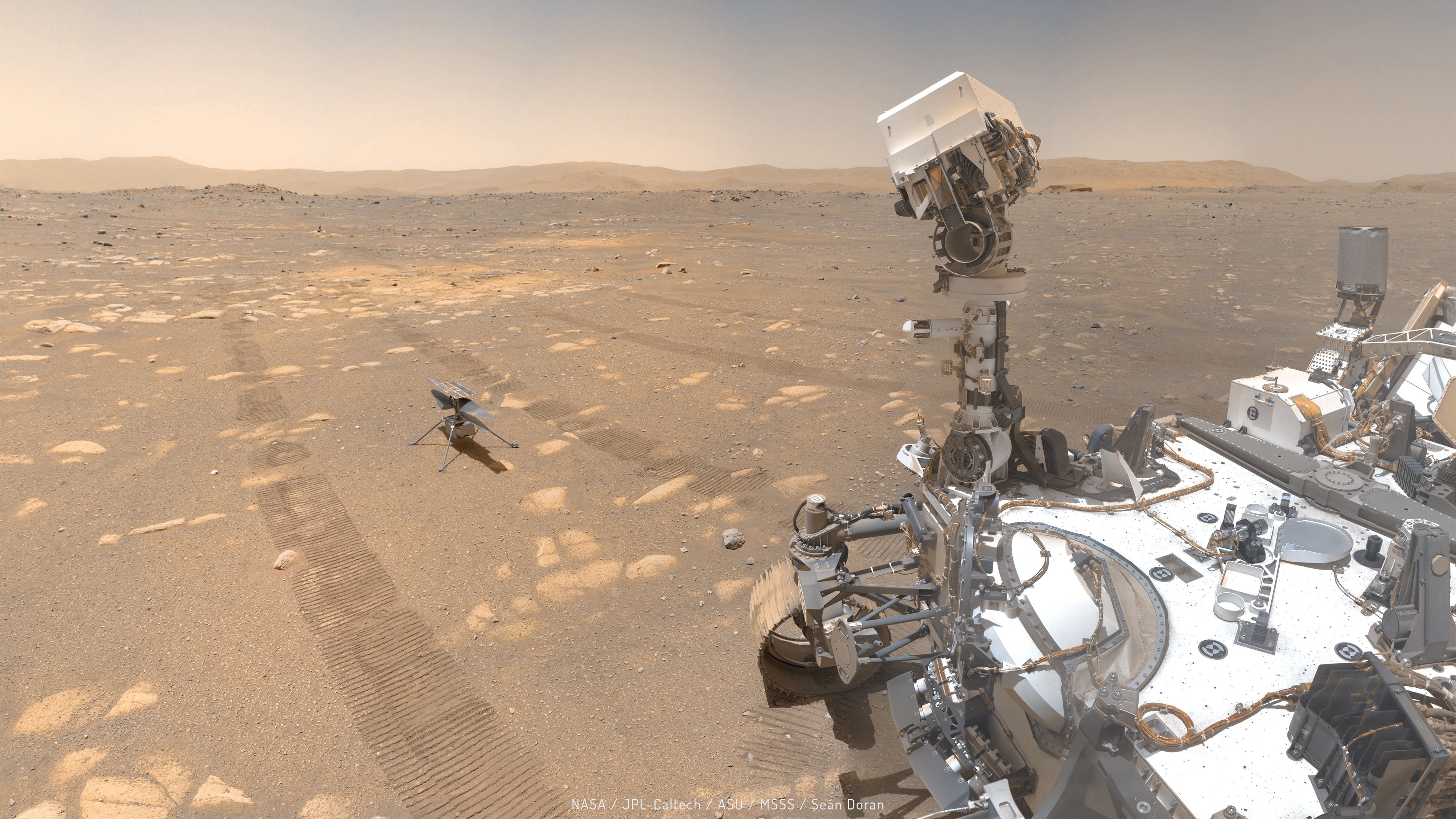
Teams over at NASA are currently dealing with two major issues affecting the Perseverance rover and the 2001 Mars Odyssey orbiter, with the former losing one of its two UHF radios and the latter limping along on two reaction wheels that impede its ability to orient itself without burning through the hydrazine for its thrusters.
The Perseverance rover is basically a copy of the Curiosity rover which landed on Mars in 2012, with its sibling — featuring updated instruments and the Ingenuity helicopter — following in its proverbial wheel tracks in 2021. Both missions were going swimmingly until on October 30th, when Perseverance‘s primary downlink radio did not send its usual heartbeats to the rover’s computer.
Following this the system switched to its backup radio, but this led to a second issue being discovered. The backup’s radio’s transmit link was only at half of its rated power. Although the rover has a backup X-band communications system that works directly with the Deep Space Network (DSN), this is only capable of 800 bps versus the 2 Mbps of the UHF link, putting the rover out of commission until the issue can be diagnosed and repaired or worked around.
Perhaps more troublesome is that the 2001 Mars Odyssey orbiter suddenly got a deadline of 1 to 2 months before it runs out of hydrazine and can no longer orient itself. Since reaching Mars orbit in 2001, its total of four reaction wheels which control the spacecraft’s orientation have gradually begun to fail. The first wheel failed in 2013, with now a second reaction wheel having ceased to function. With three required, the thrusters are thus the last option and attempts are underway to coax at least one wheel back to life.
Although a successful outcome to these diagnostics-and-repair sessions will be great, it’ll only postpone the dire need to have more in-orbit data relays. All Mars rovers rely on these satellites to transmit high-bandwidth links to the DSN, which has become problematic since NASA lost the MAVEN spacecraft, apparently due to a system glitch.
Although plans for updates to the Mars Relay Network (MRN) have been ongoing for many years, currently there’s no alternative to keeping satellites like the 2001 Mars Odyssey patched up and orbiting to not leave at least two Mars rovers stuck talking on an X-band link with speeds that make one long for a 56k dial-up connection.