
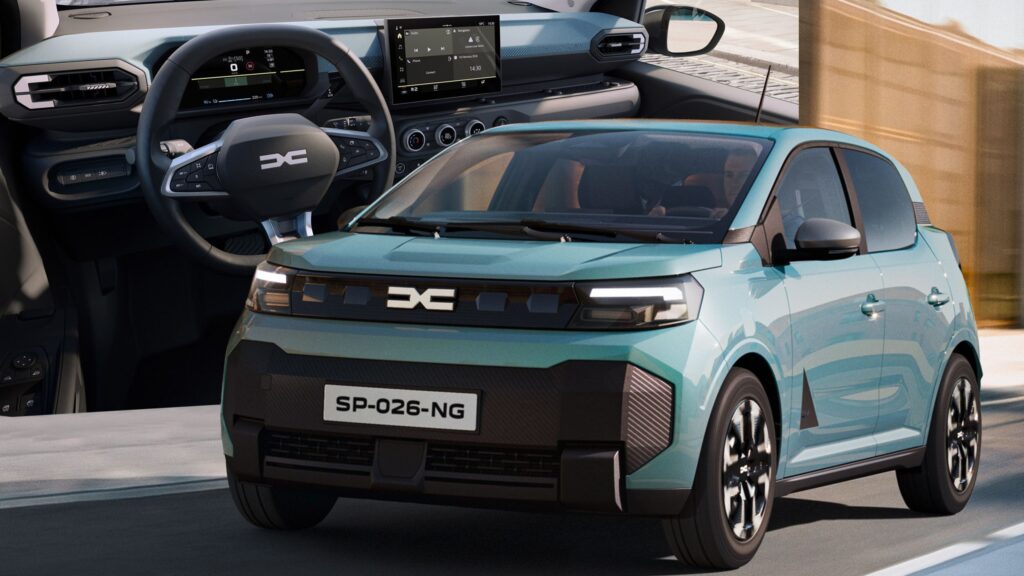
- New Dacia Spring is a Euro-made budget-friendly urban EV.
- It has a Renault platform, 80 hp and a 155-mile WLTP range.
- The entire lineup will be priced under €20k before subsidies.
Dacia has unveiled a new generation of the Spring, marking a complete overhaul for one of Europe’s most affordable urban EVs. The small hatchback is built on Renault bones, promising a 155-mile range, clever design features and a sub-€20k price tag. Unlike its Chinese-built predecessor, the new Spring will be manufactured in Slovenia, avoiding import tariffs in Europe.
The new model swaps the aging CMFA-EV platform of its predecessor for the new RG-EV architecture. This is another name for the AmpR Small platform, already underpinning the Renault Twingo E-Tech, Renault 5 E-Tech and Nissan Micra hatchbacks.
More: Dacia’s Sub-$28K Striker Claims To Be Three Cars At Once
Power comes from a Twingo-sourced electric motor producing 80 hp (60 kW / 82 PS) and 175 Nm (129 lb-ft) of torque, sending power to the front wheels. Energy is stored in a small 27.5 kWh Lithium Iron Phosphate (LFP) battery pack, offering up to 250 km (155 miles) of WLTP range. The battery needs 28 minutes to charge from 15-80% when connected to a 50 kW DC fast charger, or 2 hours and 55 minutes using the standard 6.6 kW AC onboard charger.
The shift to the new platform gives the urban EV different proportions and a larger footprint. More specifically, the new Spring is 150 mm (5.9 in) longer and 180 mm (7.1 in) wider compared to its predecessor, stretching to 3,850 mm (151.6 in) long. It is also 61 mm (2.4 in) longer than the Renault Twingo E-Tech twin, while adopting a different styling language.
Unlike the Renault which is known for its frog-style headlights and soft curves, the Dacia looks less playful and more utilitarian. Designers gave it boxy LEDs, a generous amount of plastic cladding on the bumpers, conventional door handles and wheels measuring 15 or 16 inches in diameter.
The lineup will comprise the Expression and Journey trims. Dacia has yet to announce detailed pricing but promised that all variants will cost under €20,000 ($23,000) before local EV subsidies. This means that the new model will be more expensive compared to the outgoing Spring, which started from a heavily discounted €11,900 ($13,80) in Germany earlier this year.
This is a developing story and will be updated…