
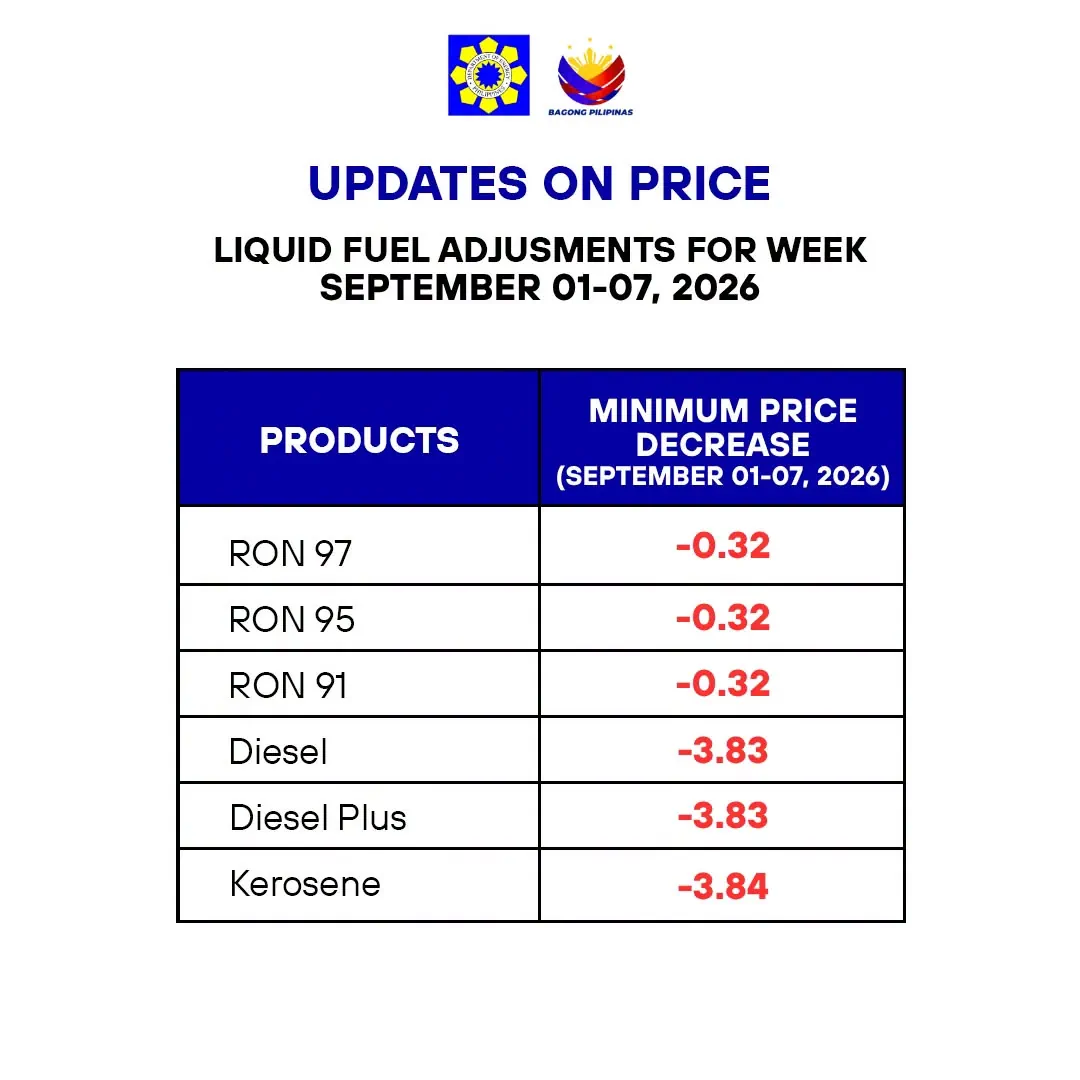
September kicks off with a round of rollbacks motivated by progress being made in negotiations to reopen the Strait of Hormuz. This comes as much-needed relief after consecutive weeks of price closing out August.
For the period of September 1 to 7, 2026, the price of diesel will go down by P3.83 per liter, while gasoline prices will decrease by P0.32 per liter. Finally, kerosene will also have a price decrease of P3.84 per liter.
PHOTO BY Department of Energy
PHOTO BY SeaOil
However, this relief may prove short-lived as reports of Iran and the United States exchanging fire once again early on August 31st prompted an immediate spike in oil price. Observers are concerned that this could set the tone for the rest of the trading week, and ultimately result in a price hike for Filipino motorists come Septmeber 8.
OTHER STORIES YOU MIGHT HAVE MISSED:
The DPWH has a floodwater basin in the works beneath the NLEX Cloverleaf section
MMDA, Antipolo, Cainta, Marikina, and Pasig team up to manage traffic along Marcos Highway
On the diplomatic front, neither belligerents have expressed interest in returning to the negotiation table for the time being. September marks six months since war broke out in the Middle East and the Strait of Hormuz was closed by Iran. Prior to its closure, the heavily-contested waterway accomodated the flow of up to 25% of the world’s oil products. The Philippines, almost entirely dependent on fuel imports, continues to feel the crunch of the disrupted fuel supply from the Middle East.
PHOTO BY Leandre Grecia
The Philippine automotive industry also took a hit in the first half of the year, posting an 11.4% decline in the first half of the year. The Chamber of Automotive Manufacturers of the Philippines still remains optimistic for the second half of the year, sharing in a recent report that July saw the highest monthly vehicle sales this year so far. The association interprets this as the first signs of recovery for the industry, and hopes remain high that the industry can keep up this momentum through the end of 2026.
Electrification also shows signs of continued mainstream adoption as oil prices continue to be unpredictable. A total of 38,286 xEVs (HEVs, PHEVs, and BEVs combined) were sold in 2026 so far, representing 15.84% of the market. It should be noted that this data does not include non-member automakers like BYD. Factoring in the Chinese brand likely drives up xEVs’ market share higher.