
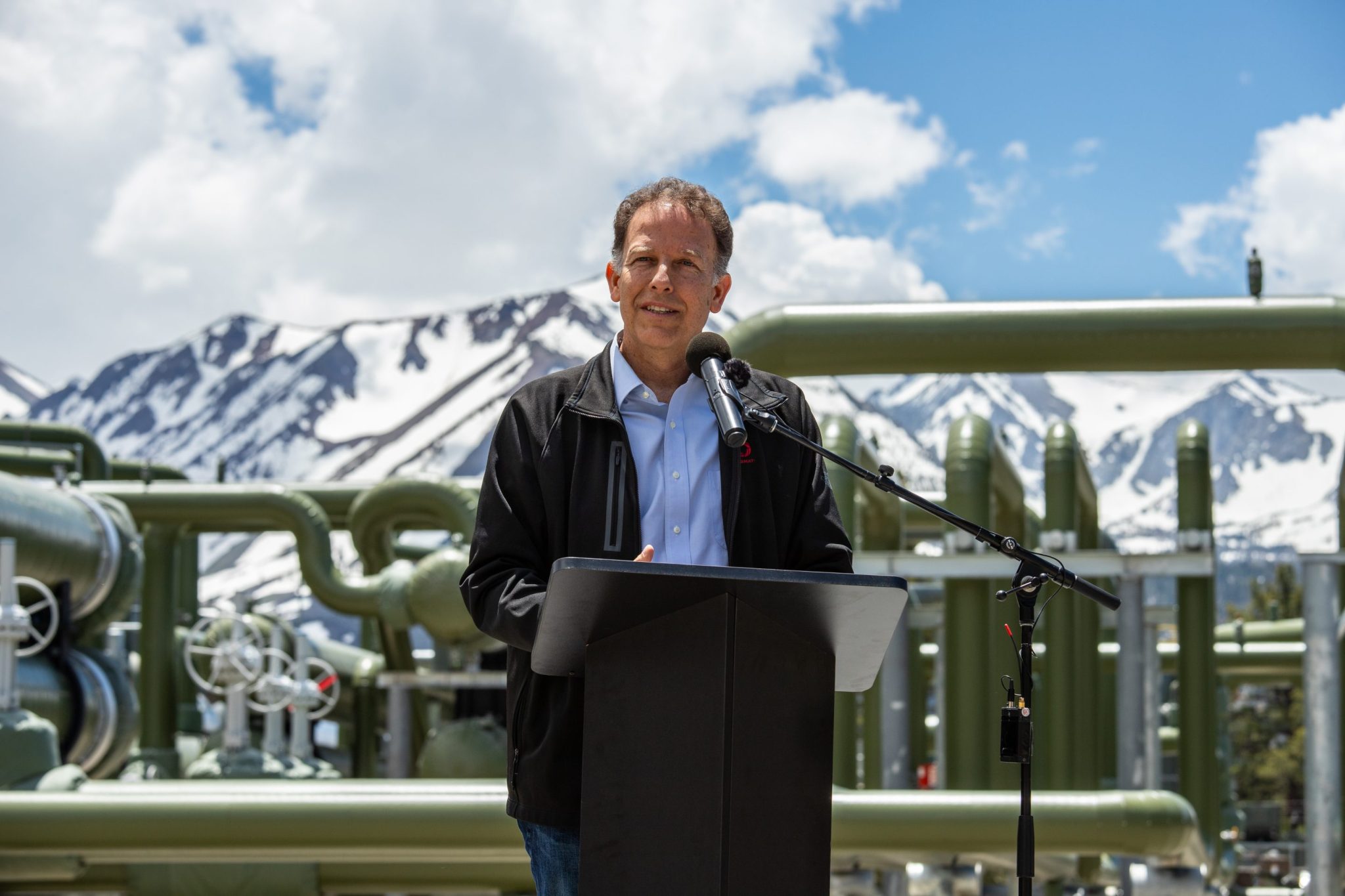
For 60 years, Ormat Technologies strategically built geothermal power plants where nature allows—over underground reservoirs of high-pressure water or steam—including around the so-called Pacific “Ring of Fire” from Asia to the Americas. Doing so made Ormat the largest geothermal operator in the world.
Today, Ormat hopes to grow exponentially with the AI data center boom, aiming to build baseload, clean power plants throughout the Western United States utilizing both new technologies and old. The goal is called EGS—enhanced geothermal systems—marrying the traditional geothermal business with the newest oil-drilling and fracking techniques. The idea is that EGS will allow for the construction of next-generation geothermal power almost anywhere the customer desires by tapping into deeper, higher-temperature underground reservoirs much more easily.
While the science is proven, Ormat and competitors are racing to show they can build the plants economically and efficiently enough to contend with other sources of power generation, including gas-fired power, renewables, and nuclear. That’s why Ormat is launching two separate EGS pilot projects with different partners—a geothermal startup, Sage Geosystems, and the century-old, largest oilfield services firm in the world, SLB. Ormat also is working closely with Google and data center developer Switch.
“We’re in a very rare situation where all the stars are aligned exactly on time,” Ormat CEO Doron Blachar told Fortune. “We have the hyperscalers and the AI demand. This basically puts us in a situation where we see endless demand for our product. The more electricity we can generate, the more we sell, and we’ve been doing a lot of exploration in the U.S. over the last few years.”
Blachar’s thesis is that Ormat already combines traditional geothermal growth and a newer battery energy storage business that’s growing with renewable solar power installations nationwide. Even if the push into enhanced geothermal systems fails, he says, Ormat will be successful. But Blachar is confident that the EGS business—the company’s biggest potential growth driver—will thrive and that Ormat is better positioned than any other geothermal player to do EGS at scale.
“We know how to buy land positions. We have [contracts] with hyperscalers, with utilities, for hundreds of megawatts,” Blachar said. “We know how to get the permits. We know how to get the interconnections.
“The uniqueness is we have all the ingredients to develop EGS. Once the pilots are successful, we’ll start running,” he added.
On Wall Street, Ormat is now most closely compared to EGS startup Fervo, which went public in May with the biggest clean energy IPO ever in the U.S. Fervo’s market cap quickly jumped to $10 billion but, after some modest setbacks, has since plunged down to $5 billion, despite its strong longer-term potential.
Ormat, on the other hand, has seen its stock rise almost 20% in 12 months, up to a market cap of about $6.75 billion—down a little from an all-time high in early June. And Blachar is quick to point out that Ormat is profitable outside of its pilot projects. Ormat posted revenues of $662.7 million for the first half of 2026, up 43% from last year, on a net profit of $71.2 million, up 4% year-on-year.
“There is no company in the industry that can take advantage of EGS better than Ormat,” he said. “We have been here for 60 years. We are big in power plants. We know how to build them efficiently and how to operate them. And once the pilots are successful—either of them, or both of them—we will be able to develop multiple EGS projects.”
Steady growth before the sprintOrmat was founded in Israel and grew globally before moving its headquarters to Reno, Nevada over 20 years ago.
Nevada is a hotspot for geothermal energy and both of its EGS pilots are located there. The pilot with Sage is at Ormat’s Blue Mountain power plant in Nevada, while the SLB pilot is located at Ormat’s Desert Peak plant. Ormat has also acquired new acreage in New Mexico, Oregon, and Idaho. Blachar said he’s bullish on Texas too. Sage’s milestone first pilot—a precursor to its Ormat project—just came online in August near San Antonio.
Blachar, who joined Ormat in 2013 as chief financial officer and became the CEO in 2020, still works out of his home city in Tel Aviv, and he speaks in thickly accented English, routinely traveling the world for Ormat projects, from Reno to Indonesia, Turkey, and New Zealand. Apart from the U.S., Indonesia is Ormat’s largest targeted growth area. “We are developing [in Indonesia], but it is taking a longer time. The processes are longer, and we are much more cautious, versus the U.S. where we are willing to take more risk in this environment.”
Ormat’s power portfolio in operation worldwide is 1.85 gigawatts—enough to power 1.4 million U.S. homes or roughly two large data center complexes. The 2028 growth target is to achieve up to 2.8 gigawatts through traditional geothermal and battery storage, not counting EGS.
But that’s still small potatoes versus what EGS could potentially build underground. Ormat was developing roughly 100 megawatts of geothermal power per year, Blachar said. Each EGS project with a hyperscaler could easily be 500 megawatts.
There is less political doubt—with Republicans attacking wind and solar and Democrats targeting fossil fuel emissions—because geothermal is beloved by both parties for now. Democrats want the clean energy, and the GOP likes how traditional oil and gas companies profit from expanding into the geothermal business. SLB, for instance, is pushing to expand in geothermal, lending its expertise in subsurface analysis and drilling wells.
Ormat’s pilot projects with SLB and Sage will be drilled next and could be online by late 2027, Blachar said. “Once they finish, we will start developing EGS projects.”
Twenty years ago, Ormat experimented with EGS, but it was too costly and difficult, he said. The drilling technologies have rapidly advanced since then as U.S. oil producers can drill 5-mile-long horizontal wells underground to maximize oil and gas production volumes.
Earlier this year, Ormat launched its Ormega100 power plant unit, a standardized, simplified power plant design with fewer moving parts that is intended to scale up economically with EGS.
“EGS today is becoming a much more realistic outcome,” Blachar said. “When you take Ormat experience and business development in the design of a power plant, and the amount of land and positions we have in the U.S., we are going to take advantage of this new technology and grow much faster.”
This story was originally featured on Fortune.com