
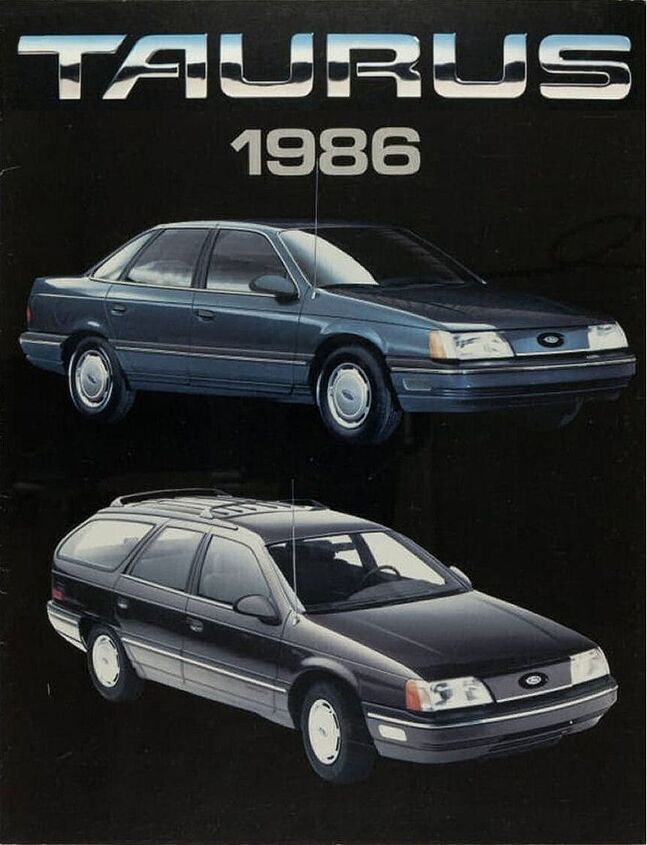
In the late '70s and into the '80s, Ford was in a bad place with regard to its domestic passenger cars and its finances. The company had only three platforms to span the entire Ford, Mercury, and Lincoln product range. Its family midsize car of the early '80s was the LTD, which was rear-drive, lackluster, and desperately in need of replacement by something front-wheel drive (FWD) and modern. So Ford spent five long years on the development of its new family car that would become the Ford Taurus, the Mercury Sable, and eventually their cousin the Lincoln Continental.
Taurus was the first project of newly minted CEO Philip Caldwell, and was the most expansive and expensive product development Ford had ever attempted. Known as Team Taurus, the project was led directly by the Vice President of Car Development, Lewis Veraldi (1930-1990). Ford would smartly use prior lessons learned from the first stage of Taurus development and consider the flaws in its prior product launches both domestic and international.
Edsel was one such consideration. The failed marque of 1958-1960 attempted to be more modern than other Ford-Lincoln-Mercury cars and introduce innovative features. It was priced higher than Ford, and in some cases even higher than Mercury. With gawky styling, gimmicky features, and questionable build quality, customers instantly rejected Edsels.
At the time, Ford developed the Edsel line in secret and did not conduct customer clinics or even show them to dealers. When the cars were shipped to dealers prior to launch day, the trailers were covered and dealers covered their windows. The lesson: Involve customers for their feedback, and not build gimmicky and modern features into what was supposed to be a mass-market car.
(Ed note: Dealers often covered showroom windows before new vehicles were launched. The Edsel wasn't unique in that sense, but it did heighten the negative response to the car.)
The next lessons considered were more recent events at the time. Ford’s Escort compact was intended to be the company’s first “world car.” While it was a new product name for North America, the Escort was a successful compact offering abroad since the late '60s. The project would consolidate the replacement for the American Pinto and the Euro market Mark II Escort into a single car.
The chassis and components would be shared, with minimal market differences between the two vehicles. American and European teams were brought together (once) and given the assignment: Make an Escort that’s the same for both markets. Then Ford’s management made an error, they stepped away and let the two teams work separately.
Throughout development the two teams did not share ideas or information. As a result, the American and European Escorts of 1981 ended up being almost completely different. There were no interchangeable body parts, and the only components shared were an inline-four engine and the automatic transmission. The crucial error was one of management, and ensuring various teams shared information and remained on the same page.
Around the same time, Ford of Europe learned another valuable lesson when it debuted its first aerodynamic family car, the Sierra. Intended as a replacement for the very popular Cortina and Taunus models, the Sierra debuted with a rounded and very aerodynamic shape. Ford’s development team was caught up on fuel efficiency and aerodynamics and forgot Cortina's core customer: the traditional family car buyer, and company car buyers.
The former was put off by the aerodynamic styling, as the beloved Cortina was a traditional three-box shape. Company car buyers were put off by the lack of a sedan version, as the Cortina was a hatchback or a wagon only. A sedan did not arrive until 1987. In the meantime, many customers who would have purchased a Sierra-class vehicle turned to the more traditional looking Escort instead.
All those past and present mistakes led to a new teamwork methodology for Taurus. The exterior and interior design teams would work together for the duration of the project, and all were located at Ford HQ. The engineering team was led by Jack Telnack (b. 1937), who had big design successes under his belt like the 1979 Mustang and work on the 1983 aero Thunderbird. Notably the Taurus wagon’s exterior was designed by Jeff Teague, the son of AMC head designer Richard Teague.
Also involved along the way were consumers, who Ford brought in for clinics from the early stages of Taurus development. Intent on preventing the mistakes from Edsel and the Sierra, Ford conducted clinics and surveys with large numbers of regular Americans. These surveys led to the selection of the steering wheel design, the seats, the suspension setup, and the radio options.
There was a push for better quality at Ford at the time the Taurus project began. The CEO appointed a new quality director, who hired a statistician to tell him what was wrong with Ford’s design process. The statistician said that 85 percent of all problems in the development of better vehicles were down to bad management decisions.
From there, Ford changed its quality process to include statistical process control. Statistical methods monitored the production process to ensure the final product conformed to the desired specification, and that the entire process maintained efficiency. Facing consumers was a new slogan from Ford that launched in the summer of 1981: Quality is Job 1.
Consumer clinics conducted, the Taurus went through several prototype revisions. An original idea included a full glass panoramic roof, though it was determined to be “too radical.” Ford also purchased competitor’s vehicles in order to take them apart and study the components. Sacrificed on the development floor were a Toyota Camry, Honda Accord, and a BMW 5 Series.
Ford used its full five-year development timeline before debuting the Taurus, which it did not do until mid-1985. Executives and the press didn’t get to see the Taurus and Sable until about four months before they began production. While many were wowed by the new car, some thought it would be a flop. We’ll delve into its introduction and exterior design next time.
[Images: Ford, BMW]
Become a TTAC insider. Get the latest news, features, TTAC takes, and everything else that gets to the truth about cars first by subscribing to our newsletter.