
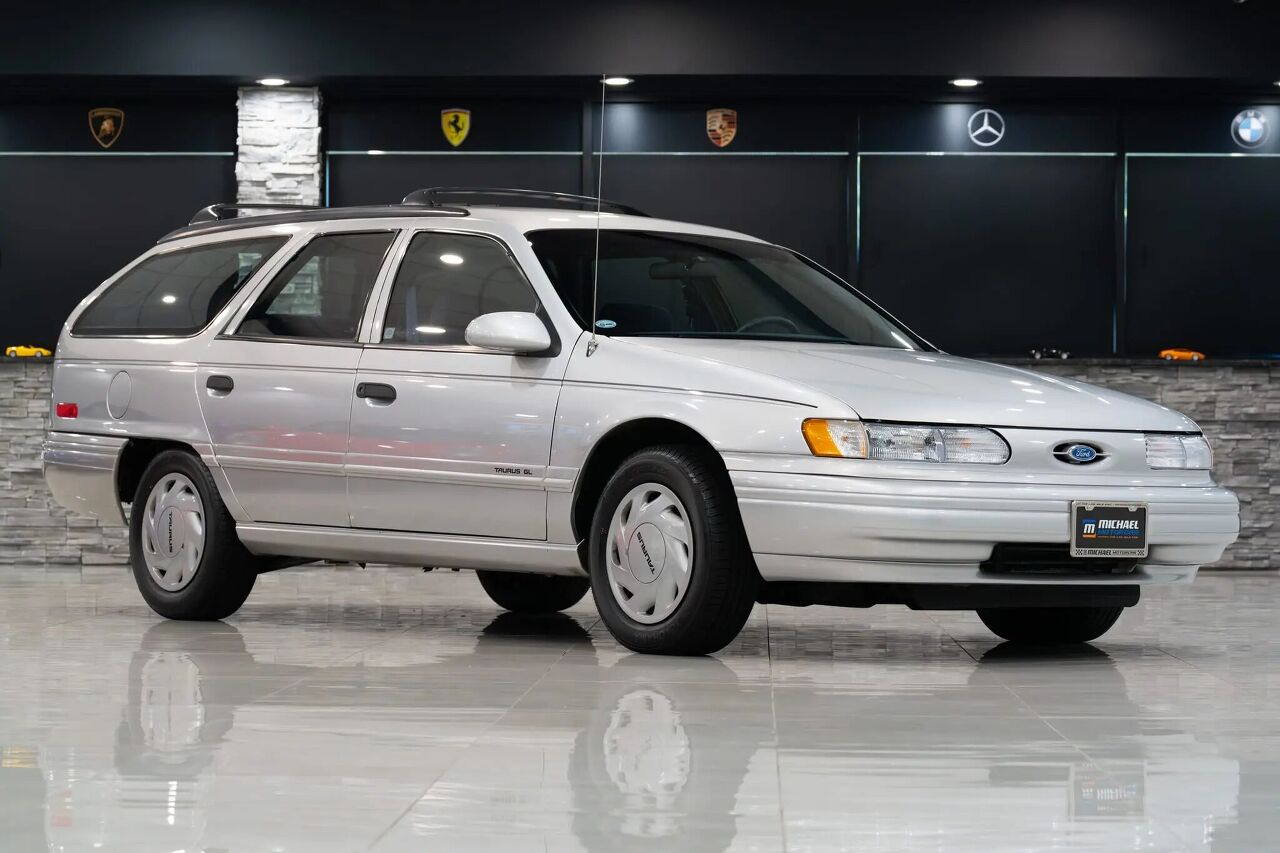
Last time we took a look at the exterior styling of the second generation Ford Taurus and Mercury Sable that arrived in 1992. Though their looks were gently evolutionary on the outside, their interiors reflected greater revisions as the models moved with the times. Both the Taurus and Sable interiors were a bit less radical, a bit more mainstream, and shared more parts both with each other and the Ford bin.
(Note: The Taurus wagon is a 1993 GL (middle trim) that sold on BaT in 2026 with just 12,000 miles. The Sable is an LS (upper) trim from 1992.)
One of the most notable interior changes to Ford’s new midsize models was the elimination of hard angles in the front of the cabin. In a trend that would sweep car design for the next decade, shapes became softer and more organic. The dash of the Taurus still used a two-section approach for the driver and passenger, but the controls were spread out more horizontally.
There was less vertical surface area to the dash, as it sloped away from the driver at both its upper and lower extremities. Facing the driver were simple gauges with clear readouts. While there were still optional digital gauges, they were less commonly selected than in the '80s. The only indicators with needles were the speedometer, fuel, and temperature gauges. Other warnings were handled with rectangular lights at either side of the speedo.
HVAC controls were moved lower in the dash than the first generation, and the digital clock took their place up high (which made more sense). The same stereo and cupholder stack reappeared for duty in the second-gen cars. Past the driver’s binnacle was a new sweeping curve that featured a stylized panel insert (smooth, or in three sections) determined by the selection of a passenger side SRS airbag. Dual airbags were not yet standard, as we’ll see below.
The dash featured a new wrap-around design that integrated into the door panels, another feature that would take hold in the '90s as car interiors looked less like someone designed the dashboard in a separate meeting than the one about the doors. Turning to Sable, we’ll see some things went missing from the prior generation.
Notably, the unique steering wheel. The Sable’s first-gen wheel was different to the Taurus, and was a bit more formal looking. That made it suitable for use in the new Continental, though supplemented there with wood trim. In 1992, both cars shared the same corporate four-spoke wheel. It was the one used in F-150, Econoline, Aerostar, Aston Martin Vantage, etc. Only the horn pad indicated which brand used the wheel.
Also absent was a different dash design for the Sable. Underneath both cars used the same dash as a basis. The only difference for Sable was the removal of the binnacle section to the right of the steering wheel. As a result the Sable technically had a bit more room in the front of the cabin than Taurus.
The sweeping dash shape was intended to look more upscale than the Taurus, with the climate controls moved down to the level of the vents. The clock of the Sable was farther away from the driver, as it resided in the trim panel that swept across the passenger side. Said panel was smooth on the Sable if ordered sans passenger airbag, and fitted with a wood insert on GL models. Base models had a black trim bar in its place.
One of those lost to time details, Sables with airbags had a sectioned dash panel that could not wear wood given its airbag-covering design. The only examples with wood on the dash and a smooth integrated panel were those without a passenger airbag. Said airbag was optional only in 1992, and became standard in 1993.
Precious few unique touches remained to differentiate the Taurus and Sable from 1992 onward. One such feature was the passenger vanity mirror. On the Taurus it was the usual flip-up affair, but the Sable featured a thoughtfully designed slide style, with a button to release it and dual lighting.
As doors were carried over into a new generation, designers were limited with edits they could make to the door panels. Obvious was the move toward a wrap-around design, with a greater volume of door panel near the mirror. This pushed back the speaker location toward the passengers. The vertical grab handle was redesigned into a more expected horizontal one, and the door handle itself moved higher in the door.
Arm rests were extended as well with more surface area. Door lock latches were swapped from a Taurus-specific design to the pin-style latches used in all Ford vehicles. In what was surely a last-of moment, base model cars with manual windows required a separate door panel design with a shorter armrest and a relocated door pocket. It was difficult to find an image of a vehicle so equipped.
Doors of Sable models no longer featured different trim designs and shapes, as they adopted the design of the Taurus. Even in the most expensive LS wagon shown here, the Sable featured a black plastic interior door handle that was previously chromed. Notice the absence of the wooden door trim found in the first generation car.
Seat designs were a carryover from the first generation, with only minor changes to stitching patterns. Said patterns and materials were now shared between the Taurus and Sable. Here, both cars wear a tweedy fabric in blue (faded to gray-blue) and gray.
The rest of the interior (particularly on the wagons) was business as usual from the first generation. With the increased focus on parts sharing between the Taurus and Sable, there was a big shift in trims for 1992. Consolidation was key, along with the discontinuation of the à la carte options catalog. We’ll talk about trims in our next installment.
[Images: Ford, BaT, BaT]
Become a TTAC insider. Get the latest news, features, TTAC takes, and everything else that gets to the truth about cars first by subscribing to our newsletter.