
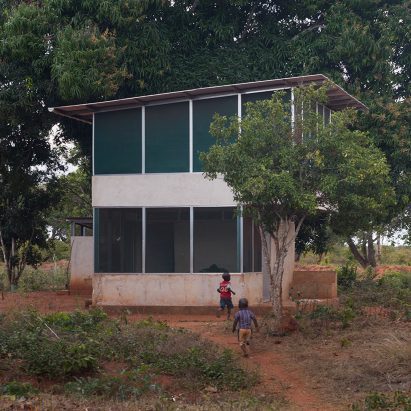
A study has found that children living in Star Homes, a housing initiative in Tanzania, have lower rates of malaria, diarrhoea and respiratory infections compared to those living in mud-and-thatch houses.
The study, which was published in Nature Medicine, found that cases of malaria in children were 44 per cent lower for children residing in Star Home residences, diarrhoea was 30 per cent less and acute respiratory infections were reduced by 18 per cent.
The research also found that children living in Star Homes had greater height-for-age growth trajectories, indicating a reversal of stunting, which is a consequence of repeated childhood infection.
Star Homes is a housing initiative in Tanzania designed to combat diseasesStar Homes was designed by representatives of the Royal Danish Academy, which also co-authored the study, in collaboration with Tanzanian and international researchers.
The study was carried out over three years by Tanzanian research group CSK Research Solutions, Tanzania's Ifakara Health Institute, the Mahidol-Oxford Tropical Medicine Research Unit at the University of Oxford, Durham University in the UK, Amsterdam University Medical Center, University of the Philippines Manila and East, Central and Southern Africa Health Community.
Taking place between January 2022 and December 2024, it looked at children under the age of 13 living across 70 villages in rural Mtwara, Tanzania.
Through a randomised public lottery of over 14,600 surveyed homes, a group of children living in 110 Star Homes was compared to children living in 513 traditional mud-and-thatch houses.
A research study looked at cases of diseases in children living in Mtwara, TanzaniaIn the study, researchers argued that the contraction of the three preventable yet deadly diseases – malaria, diarrhoea and respiratory infections – is closely linked to the home environment, where children spend a large portion of their days.
It highlighted poor ventilation, overcrowding, poor sanitation and insufficient access to clean water as contributing to the spread of pathogens and airborne infections in the home.
Designed by the Royal Danish Academy in collaboration with Tanzanian and international researchers, Star Homes houses have a two-storey prefabricated structure that uses passive engineering strategies to help with disease prevention.
Children living in Star Homes were found to have lower rates of malaria than those in mud-and-thatch housesBedrooms are positioned on the upper floor to avoid mosquitoes, which are more commonly found at ground level.
Net walls let air in and help with cross-ventilation, keeping sleeping areas cool while keeping mosquitoes out, and screened windows and self-closing doors further prevent insects from entering.
The houses have solar-powered lighting and are built atop an elevated, easy-to-clean concrete floor. Rainwater harvesting provides safe drinking water, a cooking stove vents smoke to the outdoors, and the toilet is a fly-proof, ventilated latrine.
Read: Architectural Pioneering Consultants and Wolfgang Rossbauer use local materials for a school in Tanzania"What is groundbreaking about the project is that architecture is incorporated as an active component of a randomised clinical trial and measured with the same level of rigour as medical research," said Star Homes architect and Royal Danish Academy dean Jakob Brandtberg Knudsen.
"What is crucial to our research is not architecture alone, but the interdisciplinary collaboration between architects, social scientists, physicians, biologists, and statisticians," he continued.
"Architecture can function as a health intervention on a par with medicine when it is developed and documented using scientific methods, while at the same time saving resources and reducing carbon emissions."
Star Homes houses have a two-storey prefabricated structureAccording to the study, the material cost of a Star Homes house is 24 per cent less than a typical single-storey cement-block house, and it generates 57 per cent less embodied carbon.
The study's authors described it as "the first-ever randomised controlled trial using a house as an intervention", and hope it encourages the building of disease-preventative, low-carbon homes across Africa.
Net walls help to cross-ventilate the interior while keeping insects out"Our ground-breaking study shows that building better can turn a dangerous home into a safe one by protecting children in sub-Saharan Africa against three major killer diseases," said study author Steve Lindsay, professor of biosciences at Durham University.
"Based on decades of research, this was the first clinical trial of a purpose-built healthy house, and the findings are very exciting," he continued.
"We now hope that the building industry will adopt some of the important features of our healthy house design that are protective, cheaper and use less carbon than conventional concrete African houses."
Other projects in Tanzania that have featured on Dezeen include a school made from local materials, which won architecture project of the year in Dezeen Awards 2023, and a school arranged around a tree-filled courtyard.
The photography is by Julien Lanoo and the video is by Sava Films.
The post Research finds Star Homes housing reduces malaria in children by 44 per cent appeared first on Dezeen.