
Italy will always be special because it combines a rich history, famous food, and stunning sights. It holds the most UNESCO World Heritage sites on earth and offers a relaxed, joyful way of life known as the dolce vita. For car guys, Italy has a rich motoring history defined by iconic design, racing dominance, and high-performance supercars with famous brands like Ferrari, Lamborghini, Lancia, and Alfa Romeo.
Alfa Romeo was founded in Milan in 1910. It began as a small-scale manufacturer of hand-built luxury and came to establish a legendary racing reputation. It is worth noting that Enzo Ferrari began his career at Alfa Romeo and his own Scuderia Ferrari was the marque’s racing arm for a period.
After World War II, Alfa Romeo shifted its strategy toward mass-produced midrange automobiles. This era was defined by the debut of the Twin Cam engine (affectionately nicknamed the ‘bialbero’) in the 1954 Giulietta. Designed by Giuseppe Busso, this all-alloy engine had hemispherical combustion chambers and double overhead camshafts—technologies that were decades ahead of their time for production cars.
PHOTO BY Adrian Spencer Yu
In 1962, Alfa Romeo introduced the 105/115 series—a family of cars characterized by advanced engineering, featuring the famous twin-cam engines, four-wheel disc brakes, and five-speed transmissions. This series shared a common mechanical pedigree, but came in different body styles: sedan (Belina), coupe (GT or GT Veloce), the Montreal, and of course, the unforgettable Spyder or ‘Duetto’ that Dustin Hoffman used to snag Katharine Ross in the 1967 film The Graduate.
OTHER STORIES YOU MIGHT HAVE MISSED:
This ultra-rare Ferrari 400i makes more sense than the first-ever Luce sold at auction
The Brabus Bodo Cabriolet is as villainous-looking as ever
The foundation of the 105 range was the Giulia Berlina. It was introduced with the Twin Cam engine available in 1,300cc and 1,600cc versions, with output ranging from 78hp to 110hp. In 1968, the 1750 Berlina was introduced and sold alongside the Giulia Berlina as the top-range model of the Alfa Romeo lineup. Engine size was increased to 1,779cc, and with two Weber sidedraft carburetors, it produced 116hp. The wheelbase was also increased by 60mm, necessitating a change to most of the body panels; most of the internals, however, were carried over from the Giulia Berlina.
A 1971 facelift saw a host of small exterior trim changes, and the Twin Cam engine was enlarged to its absolute maximum displacement of 1,962cc, still equipped with twin sidedraft Weber carburetors and now producing 130hp. The model was then called the 2000 Berlina, which we have here.
PHOTO BY Adrian Spencer Yu
The Alfa Romeo 105 series pioneered the formula of putting a powerful engine in a relatively lightweight four-door car for mass production, creating what we know today as the executive sports sedan (think Audi A4, BMW 3-Series, and Mercedes-Benz C-Class). Both the Giulia Berlina and the larger 1750/2000 Berlinas were known for their lively handling, no doubt due to the coil-sprung suspension comprising an independent front double-wishbone setup and a live axle at the rear, with anti-roll bars on both axles. Equally impressive were the brakes, which featured discs on all four corners. Steering was a non-assisted recirculating-ball system.
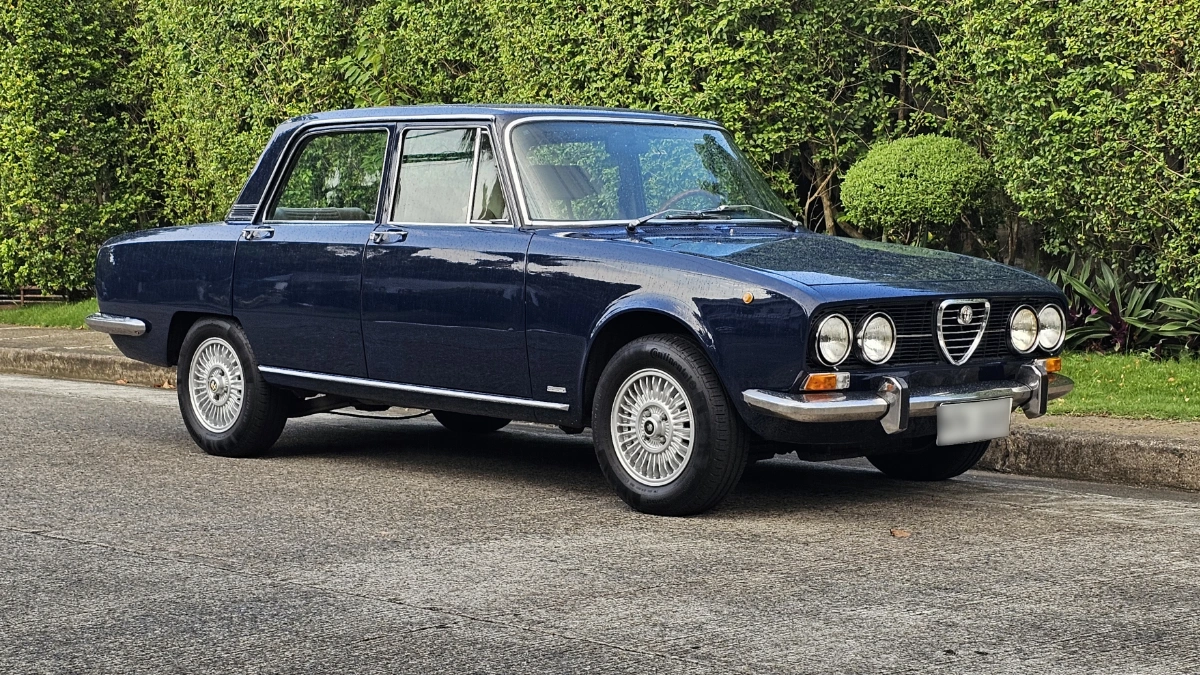
All Berlinas from the 105 series were designed by the famous Italian styling house Bertone. This 2000 Berlina has a classic three-box design, featuring a ‘top-hat’ greenhouse with very thin pillars that offer excellent visibility. The front fascia wears the classic Alfa Romeo grille flanked by four 5¾-inch headlights, while at the rear are taillight clusters shared with supercars of the era—the De Tomaso Pantera, the Maserati Bora and the Lamborghini Espada.
The rest of the exterior is discreetly elegant, boasting smooth surfaces for a more modern look. Some critics have even said the styling is deliberately low-key, understated, and meant to hide the vehicle’s true performance, making the 2000 Berlina what we call today a sleeper.
PHOTO BY Adrian Spencer Yu
PHOTO BY Adrian Spencer Yu
Inside is a hefty dose of Italian elegance and comfort, featuring premium finishes like chrome and veneer befitting a top-of-the-range product. The 2000 Berlina follows the dual-pod padded dash theme found throughout the Alfa 105 series, with a complete set Veglia Borletti instruments providing the necessary information. An integrated center console sits between the driver and the passenger, and houses the HVAC system, the radio, and the switches for wipers and lights—a truly Italian touch.
Our retro unit here is a 1972 model. It was purchased from a dealer in the Netherlands in late 2024, and was imported into the country under the Vintage Vehicle Regulation Act (Republic Act No. 11698). This Alfa Romeo 2000 Berlina is finished in dark blue with a cinghiale/brown interior, and comes with the optional 14-inch ‘turbina’ wheels and factory air-conditioning. It is a preserved, unrestored example, and although the odometer currently shows 28,000km, a service record from October 2009 shows an oil service done at 88,000km. So, it is safe to assume the odometer has already gone around, making the actual mileage 128,000km—still very low for a 50-year-old car.
PHOTO BY Adrian Spencer Yu
PHOTO BY Adrian Spencer Yu
Stepping into the 2000 Berlina brings a familiar feeling when driving cars of this era. There’s excellent outward visibility, and the seats are comfortable, but they lack the support offered by modern cars. The top-hat greenhouse affords ample space, especially for taller drivers. Sitting on the pleated vinyl bucket seat is a very Italian affair, with the pedals at a very strange angle that raises your knees above hip-level when driving. At the rear, there’s enough room for two backseat passengers. A third passenger is possible, but only for short trips. The view up front is very clear, and the beautiful gauges are well laid out and easy to read.
Turn the key and the 2.0-liter Twin Cam fires up without hesitation, then settles into a smooth idle. It revs freely and is eager to show what it is made of! The clutch is relatively light, and the car easily shifts into first gear with solid but long throws; shifting from second to third can be a bit tricky as the spacing between third and fifth is quite close. Once you get moving, you immediately notice the weight of the non-servo-assisted steering. It eventually lightens up at speed, but maneuvering at parking speeds can be a challenge. It was the start of the habagat when we tested this car, but thankfully, the air-conditioning worked very well, keeping us dry and comfortable during the test drive.
PHOTO BY Adrian Spencer Yu
At close to 1,200kg, the 2000 Berlina is quite a heavy car for the era, but the 130hp engine makes it feel very lively and light on its feet. Acceleration is decent, and stopping the car feels very confident and at par with today’s standards. Noticeably missing is the classic snort of the sidedraft Webers at full wail, but peeking under the hood reveals the factory airbox that keeps them quiet. Ride quality is excellent for a sports sedan: It is firm and lively, but most important, sharp bumps on the road are not felt. Within the city, the car behaves well in traffic—easy to drive and showing no signs of Italian temperament.
Over 600,000 units of the Alfa Romeo 105 Berlina were built during its 16-year production run, of which about 90,000 units were the top-of-the-line 2000 Berlina. While it has always been in the shadow of the more famous GTV coupes, collectors, enthusiasts, and the ‘Alfisti’ have begun to appreciate its sleeper image with the Twin Cam engine and five-speed gearbox, so values have started to appreciate in recent years. The Alfa Romeo 2000 Berlina may be the ultimate sleeper of the ’70s—a vehicle for the driver who valued engineering over styling. While its plain-looking three-box design might have seemed understated to some, those who have actually driven the car know exactly why it was able to successfully battle rivals from Mercedes-Benz, BMW, and Jaguar. Molto bene!
SPECS: 1972 Alfa Romeo 2000 BerlinaPHOTO BY Adrian Spencer Yu
Engine: 1,962cc DOHC eight-valve I4 with two Weber 40DCOE carburetors
Transmission: 5-speed manual
Power: 130hp @ 5,500rpm
Torque: 182Nm @ 3,500rpm
Drivetrain: front-engine, rear-wheel drive
Front suspension: independent with dual-wishbones, coil springs, tube shocks, and anti-roll bar
Rear suspension: live-axle with radius arms, coil springs, tube shocks, and anti-roll bar
Seating: 5
PHOTO BY Adrian Spencer Yu
PHOTO BY Adrian Spencer Yu
PHOTO BY Adrian Spencer Yu
PHOTO BY Adrian Spencer Yu
PHOTO BY Adrian Spencer Yu
PHOTO BY Adrian Spencer Yu
PHOTO BY Adrian Spencer Yu
PHOTO BY Adrian Spencer Yu
PHOTO BY Adrian Spencer Yu
PHOTO BY Adrian Spencer Yu
PHOTO BY Adrian Spencer Yu
PHOTO BY Adrian Spencer Yu
PHOTO BY Adrian Spencer Yu
PHOTO BY Adrian Spencer Yu
PHOTO BY Adrian Spencer Yu
PHOTO BY Adrian Spencer Yu