
By the time you read this, you may have watched our five-way hybrid crossover comparison. Or maybe not. If you don’t feel like reading the next thousand and a half words, I suggest you watch that instead, as it pits the Toyota RAV4 HEV against hybrids from other mainstream brands.
If you don’t feel like watching, let me let you in on a secret: The RAV4 won.
It wasn’t the fastest. Or the biggest. But it was the one that won the most categories, and came in second in every category it didn’t win. A performance more dominant than Christopher Nolan at the Oscars.
Let’s take a look at how that happened.
StylingPHOTO BY Niky Tamayo
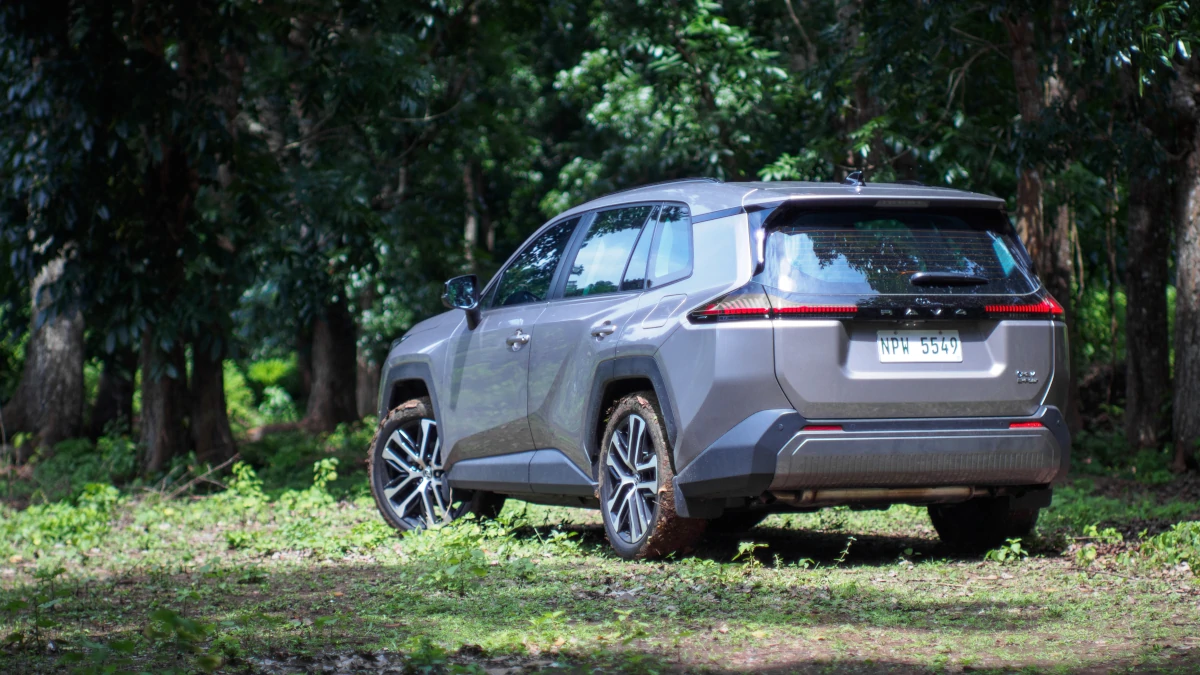
Based on a substantial refresh of the previous-generation model, the RAV4’s styling is both evolutionary and revolutionary. There’s a lot of familiar shapes, with the same chunky futuristic feel, but with Toyota’s new design DNA giving it a much sharper edge.
OTHER CAR REVIEWS:
2027 Honda Prelude review: Hybrid sporty coupe tested
Review: 2027 Nissan X-Trail e-Power
There’s a more vertical front end, Toyota’s signature light bar straddling a honeycomb grille carved into the front panel rather than sitting as a separate plastic piece. There’s also a more vertical rear hatch, Toyota chasing cargo space over sex appeal, for 16 liters more junk inside that trunk. To balance out the boxier ends, asymmetric slashes and black cladding across the rear door create the illusion of a wasp-waisted profile—perhaps the most daring styling decision on the car.
PHOTO BY Niky Tamayo
PHOTO BY Niky Tamayo
Boxy fender flares sit over big 20-inch alloy wheels—what us titos used to call ‘dubs’—and square off the looks quite nicely. Our unit is finished in ‘Urban Rock’ gray, a color that complements the sci-fi aesthetic quite nicely.
InteriorPHOTO BY Niky Tamayo
The interior features a good bit of clever space utilization. The new dashboard features a large center touchscreen that incorporates physical HVAC and sound controls. It isn’t as large as the one on the bZ4X, allowing for higher-mounted center A/C vents. The console features more storage than either the previous RAV4 or the bZ4X, with stacked shelves under the A/C vents for four phones, two charging wirelessly, and two with their own 45W USB-C outlets. An extra shelf over the glovebox features an anti-slip surface, and is wide enough for two and a half more cellphones.
The center console features a stubby shifter beside cupholders sized for oversized drinking bottles. The deep center box is big enough for medium handbags and large cameras. The lid, as on the bZ4X, can open both to the left and the right, and can further be fully removed and installed upside down, giving you even more shelf space for phones, cameras, wallets, bags, or whatever you feel like charging via the 12V socket inside.
PHOTO BY Niky Tamayo
PHOTO BY Niky Tamayo
Ergonomics are quite well thought out. The doors feature big, chunky grab handles that can be worked with either arthritic hands or bomb-disposal gloves. The stubby shifter and drive controls are likewise sausage-finger-friendly—the shift interlock relying on a brake press rather than a fiddly switch.
All buttons are large and easy to see—the 360-degree camera button, for one, is right on the console, not hidden on a random unrelated stalk, as on the CR-V. Steering buttons are laid out like Windows Mobile panels—truly an interface ahead of its time—and the displays feature a modular, chunky look, with extra-large, easy-to-read text. Not as expensive-looking as the skinny artisanal typefaces on some competitors, but not having to wear reading glasses while driving? Priceless.
PHOTO BY Niky Tamayo
On the downside, the synthetic leather feels a bit plasticky, and there’s a lot of scratchy gray plastic. On the upside, the seats feel great, with supportive—but not confining—hip and thigh bolsters. The wide center console is carved around your knees, so it isn’t a big issue, but the transmission tunnel does eat into foot space, which can be an issue if you drive in big clunky boots.
Seating point and visibility are more SUV-like than in the CR-V, but not aggressively so. The head-up display sits high up on the windshield, and fades in and out of view as you move your head, thanks to limited viewing angles. Still, once you’ve set it up, it’s quite useful, as we will see later.
PHOTO BY Niky Tamayo
PHOTO BY Niky Tamayo
The rear bench features good space and a generous adjustable seat recline. Not as generous as the CR-V, but still very good. You get rear A/C, two 15W USB-C ports, and even an overhead light mounted behind the giant dual panoramic sunroof. The center cushion has a bit of a hump to it, but is liveable for short to medium drives.
The RAV4’s trunk is bigger than before, with a nice and wide opening underneath the automatic tailgate. There’s 749 liters in total, counting the greenhouse and underfloor areas, and closer to 520 liters under the tonneau cover. There’s a bit of a slope to the floor, thanks to the battery under the rear seat, which also limits how low the loading lip can be without turning that floor into an off-ramp. There’s a large utility space underneath, occupied by a big spare tire—a rarity among HEVs!—and the floor itself is high-density foam composite, much stronger than the lawanit or plastic in other cars, and fully capable of accepting an adult’s weight. Sitting, not jumping, mind you.
Powertrain performancePHOTO BY Niky Tamayo
What might get you jumping is the new hybrid synergy drive system. Still a 2.5-liter Atkinson-cycle gasoline engine mated to twin electric-assist motors, but with a healthy 19-pony boost to 236hp.
And you can feel that extra power everywhere. Nil to 100kph times are nearly a second quicker at 7.6sec in Sport Mode. Pedal response is very linear, and thanks to the planetary gear drive, there’s no shift shock when the gasoline engine engages—just smooth, continuous torque, provided the moment you ask for it and accompanied by a muted growl coming from somewhere under that long gray hood.
PHOTO BY Niky Tamayo
On the highway, we saw between 27-32km/L at 80kph, averaging around 16km/L in mixed driving, with some more aggressive driving than previously. It’s close enough to the previous car that any differences might come down to testing conditions and rounding errors. During our five-way test, it tied for first place in a drive cycle that included high speeds, mountain climbing, and the occasional burst of acceleration to overtake. Hell, maybe if we’d tested the Adventure variant with the smaller wheels, it would have won by an even bigger margin.
Ride and handlingPHOTO BY Niky Tamayo
With revised suspension subframes and grippy 235/50 R20 Toyo Proxes Sport tires, the LTD variant puts more ‘sport’ in ‘sport utility’ than its predecessor did. Granted, the steering lacks feel, and there is still quite a bit of suspension movement in the curves, but handling is confident and secure, with roadholding perfectly matched to the peppy powertrain. The RAV4 flows better than some stiffer competitors and eschews the sloppiness of softer ones. The Goldilocks zone, yes, but with Goldilocks playing football rather than trying out beds.
The price you pay for that agility is a more nuggety ride than the ADV variant we tested recently. Sound insulation and bump isolation are both very good, but there’s no getting around the fact that you are riding around on 50-series tires wrapped around 20-inch wheels. It never reaches Fortuner levels of stiffness, and you can still fall asleep in the back seat. But it is there.
PHOTO BY Niky Tamayo
Around town, the RAV4 is relatively easy to handle. The taller nose does have you reaching for the camera button when parking more often than before, and there’s less of a view out back thanks to the high beltline and the big rear headrests, but it’s not really any more difficult than any other modern crossover to drive. And automatic emergency braking does help prevent possible accidents when you’re backing out into traffic or when motorcycles swerve in front of you. There’s also automatic parking if you’re too timid to do it yourself, though as with most systems, it can be picky about which spots it’s willing to back into.
Extra featuresPHOTO BY Niky Tamayo
Aside from the 360-degree cameras, AEB, and automatic parking, you also get cross-traffic and blind-spot monitoring as well as the full Toyota Safety Sense driving aids. This is one of the better systems out there, with intuitive lane-following functions and adaptive cruise that works down to 0kph. There’s also forward collision warning that flashes a bright light in the HUD if traffic in front of you slows down unexpectedly. That HUD also displays adaptive cruise and drive mode info, meaning you hardly ever need to look down from it while on the move. There’s automatic wipers and automatic lights, including adaptive headlights similar to the ones on the bZ4X, which can dip down in order not to blind incoming traffic, while still lighting up the sides of the road, allowing you to watch for crossing pedestrians or animals in the dark.
The infotainment system features a 12.9-inch display, Android Auto, Apple CarPlay, and Bluetooth audio, all running through a kick-arse nine-speaker JBL sound system that gives nearly nothing away to the 12-speaker Bose on the CR-V RS. It’s relatively crisp and clear, with a healthy amount of bass. Maybe the Honda has more potential at ear-bleed sound levels, but most people won’t drive that loud, will they?
PHOTO BY Niky Tamayo
Other creature comforts include ventilated seats front and rear, though only the front ones get cooling, remote locking and start, push-button start, and an automatic tailgate. All very standard stuff, though we do wish Toyota would pack those remote features into a smaller remote. The key fob of the RAV4 isn’t bZ4X large, but it’s getting there!
VerdictPHOTO BY Niky Tamayo
The RAV4 is a fantastic car. Not without its flaws, but honestly, they’re things that are easy to overlook, given how solid the total package is. The crossover’s win in our five-way mega-battle was one of the least controversial Big Test results among the assembled reviewers, and well-deserved.
In the bigger picture, however, the RAV4 is up against cheaper plug-in hybrids from China with similar space and performance. The hot-selling BYD Sealion 6 and the MG HS PHEV undercut it by a huge margin. Both strong packages, and priced competitively. And then there are the EVs, available for not much more. But the RAV4’s refinement and unplugged economy do make it an attractive package for those who can’t or won’t plug in. It still offers vast fuel savings over any comparable non-hybrid, and decent savings over most other hybrids in this class, while not forcing you to change your lifestyle greatly.
And, as far as hybrids go, the RAV4 has always been one of the most reliable ones, easily capable of delivering half a million kilometers of worry-free electrified driving in some cases. And that peace of mind, for some buyers, will be worth the price premium for a lot of buyers.
SPECS: 2027 Toyota RAV4 2.5 Limited HEVPHOTO BY Niky Tamayo
Price: P2,564,000
Powertrain: 2.5-liter gasoline I4 + dual electric motors
Power: 236hp (total system output)
Torque: 221Nm @ 3,600-5,200rpm (engine only)
Transmission: e-CVT
Layout: all-wheel drive
Seating: 5
Score: 9/10
PHOTO BY Niky Tamayo
PHOTO BY Niky Tamayo
PHOTO BY Niky Tamayo
PHOTO BY Niky Tamayo
PHOTO BY Niky Tamayo
PHOTO BY Niky Tamayo
PHOTO BY Niky Tamayo
PHOTO BY Niky Tamayo
PHOTO BY Niky Tamayo
PHOTO BY Niky Tamayo
PHOTO BY Niky Tamayo
PHOTO BY Niky Tamayo
PHOTO BY Niky Tamayo