
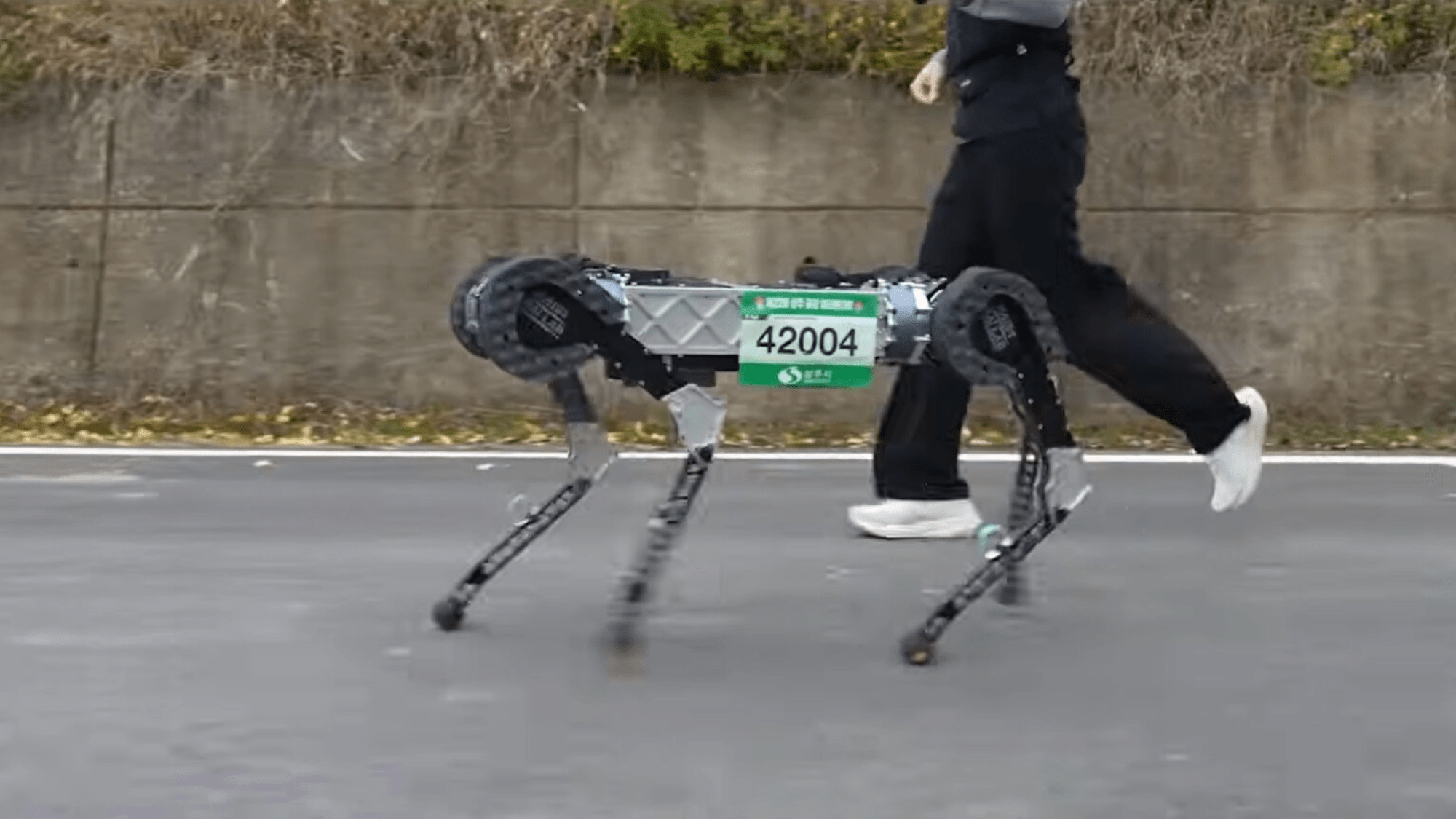
Engineers in South Korea created a first-of-its-kind robot dog capable of completing a marathon faster than many humans, and it did it all on a single charge. The quadruped, called RAIBO2, ran the 26.2-mile course in the Sangju Dried Persimmon Marathon in Korea in 2024, but details about the event and the robot were recently published in the journal Nature. Custom-built with energy efficiency in mind, RAIBO2 finished the course (with the help of some remote human controllers) in 4 hours, 19 minutes, and 52 seconds.
To put that speed in perspective, the global average time for humans to complete a marathon is around 4 hours and 32 minutes, though elite athletes finish much faster. The current world record held by Kenya’s Sabastian Sawe is 1 hour and 59 minutes. But that’s for humans.
A real dog would overheat long before reaching the finish line. What’s maybe most remarkable, though, is that RAIBO2 finished the race with more than a third of its battery still in the tank. And it did it all while averaging 5.9 miles per hour, roughly the pace of a brisk jog for most casual runners.
Teaching RAIBO2 to run, one gentle step at a timeDriverless cars and other wheeled robots can complete a marathon relatively easily. That gets much tougher, when the wheels are swapped for legs. Legged robots don’t just expend energy moving forward; they also have to constantly support their own body weight and make up for energy lost with every step. According to the team that built RAIBO2, previous existing quadrupeds had a maximum range of around 12 miles. That’s a problem for robot dogs meant for search-and-rescue missions or other jobs that may require traveling long distances, such as resupplying soldiers on a battlefield.
To solve that problem, the team stepped back and designed a robot with energy efficiency as its guiding principle. They started by making its limbs much lighter. Next, they custom-designed a more efficient, lower-resistance motor board. Besides improving efficiency, the new board also freed up space for a bigger, longer-lasting battery with 2,016 watt-hours of capacity.
The team also changed how RAIBO2 moves. Much like coaching a real dog, they used reinforcement learning in a computer simulation, rewarding the robot every time it set its feet down softly without slipping or overheating. The result is a consistent, steady gait that’s also relatively gentle.
RAIBO2 could have simply proven itself in a lab. However, its creators decided to take things a step further and test it out in the real world, alongside human runners on a challenging course. The winding route features 938 feet of total elevation change and can get slippery in certain places. Even with those hurdles, RAIBO2 finished without crashing or bursting into flames, something other running robots have struggled with in recent years.
RAIBO2 completed the marathon with a cost of transport of .25. This metric, commonly used in robotics, measures how much energy it takes to move a given weight over a given distance. The lower the number, the greater the robot’s energy efficiency. RAIBO2’s .25 figure is significant because it is lower than the cost of transport for an average human runner, which the researchers put at .37. They also say RAIBO2 is the first robot to outperform humans on that measurement.
The quadruped notably couldn’t do all that efficient marathon running on its own. A camera mounted on its head beamed the route ahead to a human operator, who steered RAIBO2 to make sure it didn’t veer off course. Building a robot that can complete the race fully autonomously would require much more computing power, which would in turn drain the battery and cut into its overall range.
Caveats aside, the robot still marks a technical advance and may push engineers to rethink what’s possible for robot range. For that, it deserves some sort of treat, or at least a pat on its metal back.
The post Robot dog runs a marathon faster than the average human, all on a single charge appeared first on Popular Science.