
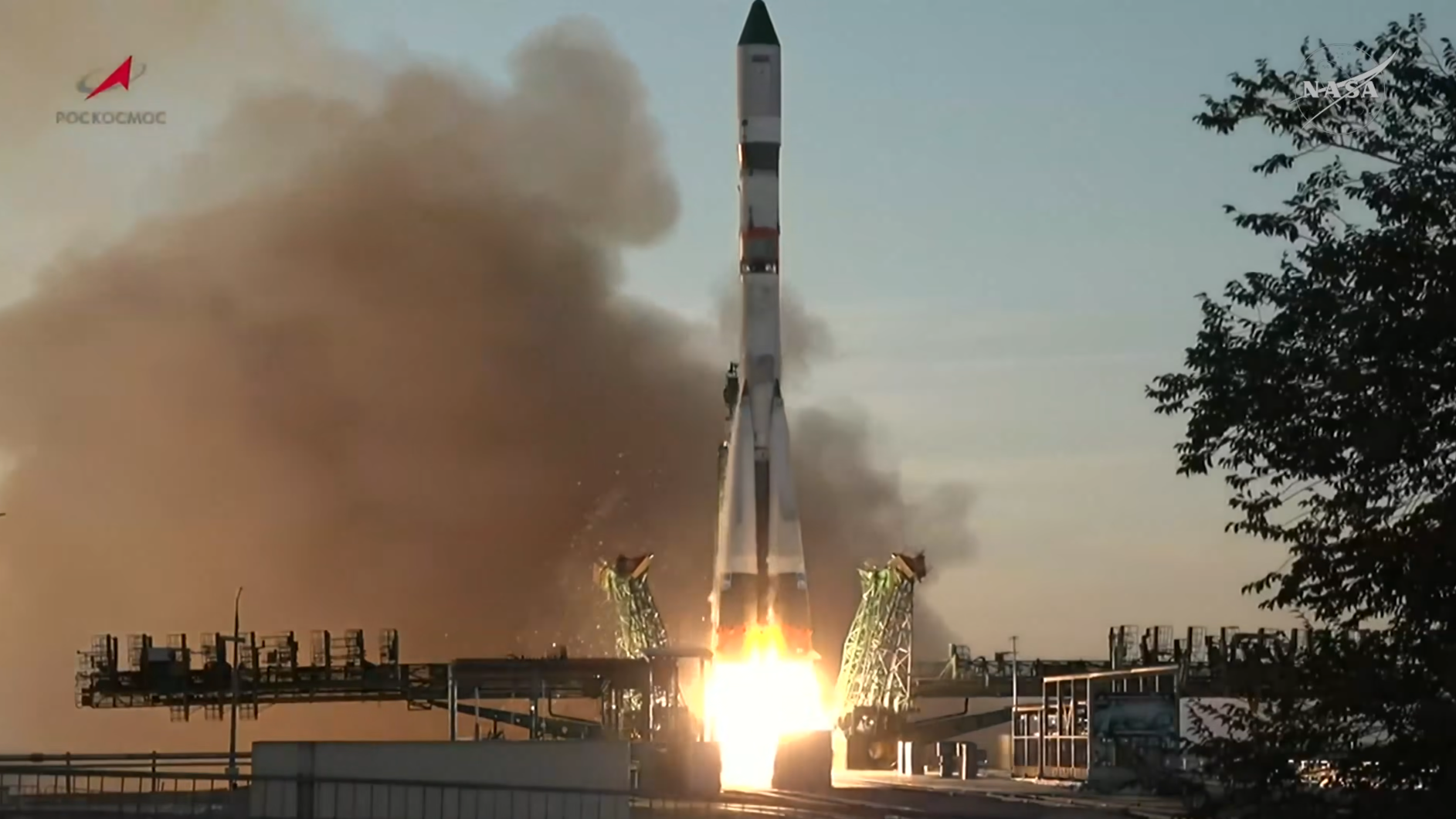
Russia's latest freighter is on its way to the International Space Station.
The robotic Progress 97 cargo craft launched atop a Soyuz rocket from the Russia-run Baikonur Cosmodrome in Kazakhstan today (Nov. 24) at 5:17 a.m. EST (1013 GMT; 3:17 p.m. Baikonur time), carrying several tons of supplies for the astronauts aboard the orbiting lab.
If all goes to plan, Progress 97 will arrive at the International Space Station (ISS) on Thursday (Nov. 26), docking with its Poisk module. But the freighter won't stay at that particular locale for long.
The cosmonauts currently living on the ISS — Pyotr Dubrov, Anna Kikina and Sergey Teteryatnikov — will unload Progress 97 through Poisk. But the freighter will then hop over to a different port, according to journalist and space historian Anatoly Zak: the aft one of the PrK transfer tunnel, which leads to Russia's Zvezda service module.
The PrK port is the best site for engine burns that boost the orbit of the ISS, a service that Progress freighters regularly provide. But Progress 97 cannot unload its cargo through that port because the PrK transfer tunnel has been sealed off, due to an ongoing air leak that was first documented in 2019.
Progress-97 is therefore "the first cargo mission scheduled to unload its cargo and perform orbit corrections of the ISS at different docking ports," Zak wrote on the site he runs, RussianSpaceWeb.com.
Progress 96 cargo spacecraft packed with science and supplies approaches the International Space Station for a docking on Sept. 19, 2026. (Image credit: NASA)The Progress 97 mission, which Russia calls Progress MS-36, was originally expected to launch this past August, according to Zak. But the liftoff was pushed back several times, most significantly by the collapse of the service platform at Baikonur's Site 31 in November 2025. It took Russia about three months to repair the platform, leading to a series of delays.
Progress 97 will likely stay docked to the ISS for about six months, after which it will be loaded up with trash and sent home to burn up in Earth's atmosphere.
Japan's HTV-X vehicle and Northrop Grumman's Cygnus spacecraft are similarly expendable. The only currently operational ISS cargo craft that's reusable is SpaceX's Dragon capsule, which makes parachute-aided ocean splashdowns at the end of its missions.