
This December will mark for the people of Russia one of the most defining moments in their history; the 35th anniversary of the dissolution of the Soviet Union. A major world power that had existed for nearly 70 years, its collapse reflected other significant developments in Eastern Europe at that time, where long-established communist regimes fell one by one and national boundaries changed dramatically, with Yugoslavia similarly dissolving, Czechoslovakia splitting into the two separate nations of Slovakia and the Czech Republic, and East Germany and West Germany becoming a united country once again. The latter geopolitical development stands in direct contrast to the ongoing situation in Korea and Cyprus, with both lands split for decades into two independent states; one of which, the Turkish Republic of Northern Cyprus, is recognised only by Turkey (a similar situation to the breakaway state of Somaliland, with Israel the only country to recognise it as an independent nation).
Vittorio Trevitt explains.
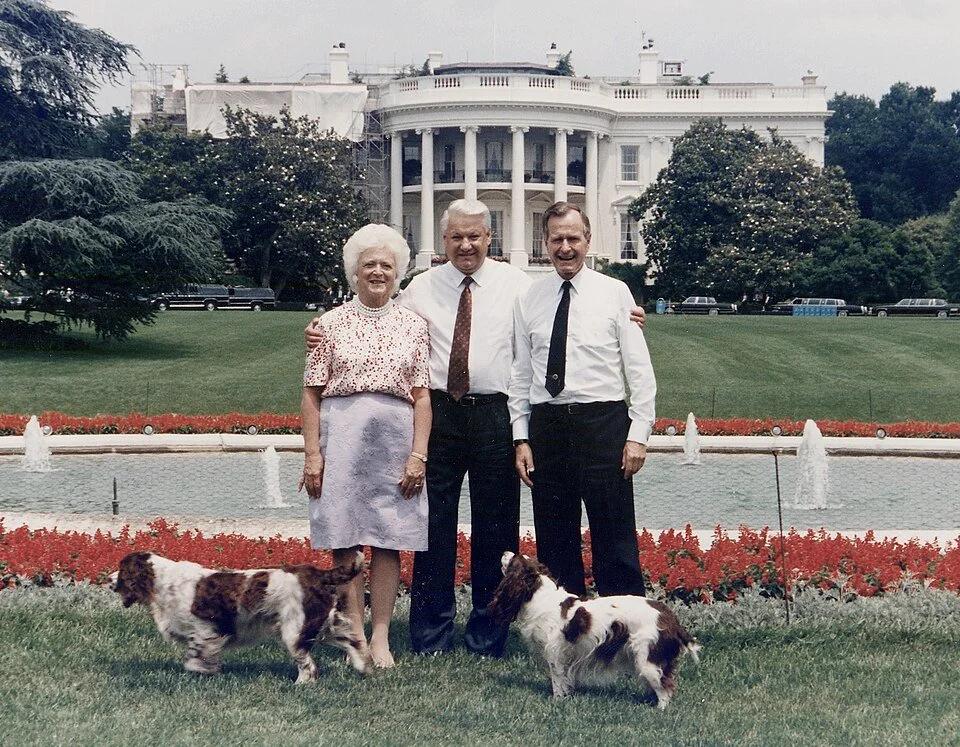
Boris Yeltsin (center), with US President George H.W. Bush and Barbara Bush in 1992. Source: Public domain, National Archives and Records Administration, available here.
The Soviet Union’s demise has to this day elicited mixed reactions from Russians, but at the time it heralded the chance for the Russian people to put their autocratic past behind them and build a prosperous, democratic society. It is worth assessing, since that time, how much things have changed in Russia and the impact that the decisions of Russia’s post-Soviet leaders have had both within and beyond the nation’s borders.
Boris Yeltsin, the first president of the newly formed Russian Federation, was a political veteran who had previously held a series of posts (including that of the head of Moscow) and received admiration for his stance against a coup attempt by hardliners seeking to turn back the tide of reform opened up by Yeltsin’s predecessor Mikhael Gorbachev; dramatically symbolised by Yeltsin standing on top of a tank and then speaking out against the plot, which ultimately failed. Yeltsin’s presidency, however, would be a far from memorable one. Although prior to its collapse Gorbachev had envisaged a democratic socialist path for the Soviet Union, the course taken by the Yeltsin administration for the new Russian state was diametrically opposed to Gorbachev’s vision. Believing that the quick adoption of a free-market system was the way forward, Yeltsin presided over the rollout of a major economic reform programme which throughout the course of the Nineties resulted in mass joblessness, rapidly rising inflation, and delays in wage receipts and pension payouts.
Two years into his presidency, there was much opposition to the administration’s financial policies both amongst the general public and within the legislature, the latter of which Yeltsin would directly confront in late 1993. Yeltsin proposed changes to the constitution that partly involved giving stronger powers to the presidency; something that encountered strong parliamentary opposition due to concerns that this would emasculate the country’s fledgling democratic system. A standoff between the president and the legislature (with the vice president himself joining the opposition camp) led to tanks being sent against the latter, the arrest of several political figures, and the subsequent adoption of a new constitution; albeit following a public vote. This did not, however, give Yeltsin a consistent pro-government majority in parliament. In elections held in December that year, parties that supported the administration’s economic strategy only won a minority of seats, with the party winning the most seats being an ultranationalist outfit; the inappropriately named Liberal Democratic Party (LDPR). During the election campaign, its leader Vladimir Zhirinovsky, a racist demagogue who expressed admiration for the idea of Nazism, made bombastic statements directed against all kinds of groups such as the Baltic states (contributing to the case put forward by the latter to join NATO) and the Caucasus; calling for Russia’s borders to be closed off to the “criminal element” of that region. Zhirinovsky also advocated an expansion of Russian territory to where it stood eighty years earlier together with mass arrests and executions to combat crime.
It is worrying that a party led by such a figure could have done as well as it did. Nevertheless, despite its breakthrough, most parties in the Duma did not share the LDPR’s ideology, and further elections in 1995 witnessed the Communist Party of the Russian Federation (KPRF), a descendant of the ruling party of the Soviet Union, obtain the largest parliamentary representation. Along with other left-wing groups, the KPRF now formed part of a reformist legislative majority. Their triumph demonstrated the extent to which ordinary people yearned for a more progressive course on social and economic policy after years of hardship. Indeed, the KPRF made the ambitious promise of restoring the various social guarantees that existed during the Soviet era. Although they were unable to deliver on this, the communists were nevertheless able to successfully make use of their newfound influence to effect improvements in welfare allowances and the minimum wage.
In presidential elections the following year, Yeltsin’s main rival was KPRF leader Gennady Zyuganov, who forced Yeltsin into a runoff after coming just a few percentage points behind the incumbent. Zyuganov’s platform was appealing to an austerity-weary public, which included promises like improvements in retirement benefits and earnings, controls on prices, and assured employment. In the end, Yeltsin plucked victory from the possible jaws of defeat; winning over 50%of the popular vote. The fear factor played a major part in Yeltsin’s triumph, with television channels broadcasting negative depictions of Zyuganov together with anti-communist propaganda which implied that a Zyuganov presidency would mark a return to the horrors of Stalinist rule. Yeltsin also helped his cause by making similar pledges to Zyuganov in regards to pay and allowances, while delivering splurges in public spending in the run-up to the elections. Although the KPRF would remain the largest party in the 1999 legislative elections (the last that Yeltsin would preside over as president), it lost much of its representation, and failed to establish itself as a possible alternative party of government.
During his first term, Yeltsin presided over a separatist movement in Chechnya which, as has often been the case throughout history with examples such as Kosovo, Transnistria, South Ossetia, Abkhazia and Western Sahara, culminated in armed conflict. After the sending of Russian forces into Chechnya in the latter part of 1994, a war was waged that led to widespread death and destruction. Shortly before the 1996 presidential elections, Yeltsin signed a decree at a military base in Chechnya bringing an end to conscription while describing Russian soldiers as heroes; moves that probably helped save his presidency. Yeltsin’s honeymoon period proved, however, to be short-lived. Two years into his second term (which went off to a good start with the signing of peace accords in Chechnya) Russia’s economy went into turmoil as a result of misfortunes such as the fallout from the 1998 Asian financial crisis and a mounting deficit; with a currency devaluation, a default on short-term debt, and a subsequent fall in living standards the consequence of these.
At the dawn of the new millennium, Yeltsin stood down from the presidency; leaving behind an economically scarred and socially fractured nation. The appointment of then prime minister Vladimir Putin as the one to succeed Yeltsin would prove to be a major turning point. A strong figure, Putin has remained the president of Russia ever since; barring a period from 2008 to 2012 when the post was held by a close associate, Dimitry Medvedev. Under Putin’s leadership, Russia has little independent media and there is the imprisonment and death of journalists and opposition politicians. Although the holding of elections provides the image of democratic choice, in practice Russia is an authoritarian state. Over the years, the administration has facilitated the creation of new parliamentary parties that are partial towards the regime while during Putin’s first term the remaining independent national television networks came under government control (national T.V. being the source where the majority of Russians draw their information on current affairs from), therefore ensuring that the mainstream media broadcasts a pro-government message. Unsurprisingly, the United Russia party (Putin’s political vehicle) has consistently won every national election since its formation in 2001. A more recent example was the legislative elections held in September 2026, with United Russia winning well over two-thirds of all seats while one notable opposition party, the liberal Yabloko (distinct from the other registered political parties in standing against Russia’s war in Ukraine), was prevented from taking part.
Russia is not atypical of the former Soviet Union. Although the Baltic states have been liberal democracies since gaining independence from the Soviet Union, and Armenia has made strides towards democracy in recent years, Belarus has been led uninterruptedly since 1994 by Alexander Lukashenko; an autocratic ally of Putin’s. The Central Asian states of Uzbekistan, Turkmenistan, Kazakhstan and Tajikistan have been under the control of dictatorial regimes since the end of Soviet rule. Further west, Azerbaijan has for the most part been led by dictatorships while Kyrgyzstan, Georgia and Moldova have undergone shifts from political liberalisation to authoritarian turns. Ukraine has been different, which since the Orange Revolution of 2004 (a series of protests precipitated by rigging in favour of a pro-Russia candidate, who ultimately lost) has often witnessed the election of reformers favouring closer ties to the West. The most recent of these is former television star Volodymyr Zelenskyy who, in his third year in office, would become a war leader. In 2022, eight years following a decision by Russia to annex the Ukrainian region of Crimea, the Russian military launched an invasion of Ukraine (described in Russia as a “special military operation”) that has to date claimed hundreds of thousands of lives on both sides and forced millions of people to flee their homes. The invasion of Ukraine has effectively turned Russia in the eyes of many in the West into a pariah state while having negative repercussions for living standards the world over.
More than three decades since the fall of the Soviet Union, the idea of Russia becoming a Western-style free and affluent society remain elusive. Although economic conditions have greatly improved since the Yeltsin years, as characterised by a larger middle class, the economic costs of the war in Ukraine have precipitated a squeeze on household incomes more recently. Attacks on freedom of speech continue to be waged, as demonstrated by social media restrictions and literary bans. Despite Putin’s autocratic rule, however, public protests that have taken place over the years against the regime concerning matters such as a proposed rise in the retirement age show that support for the regime is far from universal. As long as there are Russians who challenge it, the dream of Russia becoming a wealthier, more liberal society is one that can still become a reality.
Did you enjoy the piece? Join us on X here to receive regular updates: @HistoryIsNowMag