
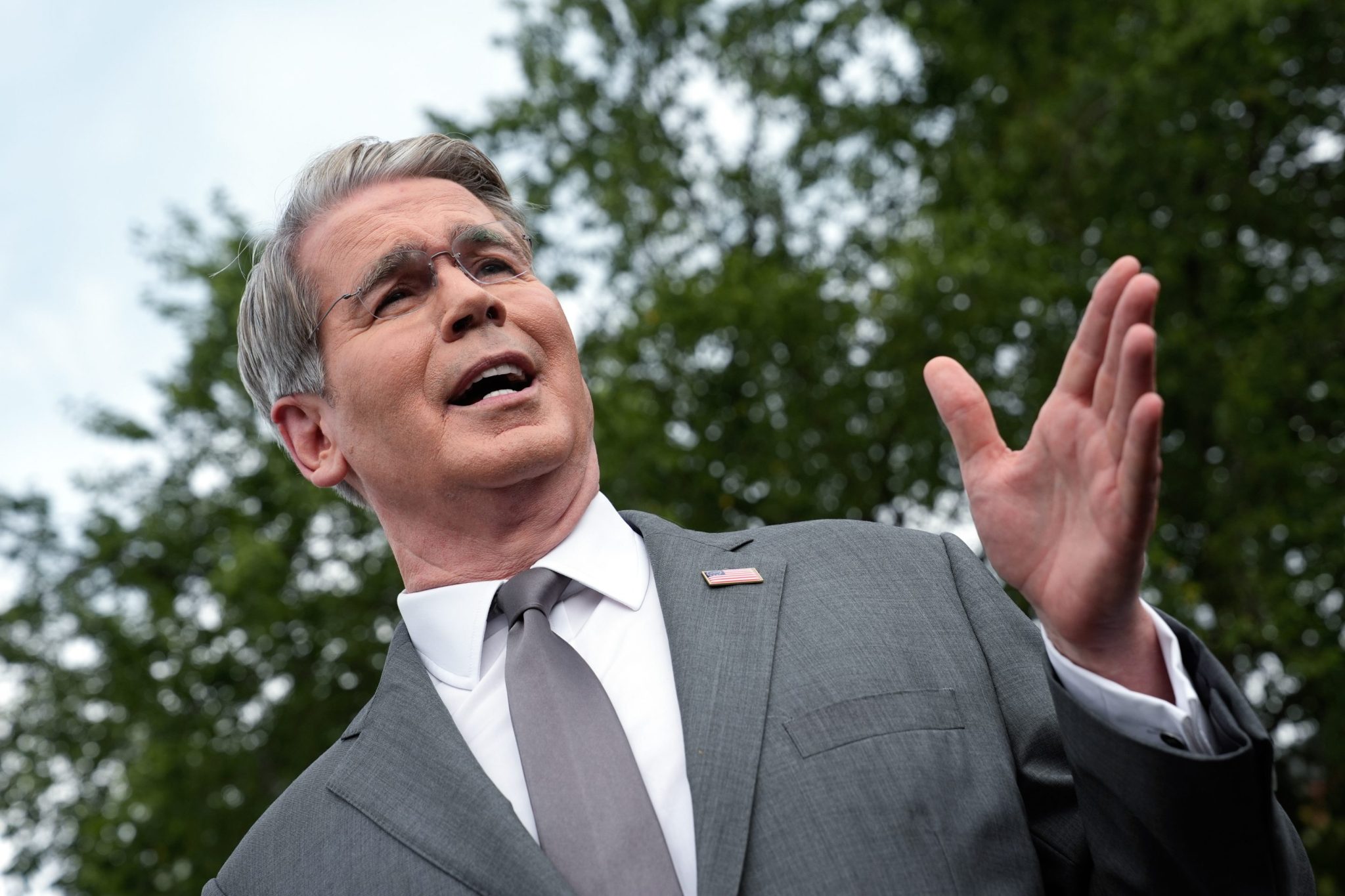
Treasury Secretary Scott Bessent might win points with his boss, President Trump, for his intervention in the market for U.S. Treasuries — doubling its buybacks to at least $4 billion — but he will earn no points from the bond vigilantes.
The history of such market interventions is littered with failures. Given Bessent’s participation in the Soros raid on the pound in 1992, when the Bank of England and the U.K. Treasury were forced to devalue sterling, one would have thought that Bessent knew that markets have a way of outsmarting government officials.
The Treasury is engaged in a new version of “Operation Twist,” buying long-term debt to keep longer-term yields down and selling an equal amount of short-term debt, which tends to raise short-term yields. Overall, this will tend to flatten or “twist” the yield curve — at least initially.
The key distinction to make is whether Operation Twist is conducted on its own as a part of fiscal policy, or whether it is accompanied by a change in monetary policy.
The reason is that two main factors drive yields. First, is the supply and demand of credit, including the size of the fiscal deficit and corporate and household demand for credit. Second is inflation, which is almost entirely determined by monetary policy.
When implemented on its own with no change in monetary policy, there is a possibility that Operation Twist can succeed temporarily, but only if market players agree that the moves engineered in rates are roughly acceptable. However, if they are not – for example, if the government fails to narrow the deficit – all that will happen is that holders of longer-term debt will shift their positions along the yield curve until they can earn the returns that reflect their outlook.
If Operation Twist is implemented against a background of changing monetary policy, the chances of success are very different.
There have been three previous attempts at implementing Operation Twist: two in the U.S., each by the Fed in 1961-65 and 2011, and one by the Bank of Japan (BOJ) from 2016 until 2024.
In the 1961 case, U.S. authorities sought to boost capital spending by lowering long-term rates, while stimulating inflows of funds from abroad by raising short-term rates. The policy failed because underlying monetary policy proved too expansionary. Between the start of 1961 and October 1965, the annual rate of broad US money growth (M3) accelerated continuously from 3% to 10%. By 1964-65, inflation was on the rise, and bond vigilantes demanded higher yields. Their demands torpedoed the policy.
In the second case, as a part of its QE strategy, the FOMC decided in September 2011 to extend the average maturity of the Fed’s portfolio by selling short-term and purchasing longer-term Treasury securities. Its aim, under Chair Ben Bernanke, was to stimulate housing and corporate investment by lowering long-term rates in the aftermath of the Great Recession of 2008-09.
Unlike the 1961 episode, this time, the U.S. economy needed faster money growth to escape the effects of the Great Recession. Between January 2011 and May 2012, annual growth of M2 surged from 4% to 10%. This assisted in generating a gradual economic recovery in 2013 and 2014. Without the acceleration in money growth, it is doubtful whether the Fed’s Operation Twist in 2011-12 would have had any effect.
The third case involves Japan, where YCC, or yield curve control, was implemented by the BOJ as part of its grandiosely titled QQE, or Qualitative and Quantitative Easing, between 2013 and 2024. Along with zero and negative interest rates, YCC was a component of an attempt at monetary easing by the BOJ under Governor Kuroda. This operation must be viewed as a failure. Even though the Bank of Japan purchased very large volumes of securities under QQE, driving the Bank’s holdings of Japanese Government Bonds (JGBs) up to 46% of net Japanese government debt outstanding, most of the time broad money growth (M2) remained below 3% per year, a rate too low to boost either economic activity or inflation.
The underlying reason for the failure of YCC in Japan was that QQE was poorly designed. Instead of purchasing securities from firms and households, which would have boosted M2 growth, the BOJ bought securities mainly from banks. This resulted in nothing more than an asset swap between the commercial banks and the BOJ, with no upturn in money growth.
In the 1961-65 U.S. case, Operation Twist was overwhelmed by sustained rapid money growth, which resulted in inflation. In the 2011 U.S. case, Operation Twist was a minor component of a much-needed QE policy that boosted broad money growth. This aided an economic recovery and an escape from deflation. In Japan’s case, YCC was a component of a failed QQE strategy.
Scott Bessent’s version of Operation Twist can only succeed if monetary growth is supportive of his action. During the first half of 2026, broad money has been growing at nearly double-digit rates. This fact will torpedo Bessent’s interventions, making them pointless. For Bessent to reach the promised land of lower long-term rates, the Fed must tighten monetary policy and slow the rate of growth in the money supply.
Steve Hanke is a Senior Contributing Columnist at Fortune and a professor of applied economics at The Johns Hopkins University. His most recent book, co-authored with Matt Sekerke, is Making Money Work: How to Rewrite the Rules of Our Financial System, Wiley 2025. John Greenwood is a fellow at the Johns Hopkins Institute for Applied Economics, Global Health, and the Study of Business Enterprise.
The opinions expressed in Fortune.com commentary pieces are solely the views of their authors and do not necessarily reflect the opinions and beliefs of Fortune.
This story was originally featured on Fortune.com