
Although we tend to be more aware of the large muscles in our bodies that enable our legs and arms to move, the real stars at the many small muscles found in our face, hands and so on. Everything from focusing our eyeballs to typing on a keyboard requires the precise cooperation of many small muscles, which is not a feat easily emulated by technology.
Here the liquid crystal elastomer LCE) and graphene composite fibers demonstrated by [Ziyun Zhang] et al. provide an interesting example of how artificial muscles could approach such versatility. Although LCEs are not new technology – having been invented in the 1970s – it’s not enough to simply have an actuator for delicate tasks.
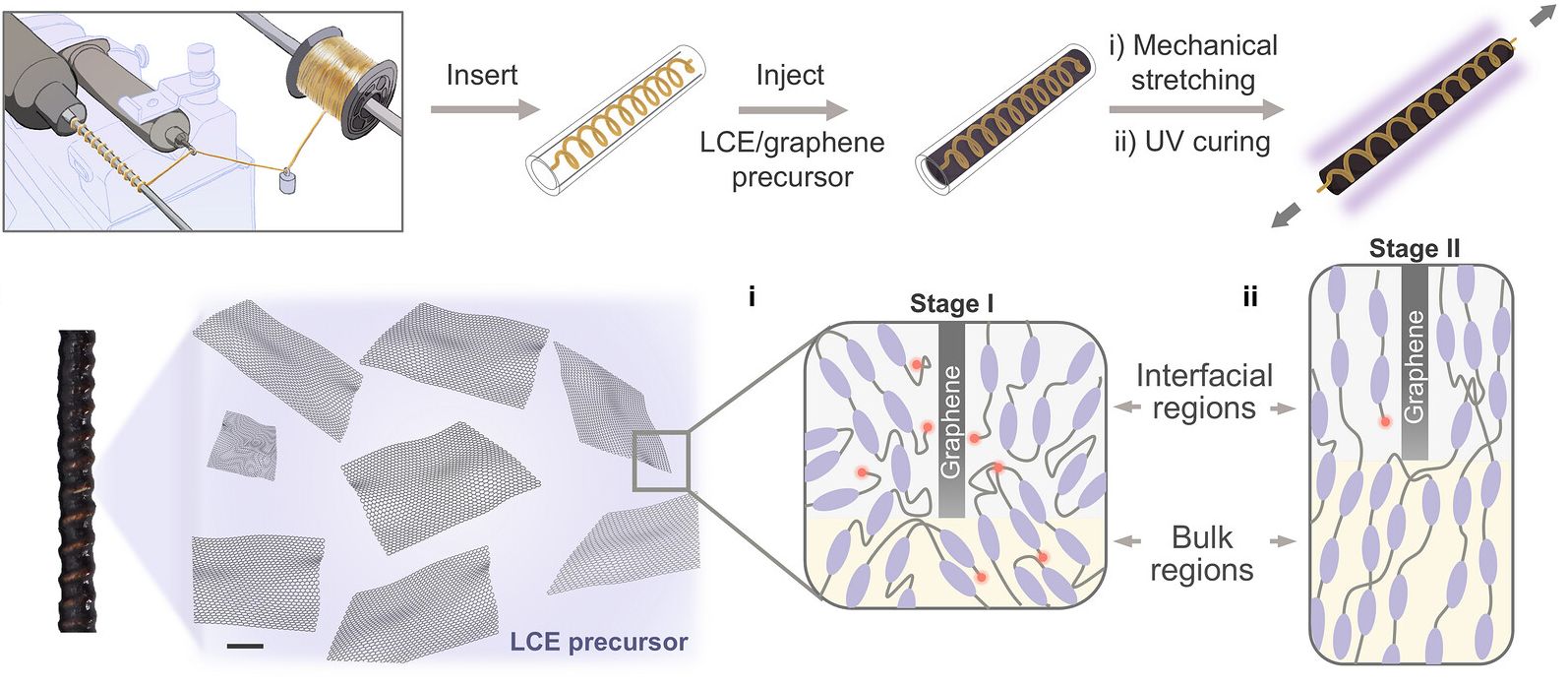
In the paper their CoilLCE is demonstrated. This involves a closed loop system with multistage actuation by creating an LCE-graphene composite with a thin copper heating coil that is embedded into the artificial muscle. The addition of graphene was mostly to increase toughness and to increase thermal conductivity.
To self-sense the state of the muscle the copper coil’s resistance measurement as it relates to temperature was used, which turned out to be accurate to within about 2%. The performance of these muscles was demonstrated both with a robotic hand on a toy piano and with a human eye model. Although not exactly a speed demon or incredibly convenient unless you have a way to also efficiently cool the muscle after heating, it does show promise for the use of LCEs for this kind of fine-grained control.