
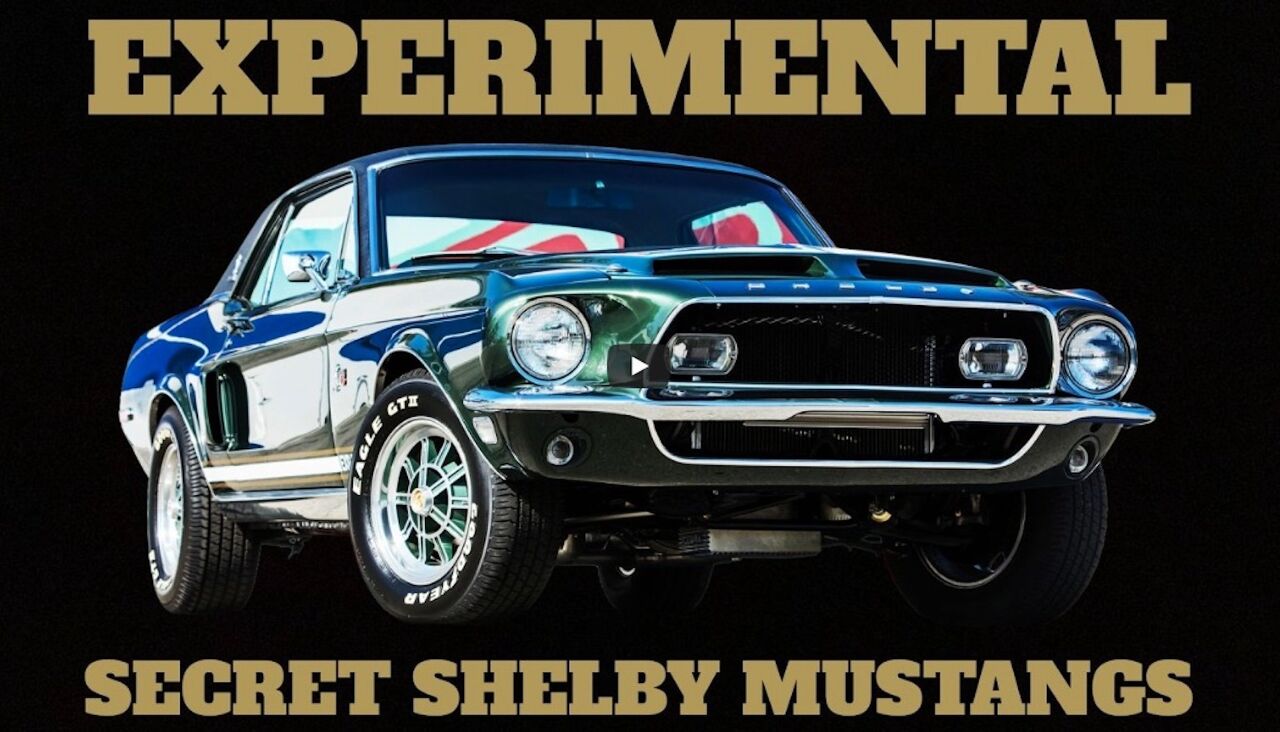
In this video we are going to take a look at the history of the Shelby 1967 EXP 500 Little Red and the 1968 EXP 500 Green Hornet. We also take a 2005 Carroll Shelby Commissioned and owned recreation EXP 500 CSS Green Hornet out for a drive.
The TTAC Creators Series tells stories and amplifies creators from all corners of the car world, including culture, dealerships, collections, modified builds and more.
An AI-generated transcript summary edited by a staffer is below.
[Image: Tony's Fords and Mustangs/YouTube]
Become a TTAC insider. Get the latest news, features, TTAC takes, and everything else that gets to the truth about cars first by subscribing to our newsletter.
Summary
This video explores the history of Ford and Shelby's experimental Mustang prototypes from the late 1960s, focusing on the 1968 Shelby EXP500 Green Hornet and a recreation commissioned by Carroll Shelby in 2005. The host visits the recreation's current owner, Paul, to examine the car, discuss its history and driving experience, and consider whether it should be regarded as a legitimate Shelby rather than simply a tribute car.
The host ultimately argues that the Green Hornet recreation and its black counterpart, the Black Hornet, deserve recognition as legitimate Shelbys because Carroll Shelby personally commissioned, supervised, owned, and drove them, and both are included in the Shelby registry.
Key Takeaways
1. The experimental Shelby Mustangs began with Little Red
In 1967, Ford and Shelby developed the Shelby EXP500, a pair of experimental Mustang coupes known as Little Red. These cars were designed to test styling concepts and new technologies, including spray-on vinyl roofs, leather seats, and high-performance engine configurations.
One version was fitted with dual Paxton superchargers on its 428-cubic-inch V8. The prototypes are widely credited with inspiring the 1968 Ford Mustang California Special.
Both cars were believed to have been scrapped in 1968. However, in 2018, Barrett-Jackson chairman Craig Jackson and a research team discovered one of the prototypes in a field in North Texas. The car was subsequently restored.
2. The original 1968 Green Hornet was an advanced engineering testbed
Ford and Shelby collaborated on another experimental Mustang coupe in 1968. Originally finished in lime gold, the car was painted dark metallic green and fitted with a black vinyl roof, earning the name Green Hornet.
The car featured a 428-cubic-inch Cobra Jet V8, an upgraded C6 three-speed automatic transmission, and several experimental technologies that were advanced for the period.
Notable engineering features included:
- Fully independent rear suspension.
- Rear disc brakes.
- An experimental Conelec computer-controlled fuel-injection system.
- A reinforced drivetrain developed for testing and performance applications.
Fred Goodell, Shelby American's chief engineer, took a particular interest in the project, while Carroll Shelby also participated in testing and development.
Unlike many experimental vehicles of the era, which were dismantled or scrapped, the original Green Hornet survived. A Ford executive purchased it, and it eventually ended up at a dealership in Cheboygan, Michigan, where it remained for more than 30 years. Craig Jackson later acquired the car and arranged for its restoration to its original prototype configuration.
3. Carroll Shelby commissioned a Green Hornet recreation in 2005
In 2005, Carroll Shelby commissioned Legendary GT Continuation Cars, an authorized builder of classic Shelby Mustangs, to recreate the Green Hornet.
The company began with a 1968 Ford Mustang California Special and completed a comprehensive, nut-and-bolt restoration. The resulting car was built to evoke the original experimental Green Hornet while incorporating documented Shelby components.
Key features include:
- An original 1968 Shelby 428-cubic-inch V8 with a certificate of authenticity signed by Carroll Shelby.
- Cobra Jet intake and exhaust components, Shelby intake hardware, and a Holley 700-CFM carburetor.
- A modified C6 automatic transmission with an external cooler.
- A Currie nine-inch rear axle.
- Shelby 10-spoke wheels fitted with Goodyear tires.
- Metallic green paint and a Shelby front-end treatment.
- Retained California Special rear styling and side brake-cooling scoops.
- A two-tone gold-and-black interior with an original 1968 Cobra steering wheel.
- Custom AutoMeter gauges and Carroll Shelby signatures on the seatbacks.
The car's documentation includes copies of its title history, Shelby-related paperwork, and its listing in the Shelby registry.
The video identifies it as the only metallic green EXP500 CSS.
4. Carroll Shelby personally owned and drove the recreation
One of the most significant aspects of the recreation is Carroll Shelby's direct involvement. According to the video, Shelby drove the car approximately 1,000 miles before it was transferred to the Shelby Museum.
Paul subsequently purchased the car and has preserved it in the condition in which it left the museum. At the time of the interview, the odometer showed approximately 1,730 miles, and Paul estimated that he had added fewer than 100 miles.
For Paul, the car's appeal goes beyond its specifications. Knowing that Carroll Shelby sat in the same seat, handled the controls, and personally participated in the car's history makes ownership a particularly meaningful experience.
Paul says the car runs exceptionally well and is enjoyable to drive. However, he rarely takes it on the road because of its historical significance and concerns about other drivers and wildlife.
The host also declines an opportunity to drive it, preferring to admire the vehicle and ride along rather than risk damaging a car with such a unique history.
5. The Green Hornet recreation can be mistaken for other Mustangs
Despite its unusual provenance, the car does not always attract recognition from the public. Some people assume it is a restomod or an ordinary California Special, while others mistakenly believe it is the original 1968 Green Hornet prototype.
Paul explains that the car is neither an ordinary restoration nor the original experimental vehicle. It is the recreation commissioned by Carroll Shelby himself.
That distinction is important: its historical significance comes from its documented connection to Shelby and his direct involvement, rather than from being the original prototype.
The video also notes that the car was featured at an Iron City Brewing car show in Pittsburgh, where more than 2,000 vehicles attended. It was selected to appear on that year's Iron City beer can, giving the recreation additional public recognition.
6. The Black Hornet shares the recreation's unusual status
The Green Hornet was not the only recreation commissioned by Shelby during the mid-2000s. A second car, finished in black and called the Black Hornet, was also built.
The host considers both cars legitimate Shelbys for three principal reasons:
- Both are listed in the Shelby registry.
- Carroll Shelby personally supervised their construction.
- Shelby owned and drove both vehicles.
The host compares their creation to the original Shelby Mustangs of the 1960s. Those cars began as regular Ford Mustangs that were sent to Shelby's facility, modified under his supervision, and certified as Shelbys.
In his view, the Green Hornet and Black Hornet follow that same basic tradition. Indeed, he argues that many original Shelby Mustangs cannot claim the same degree of personal ownership and driving involvement by Carroll Shelby.
7. The original Green Hornet never entered production
Archival footage included in the video features Carroll Shelby discussing the development of the Green Hornet and the broader challenges facing performance cars in the late 1960s.
Shelby explains that the car was intended to advance both automotive performance and styling. However, changing government priorities around emissions and safety affected the prospects for production, and the Green Hornet never became a production model.
Despite that outcome, the experimental car remained an important example of Ford and Shelby's engineering ambitions and their willingness to explore technologies that were not yet ready for mainstream use.
Overall Conclusion
The video combines automotive history, engineering details, and an owner's perspective to explain why the Green Hornet is more than an unusual Mustang.
The original 1968 EXP500 was an experimental platform that incorporated advanced suspension, braking, and fuel-injection technology. Its survival preserved an important piece of Ford and Shelby history. Decades later, Carroll Shelby's decision to commission a recreation created a second vehicle with its own distinctive historical credentials.
Although the recreation is not the original prototype, its authentic Shelby components, extensive documentation, registry listing, and Carroll Shelby's direct involvement distinguish it from a typical tribute car.
The host's conclusion is that the Green Hornet recreation and the Black Hornet deserve to be considered legitimate Shelbys. Their significance lies not simply in their appearance or performance, but in their direct connection to Carroll Shelby and the tradition of transforming ordinary Mustangs into something special.