
In the wild, mimicry is an important tool for survival. Some baby hummingbirds disguise themselves as caterpillars with stinging hairs to avoid predators, while octopus, squid, and cuttlefish use camouflage to blend in with their surroundings and hide. Even plants get in on the mimicry fun, with some mimicking the small of rotten meat to attract flies and others using their petals to trick flies into pollinating on them.
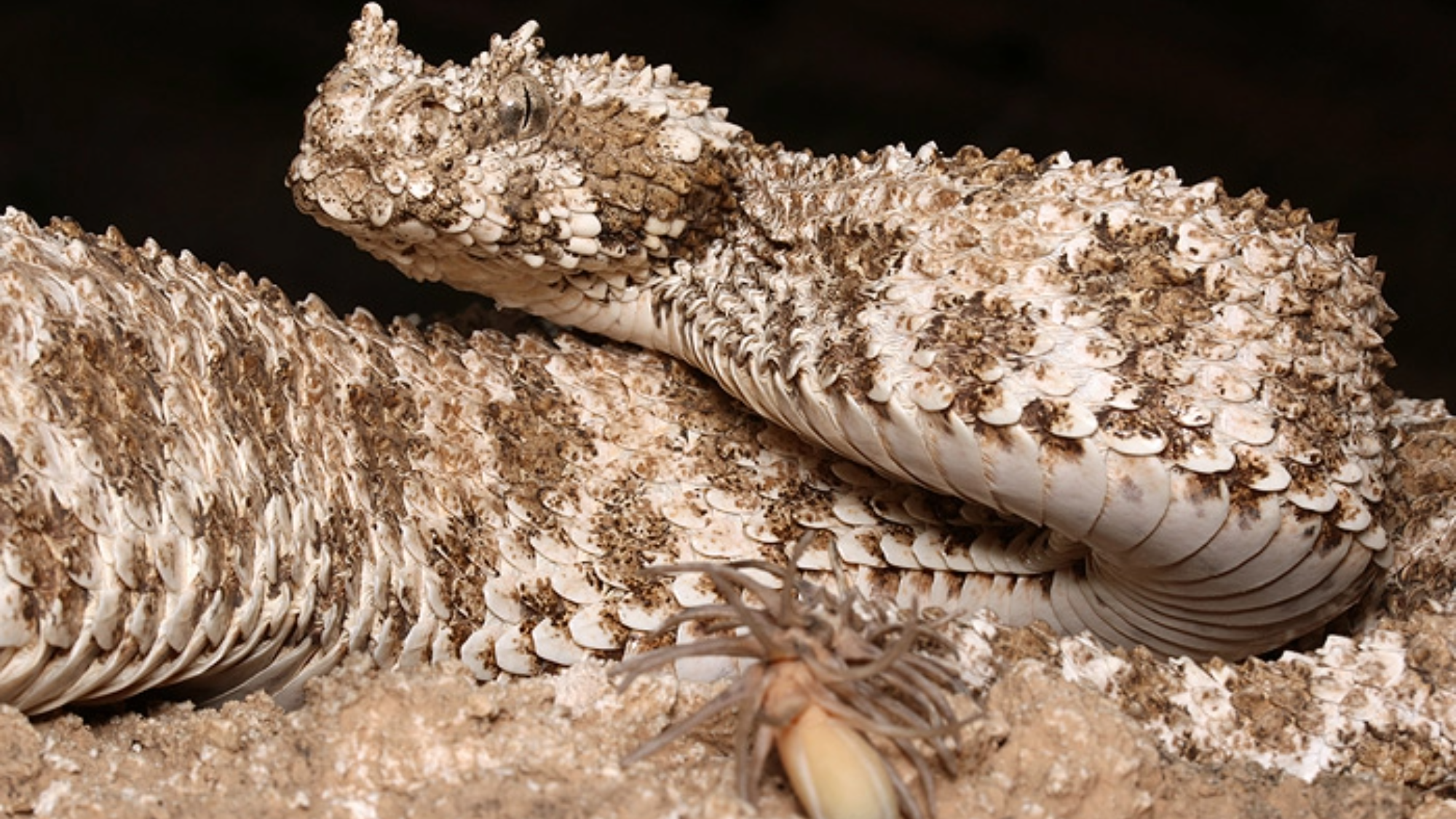
True to its name, Iran’s spider-tailed horned viper (Pseudocerastes urarachnoides) has a rather novel strategy. It uses a tail that looks like a spider to lure birds trying to eat the decoy spider. When the time is right, the snake jumps into action and eats the bird.
The spider-tailed horned viper is a relatively new species to science, and a study published today in the journal The Anatomical Record is peeling back the layers of this master mimic. A team from the Field Museum in Chicago used X-ray computed tomography (XCT) scanners to take a look inside of the snake’s spidery tail and found that their tailbones appear rather normal.
“Scientists first collected a specimen of this snake in 1968, and when they brought it back to the Field Museum, people thought that it had some sort of deformity at the tip of its tail, like a tumor,” Sara Ruane, a study co-author and the Field’s Associate Curator of Herpetology and Director of the Core Laboratories, said in a statement. “It sat on the shelves of the museum for decades, but it wasn’t until another specimen with a similar tail was found in 2003 that people revisited it.”
Scientists described the snake as a new species in 2006, using the specimen housed in the Field Museum’s collections as the holotype. Holotype specimens serve as a main standard-bearer and reference point for the physical characteristics of a species, so that scientists can compare and contrast them to see if a specimen belongs to one species or another.
Shortly after naming the spider-tailed horned viper, researchers recorded video of the snake using the spider-like appendage at the tip of its tail as a way to lure in unsuspecting birds.
“I remember being a PhD student in about 2008 and first seeing the videos of this snake in the wild,” says Ruane. “The appendage at the end of its tail is so outrageous, I remember thinking it was so cool. It’s truly unique among snakes.”
In 2023, Ruane attended a conference with Georgios Georgalis, an associate professor at the Polish Academy of Sciences in Kraków. Georgalis mentioned that he was interested in studying the Field Museum’s spider-tailed horned viper holotype specimen.
“I am primarily a paleontologist, so I try to use modern snake species to make sense of fossil remains,” said Georgalis, who is also a co-author on the new study. “In vipers, the vertebral column unfortunately doesn’t give us very many clues about what kind of snake we’re looking at. When we find fossils, we often just find individual bones rather than the entire skeleton, and the individual vertebrae are so different from each other along the snake’s body that it’s hard to use them to identify a species.”
The spider-tailed horned viper offered a unique opportunity to study snake vertebrae. Georgalis said that viper vertebrae in particular have not been very well studied. They also wanted to know more about this species’ unusual tail.
To take a closer look, they used the Field Museum’s XCT lab. With XCT, scientists can scan objects and take thousands of X-ray images. These images are then stacked together to produce a 3D rendering of the object’s interior. It essentially allows scientists to study rare or one-of-a-kind specimens in detail without cutting them open or and risking damage.
“With the spider-tailed horned viper, we were particularly interested in seeing what the vertebrae at the tip of the tail look like, because the exterior of this snake’s tail is so unusual, and because it’s used for this unusual bird-luring behavior,” says Georgalis. “In some other snakes, like sand boas and rubber boas, the vertebrae at the tip of the tail have extreme shapes that look really alien. We wanted to investigate if the spider-tailed horn viper’s tail was similarly strange inside.”
Surprisingly, the scans revealed that the inside of the viper’s tail looked quite normal. The spider-tip tail is only visible on the outside of the snake and the vertebrae were the same as they would be in other vipers.
“There was nothing in the snake’s skeleton that would suggest how extreme its tail looks on the outside,” said Georgalis.
XCT scan showing the normal bones inside the snake’s bizarre tail. Image: Sara Ruane and Stephanie Smith.Findings like these show how fossil skeletons only tell one part of the story of what an animal looked like and how it behaved. Nothing in the spider-tailed horned viper’s skeleton would suggest it has such a unique tail, or that the tail twitches in a way that tricks birds.
“It’s one of the, let’s say, frustrations of the life of a paleontologist,” says Georgalis. “We work with beautiful animals, but most of the time, we’re trying to put together puzzles with some of the pieces missing, and in the end, we can’t be 100% sure of what the animal actually looked like.”
It’s also a reminder that prehistoric life may be even stranger than we can imagine by looking at bones alone. These findings also lay some groundwork for scientists studying how tissues evolve and develop and underscores the value of museum collections.
“Specimens that were collected 50, 100, 200 years ago are still being used all the time to learn new things,” said Ruane.
The post Snake that hunts with fake spider on its tail shocks scientists appeared first on Popular Science.