
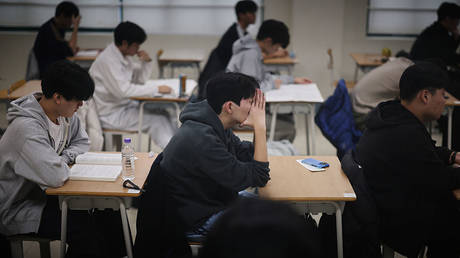
Choi Kyo-jin took responsibility after emergency anti-cheating measures sparked chaos during the country’s crucial university entrance exam
South Korea’s education minister has resigned amid a growing AI cheating scandal that triggered chaotic last-minute security measures and widespread confusion during the country’s crucial national university entrance exam.
The controversy erupted after the top scorer in a national tax accountancy exam admitted to cheating by using a miniature camera to photograph questions, generative AI to obtain answers, and a smartphone to view them. He had answered 159 of 160 questions correctly, scoring 397.5 out of 400 points.
The confession raised concerns about the adequacy of existing security measures and the government’s ability to prevent similar misconduct just days before the country’s career-defining university entrance exam was due to take place.
“As the minister in charge, I do not believe I am immune from public criticism that we failed to prepare adequately in advance,” Education Minister Choi Kyo-jin wrote on X on Sunday.
Read more The rise of AI: Something to fear or something to ignore?
In the wake of the scandal, the government scrambled to introduce last-minute security measures, including blocking public Wi-Fi near testing centers and deploying thousands of additional supervisors. Students were also instructed to use only pencils and wear clothing without buttons or to cover any buttons with stickers to prevent the use of concealed cameras.
Authorities also sent emergency alerts to phones nationwide, designed to sound at full volume even on silenced devices, in an attempt to identify students who had failed to surrender their phones before the exam.
The government offered rewards of at least $75,000 for information about cheating, while promising lighter penalties to those who reported their accomplices. Students caught cheating could face a 10-year ban from taking the exam.
South Koreans share ANTI-CHEATING ALERT — phones went off EVERYWHERE The emergency message was sent to expose hidden phones at university entrance exam sites One user tested the alert on different phone models and it reached every single one https://t.co/6jFvmtnQAF
— RTVisual (@RT_Visual_on_X) November 19, 2026
The Education Ministry subsequently reported 111 suspected electronic-device violations during the test, with 49 detected through the alerts.
The last-minute changes caused confusion among students and teachers, who complained that the repeatedly revised rules added to the anxiety surrounding the high-stakes exam. Teachers’ unions also criticized the government’s response as belated.
Read more Source wars: Jensen Huang and the battle for AI dominance
“Now that the exam is over, I take full responsibility and hereby offer my resignation,” Choi wrote. President Lee Jae Myung accepted his resignation, according to the presidential office.
The annual College Scholastic Ability Test (CSAT), known locally as the suneung, is one of South Korea’s most consequential examinations, playing a decisive role in future career prospects. According to the OECD, graduates of South Korea’s most prestigious universities earn nearly 25% more than those from lower-ranked institutions upon entering the workforce.
South Korea goes to great lengths to ensure the exam runs smoothly, temporarily suspending flights during the English listening section, delaying stock trading and office hours, and adjusting public transportation schedules to help candidates reach testing centers. More than 550,000 candidates sat the test on Thursday at 1,312 centers nationwide.