
When Irving T. Bush started building his waterfront terminal in Sunset Park at the end of the 19th century, the idea was simple: put the warehouses, the factories, the rail and the piers in one place, and let goods move from production to shipment without ever leaving the property. More than a century later, New York City is betting that a version of that logic still works, now with a very different cast of tenants.
That bet is called MADE Bush Terminal. The acronym stands for Manufacturers, Artisans, Designers, and Entrepreneurs, and the 20-acre campus on the Brooklyn waterfront is the city's attempt to give people who design physical things a place to make them here, at scale, rather than sending the drawings overseas. Two years after its unveiling, the tenant list reads like a cross-section of where industrial design is heading.
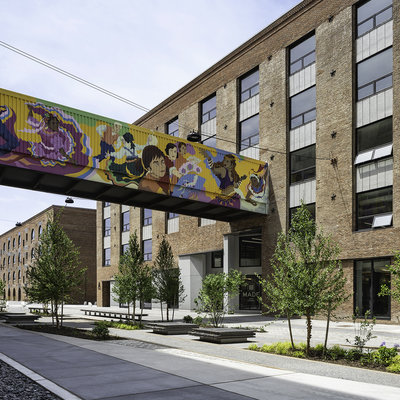
The CampusThe New York City Economic Development Corporation (NYCEDC) unveiled the northern portion of the historic Bush Terminal under the MADE name in November 2024. nARCHITECTS handled the renovation of Building A, a 230,000-square-foot structure that serves as the campus anchor, and the team kept the brick, timber and freight-elevator bones that made these buildings useful to manufacturers in the first place.
Image courtesy nARCHITECTS
Today the campus holds roughly 140,000 square feet of industrial workspace, 30,000 square feet for cultural and public programming, and acres of new waterfront open space. It sits within NYCEDC's 200-acre Sunset Park District alongside the Brooklyn Army Terminal, the South Brooklyn Marine Terminal and the Brooklyn Wholesale Meat Market.
What distinguishes MADE from a typical industrial lease is the curation. NYCEDC is deliberately mixing craft-based and high-tech tenants on the same floors, on the theory that a lighting studio, a 3D print bureau and a biofabrication lab will find reasons to talk to each other. Judging by who has moved in, the theory is getting a fair test.
Who's Making WhatStickbulb
The most recent and largest arrival is Stickbulb, the New York lighting manufacturer co-founded by Russell Greenberg and Christopher Beardsley. In July the company signed a long-term lease for 8,300 square feet on the fifth floor of Building A plus another 19,000 square feet in Building B, moving out of Long Island City. The new space puts production, design and showroom under one roof. Beardsley has said staying in the city was a priority, and that the move lets Stickbulb increase manufacturing capacity while continuing to build its lighting domestically.
Makelab
Makelab, the on-demand 3D printing studio founded by Christina Perla and Manny Mota, took around 4,000 square feet on a five-year lease this spring. The shop prints rapid prototypes, medical models and end-use production parts, and its portfolio includes architectural site models for firms like Zaha Hadid Architects. The bigger footprint gives Makelab the logistics and capacity to take on larger clients with high-volume schedules. For the designers working a few doors down, it also means a prototype is an elevator ride away.
PELLE
Jean and Oliver Pelle's studio, known for sculptural lighting and furniture, signed a ten-year lease for nearly 12,000 square feet and relocated from Red Hook. The new headquarters brings design, fabrication and client work together, with a dedicated painting studio, workrooms for lighting and cast-paper production, and the Pelle Gallery. At an industry event on campus this summer, Jean Pelle pointed to the studio sizes and the enormous freight elevator as practical reasons the space works.
MushLume
Danielle Trofe's MushLume grows lighting rather than manufacturing it in the conventional sense. Agricultural hemp waste is bound with living mycelium and molded into shades and acoustic panels, and the material's natural flame resistance earns the fixtures a Class A fire rating. Trofe's 3,000-square-foot lab at MADE consolidates design, cultivation and production for the first time, and the studio has been using it to push toward integrated systems that absorb sound while they light a room. MushLume also runs open studios and hands-on mycelium workshops on site.
Aripack
Aripack makes custom flexible and rigid packaging for food, beverage and consumer brands. The family-owned company has been in Brooklyn since 2004 and moved its whole team from East New York into 6,000 square feet at MADE. It's a reminder that the campus isn't only about objects with gallery appeal.
A Campus in MotionThe most interesting recent addition isn't a tenant in the usual sense. In August, NYCEDC launched a year-long pilot of a Circular Construction Hub at MADE, operated by Our Temenos, a Brooklyn ecological landscaping firm founded by Rosemarie Miner. The hub recovers, sorts, stores and redistributes construction materials so they can go back into use instead of into a landfill. Miner pitches it as a hyperlocal resource for small contractors dealing with unreliable supply chains.
The pilot is also a data exercise. Our Temenos handles intake and resale while NYCEDC tracks costs, logistics and whether the model can pay for itself. It grew out of the agency's "Ideas for Impact" open call, and it's the first award of its kind. Putting it at MADE is fitting: a campus built on adaptive reuse is now testing whether reuse can work as a business.
More is on the way. NYCEDC has partnered with Public Service on a 1,000-capacity music and arts venue in a ground-floor warehouse, designed with nARCHITECTS, design consultancy ARUP and lighting designer Ben Kreukniet and slated to open late this year. The rebuilt Pier 6 will add five acres of waterfront parkland in 2027, and the next phase will remake Building C for manufacturing, light industrial and public-serving uses.
The Next ChapterPlenty of old industrial buildings get "reimagined" into offices and food halls, keeping the brick and losing the making. MADE is keeping the manufacturing identity while adding the cultural programming and public access that make a waterfront campus somewhere people want to be. If a mycelium lab, a 3D print bureau, a packaging firm and two lighting manufacturers can share an elevator and occasionally a project, Irving Bush's old idea of keeping production close will find a second life.
MADE is actively seeking new creative tenants. If this kind of environment sounds like a good fit for you and your team, reach out to them about leasing space today.