
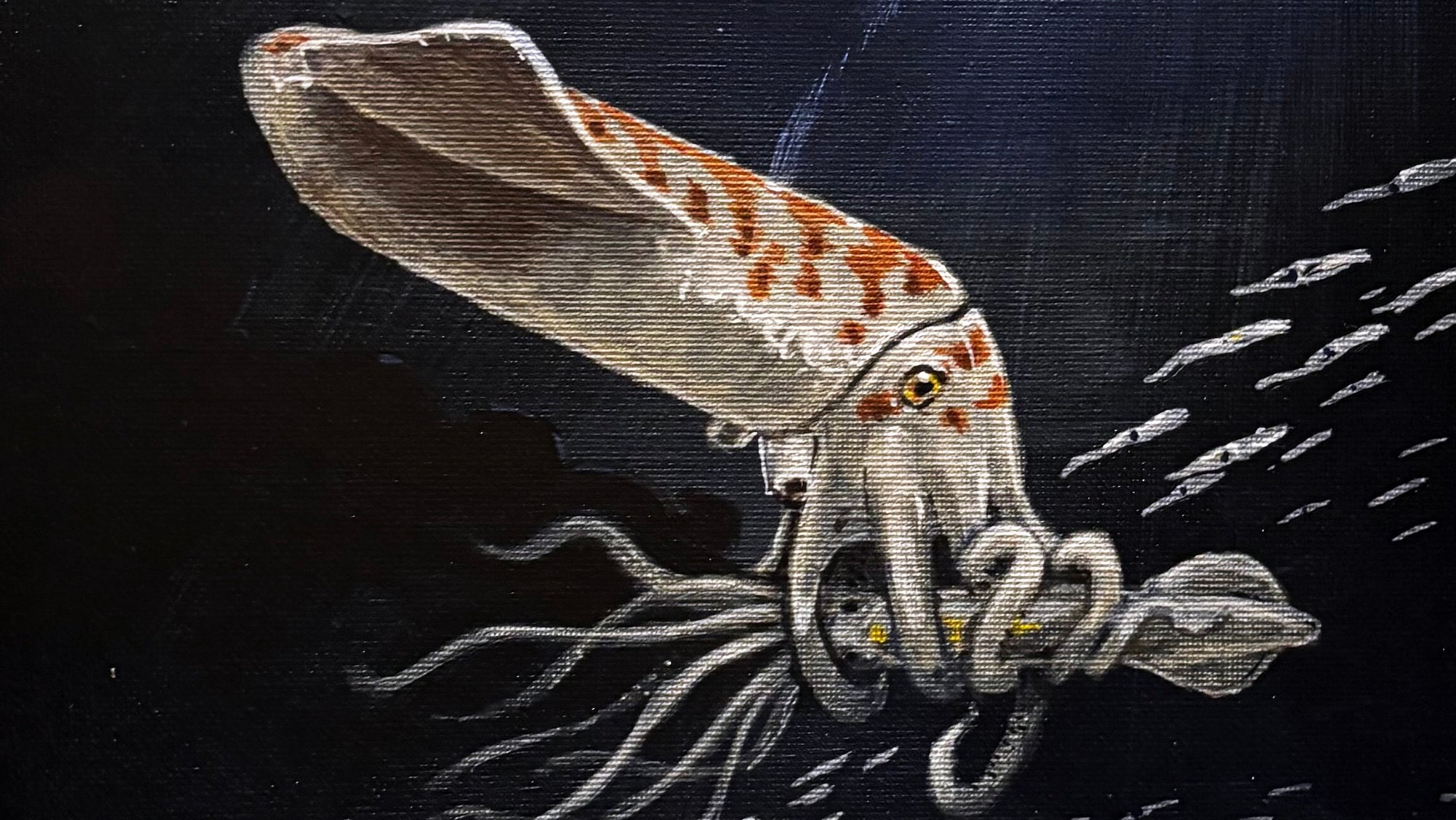
Thanks to having the “chunkiest squid butt” ever seen on an ancient cephalopod, paleontologists have discovered a 160-million-year-old octopus cousin. The newly identified fossils are described by an international research team in their study recently published in Papers in Palaeontology, which also includes a potential explanation for Wyoteuthis linsterorum’s hefty proportions. Just like today’s tentacled ocean dwellers, the Mesozoic squid ancestor likely had no problem devouring its relatives—or even members of its own species.
W. linsterorum is a belemnite, a group of prehistoric cephalopods who left behind some of paleontology’s most common fossils. Examples of their bullet-shaped structures known as a rostrum have regularly shown up at dig sites around the world for over 200 years. This includes the Sundance Formation in present-day Wyoming, which was covered by an inland sea millions of years ago.
Most of Wyoming’s belemnites are comparatively tiny—usually about two-to-four inches long and less than one inch wide. But about 30 years ago, Wyoming Dinosaur Center founder Burkhard Pohl found a fossil that “stuck out like a sore thumb,” according to study co-author Bill Wahl. While the preserved belemnite rostrum was about as long as other examples, it measured about 2.4 inches wide. Based on what they knew of belemnite proportions, paleontologists estimated this specimen’s entire body probably reached nearly two feet long.
The two ‘W. linsterorum’ fossils were discovered over 30 years apart. Credit: Jessica LippincottWithout any comparable examples, the thick squid butt remained in storage for nearly three decades. In 2019, fossil collector Cliff Linster finally discovered a similar cephalopod near Ten Sleep, Wyoming. He soon donated it to the Wyoming Dinosaur Center, and researchers began analyzing this pair of mystery fossils.
Computed tomography (CT) scanning allowed the team to inspect the remains without damaging them. The results confirmed the ancient sea creatures were never-before-seen belemnites.What’s more, they belonged to a family researchers previously believed went extinct millions of years earlier.
“After spending years fossil hunting in Wyoming and collecting countless fossils of the common Pachyteuthis belemnites here in Wyoming, this one is unlike anything I have ever seen,” Jessica Lippincott, a paleontologist and study co-author, said in a statement.
But why did W. linsterorum evolve to reach such bulky proportions? The team believes the answer lies in the diets of many present-day cephalopods.
“A possible explanation is that their relatively large size gave them an advantage when hunting co-occurring smaller belemnites of the genus Pachyteuthis,” explained paleontologist Alexey Ippolitov, a study co-author now at New Zealand’s Victoria University. “Modern squid, after all, are hardly picky when it comes to prey: they readily hunt not only other species of cephalopods, but sometimes even their own kind.”
An unexpected and surprising species, W. linsterorum is named in honor of Cliff Linster, who died in June 2026. While he didn’t live to see the dedication, Linster was well aware that the team was working to describe the animal he helped discover.
“It goes to show that we are still finding new species of fossils all the time, and people who rockhound or collect invertebrate fossils can also contribute to science,” said Lippincott.
The post ‘Squid butt’ fossil belongs to one of the ‘chunkiest’ cephalopods ever discovered appeared first on Popular Science.