
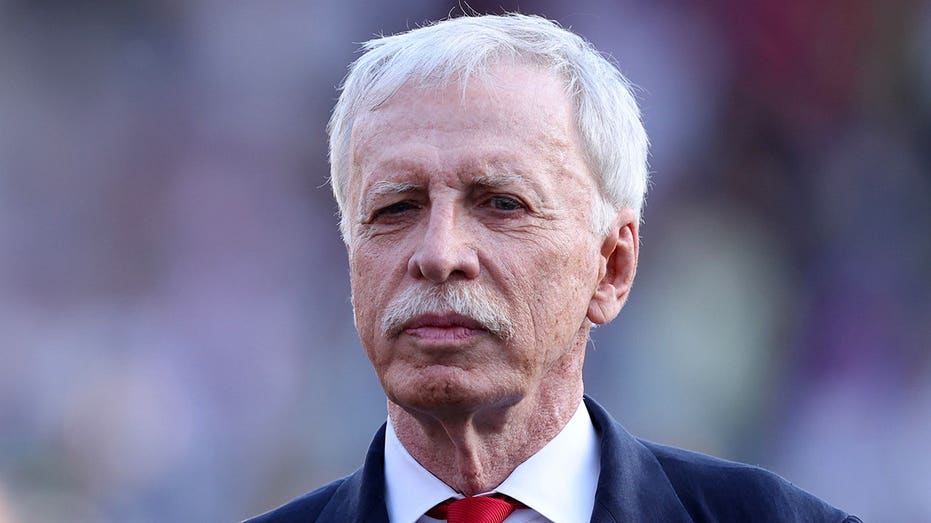
If there were any remaining doubts as to the viability and earning potential of Major League Baseball teams, this week's news should end it.
Out of seemingly nowhere, Stan Kroenke, one of the wealthiest people in America, agreed to purchase a majority stake in the Los Angeles Angels from longtime owner Arte Moreno. It had been rumored in recent years that Moreno was considering a sale, but a deal never materialized. Until now.
The price Kroenke paid for the Angels was estimated at a record-breaking $4 billion, representing an enormous return for Moreno who purchased the franchise for just over $180 million from the Walt Disney Company back in 2003. It was also, at first glance, a significant price for an organization that has the longest postseason drought in baseball. Despite having Mike Trout and Shohei Ohtani on the same roster for several seasons, the Angels have not reached the playoffs since 2014.
ARTE MORENO ERA OFFICIALLY OVER AS ANGELS SELL TO RAMS OWNER STAN KROENKE FOR $4B
The immediate question, then, is why? Why would Kroenke, an eminently talented and successful businessman who's already principal owner of organizations like the Los Angeles Rams, Arsenal FC and the Denver Nuggets, now turn his attention to, well, the polar opposite?
And the answer explains why so much of the information coming from Major League Baseball and the league's owners is misleading, at best.
With the Collective Bargaining Agreement between the league and MLB Players Association expiring at the end of the season, it's widely expected that the owners will lock the players out until a new deal can be reached. The largest point of contention between the two sides is disagreement over a potential salary cap.
Players have, for decades, said a salary cap is a red line they will never accept. While owners are hoping to take advantage of widespread, and inaccurate, fan sentiment believing that a salary cap is necessary for the league to achieve competitive balance.
Another key aspect of their argument is that the business of baseball is not as strong as it should be. That franchise valuations have lagged behind the NFL because that league has a salary cap, ensuring relatively fixed costs for players. As well as that the collapse of the local sports television networks have negatively impacted their bottom lines.
Here's the problem with that, though: there have been two MLB organizations to sell in 2026: the San Diego Padres and now the Angels. Both set records for the largest ever purchase price of an MLB team, and neither organization has a local broadcast partner, like say, the Dodgers do with Spectrum SportsNet LA or the Yankees do with YES. If the loss in revenue from those television deals was so catastrophic, why are these two organizations worth so much money?
MLBPA Interim Executive Director Bruce Meyer told OutKick that it shows the "overall health" of the industry is outstanding and that owners are realizing "huge profits."
"Arte Moreno bought the Angels in 2003 for $183.5 million, and now the team is in the middle of the longest playoff drought in MLB, with 11 consecutive losing seasons," Meyer said. "Despite that record — and Moreno’s complaints about profitability — yesterday, Moreno sold the team to Stan Kroenke for at least a record $4 billion, netting a multibillion-dollar return on his purchase. It's a perfect example of the overall health of the industry, and the huge profits owners realize from owning baseball teams—value which is generated by the talents of players."
Kroenke's not one to make bad investments, nor one to rush to judgment on a $4 billion purchase. So why'd he do it? Because, as Meyer says, baseball is booming.
ZERO BS. JUST DAKICH. TAKE THE DON'T @ ME PODCAST ON THE ROAD. DOWNLOAD NOW!
The Angels are a potential gold mine waiting to be taken advantage of by competent ownership. Even without a competitive team, for more than a decade, the Angels still rank 13th in baseball in average attendance with nearly 33,000 tickets sold per game. Already, reports have suggested Kroenke intends to build a brand new, multi-billion dollar stadium to take advantage of a fanbase ready and willing to support a winning team.
Trout, the long-suffering franchise icon, said as much.
"I'm excited," he said Tuesday after the news broke. "Look, the track record — it's there."
"Seeing the reaction from the fans and some of the guys and the whole vibe, I think it was needed for a fresh start," he continued. "The biggest thing is getting that feeling of getting that winning culture back and having that vibe in the clubhouse."
This is a sleeping giant in the nation's second-largest media market. The Padres down the road sell out most of their games. A more appropriately-run Angels team could be next.
Then there's the real estate investment component. Angel Stadium sits on a massive, underdeveloped parking lot. Kroenke is almost certainly looking to tear up that wasted concrete and build mixed-use development nearby. Shops, restaurants, townhomes, apartments, condos, you name it. Build a ballpark village next to a brand new facility, and people will come.
This model has already been demonstrated by The Battery, a Braves-owned development next to Truist Park in the Atlanta area. New York Mets owner Steve Cohen intends to build a casino on underutilized land next to Citi Field. Billionaire owners are capitalizing on their baseball franchises to create real estate portfolios that rely on fans from those teams.
PADRES STRIKE DEAL TO SELL TO INVESTOR GROUP LED BY PRIVATE EQUITY BILLIONAIRE, VOWS WORLD SERIES CHAMPIONSHIP
That's well within their rights, of course, and it's smart business. It also can create a better experience for fans, who can come to the ballpark earlier or stay afterward with friends and family. The problem from the players' perspective is that when the league says they want to base a salary cap on the revenue they bring in, they exclude this ancillary, connected, income from the calculation.
Kroenke bought the Angels for a gigantic price because he doesn't care whether a salary cap happens or not. None of the owners care about a salary cap, at least as it pertains to competitive balance. They want to limit spending on players and retain more profits. That's it.
They claim their businesses are struggling. That they're losing money and don't turn enough yearly profit. But their exploding franchise values keep undermining those claims and proving that the opposite is true. Even the 53-86 Angels, on pace for their first ever 100 loss season, are worth a fortune. That's the truth, regardless of what they say to win fan support.