
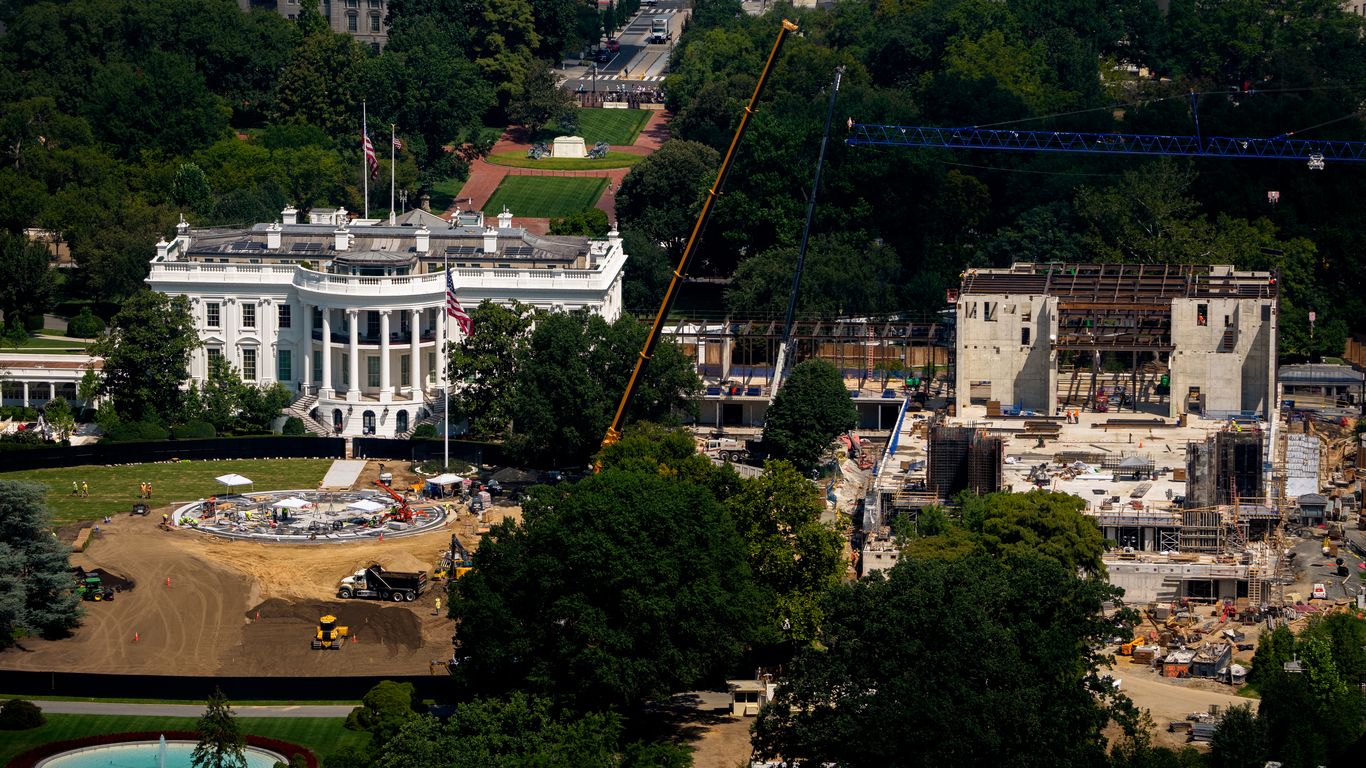
The Supreme Court on Monday permitted President Trump to proceed with plans to build the White House ballroom.
Why it matters: The 5-4 ruling is likely the final word on the project, which can now proceed with above-ground work after it was halted while the case played out in court.
Driving the news: The majority decision noted that the justices did "not pass upon the legality of the government's East Wing project."
- They concluded only that, based on the submissions before the court, "the government is likely to prevail" in showing that the National Trust for Historic Preservation "lacks standing" to challenge the project in federal court "and that the remaining stay factors favor relief."
- Chief Justice John Roberts and Justices Sonia Sotomayor, Elena Kagan and Ketanji Brown Jackson dissented.
What they're saying: In his dissenting opinion, Roberts wrote that construction was "likely unlawful."
- The court is allowing construction to proceed "not because that construction is legal," but because the Trust likely lacks standing, Roberts wrote.
- Representatives for the White House and the Trust did not immediately respond to Axios' request for comment.
Catch up quick: The decision follows an interim Supreme Court order earlier this month pausing a D.C. federal court's halt on all construction while the justices considered Trump's request to keep the project moving.
- A divided federal appeals court panel had blocked above-ground construction, upholding a U.S. District Court judge's ruling in favor of the Trust, which argued Trump needed congressional approval for the project.
Follow the money: The ballroom and its underground bunker are estimated to cost at least $600 million, up from the initial $400 million price tag when the administration announced its plans.
- Trump has said private donors would fund the ballroom, but his administration has asked Congress to use taxpayer dollars for security upgrades for it and other areas of the White House complex.
- About $352 million in taxpayer dollars was redirected to the project in June from money allocated through the One Big, Beautiful Bill.
Editor's note: This story has been updated with additional details throughout.