
For the first time, Mexico’s Supreme Court (SCJN) has opened a formal avenue for Indigenous peoples, communities, and Afro-Mexican communities to participate in constitutional disputes (known as controversias constitucionales) as interested third parties — a role that had previously been limited to only government bodies.
“Today is a historic day,” Chief Justice Hugo Aguilar Ortiz, who is of Mixtec Indigenous origin, said during the Tuesday ruling. “We are attending this appointment with history to see if we can correct in some way 200 years of exclusion and racism, and, among them, the judicial exclusion of Indigenous peoples and communities.”
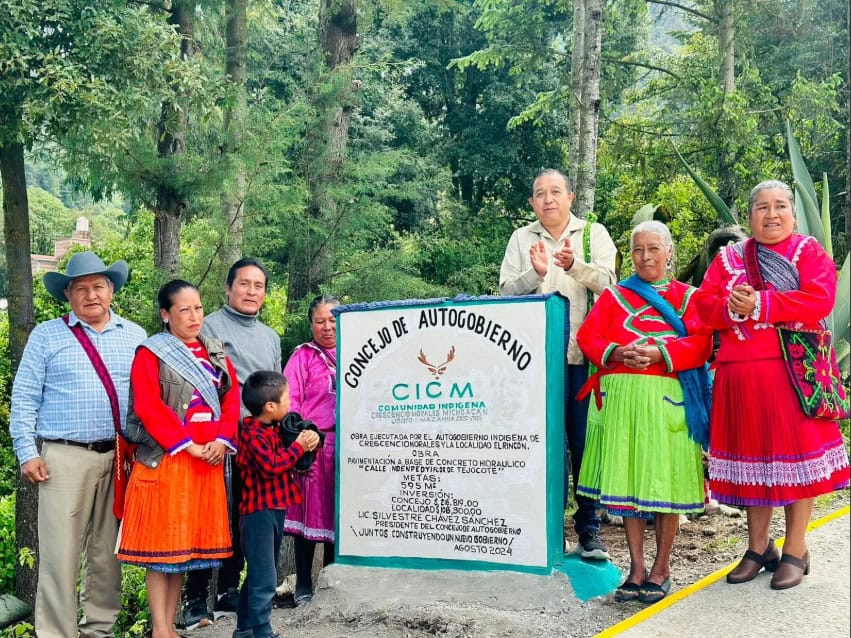
The case originated in the Indigenous community of Crescencio Morales, in Zitácuaro, Michoacán. The community sought to participate in a constitutional dispute filed by the Zitácuaro municipal government over control of the autonomous community’s budget. (Concejo Indígena fundador de Crescencio Morales / Facebook)With five votes in favor and four against, the SCJN recognized the participation of the Mazahua community of Crescencio Morales, in Zitácuaro, Michoacán, in two constitutional controversies brought by the municipal government, related to regulations and actions connected to a prior consultation on indigenous self-government.
In its ruling, the SCJN concluded that the Mazahua community “must be recognized as an interested third party, in order to remove obstacles to its effective access to justice and ensure its full participation in a process whose resolution may directly affect its collective rights and interests,” Minister Arístides Guerrero García said.
An interested third party is any person or entity that has a contrary interest to that of the complainant in an amparo trial or constitutional dispute. Even though they are neither the plaintiffs nor the defendants and thus can’t initiate the trial, they can join ongoing disputes as an interested third party when a ruling by the SCJN could affect their rights or interests.
Historically, only entities, powers or governing bodies were able to act as third parties in constitutional disputes.
That doesn’t mean that Iindigenous communities weren’t able to defend their rights. They could, through other means. What the new ruling established is the opportunity to join a constitutional controversy promoted by an authority, meaning they can consult the file, submit arguments, and defend their rights.
The court cited articles 2 and 17 of the Mexican Constitution as the basis for the new ruling.
Article 2, reformed in 2024, recognizes Indigenous and Afro-Mexican peoples and communities as subjects of public law, with their own legal personality and assets. Together with the right of access to justice under Article 17 of the Constitution, the SCJN ruled that those groups have a procedural voice if the outcome of the constitutional controversy affects their legal sphere.
Three ministers voted against the ruling, arguing that granting a recognition that is not explicitly provided for in the Constitution, “directly implies an overreach of powers” and amounts to legislating.
“This decision breaks the separation of powers,” Minister Espinosa Betanzo said.
Meanwhile, Minister Ríos González, who also voted against the ruling, added that the votes against the ruling do not imply a stance contrary to the rights of Indigenous peoples.
With reports from La Jornada
The post Supreme Court ruling lets Indigenous communities speak in constitutional trials for the first time appeared first on Mexico News Daily