
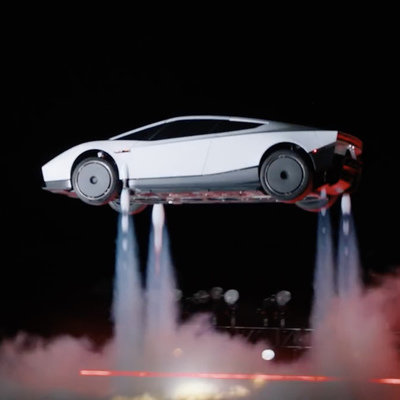
Last night in Texas, Tesla assembled group of fans, influencers and journalists to witness the unveiling of their new Roadster. "We need an audience to prove that it's not AI," Elon Musk said. "So you guys can tell people you saw it with your eyes, because what you see with your eyes, you will not believe."
Here was the first part of the demo:
This Roadster features a suction system that allows it to drive up the ramp. In real-world driving, Musk says, this will enable the vehicle to corner quickly at high speeds, because it can generate tremendous grip.
The second part of the demo:
As you can see, the car features freaking vertical and horizontal thrusters, and both Tesla and SpaceX's eggheads have figured out how to use them to precisely tune the car's orientation in flight, as well as dampen the landing. These are "the results of what happens when you have a collaboration with the world's best car company and the world's best rocket company," Musk said.
The third part of the demo:
To be clear, the car doesn't actually have combustion-powered rocket engines. Instead it's been fitted with compressed-air thrusters, which use onboard high-pressure air tanks feeding a series of nozzles that aim in different directions. "The car can recharge its air tank," Musk explained. "It's not like you need special propellant or anything like that."
The last part of the demonstration, which is paradoxically not that compelling to watch because it happens so quickly, is the car launching from 0-60 in less than one second.
It's worth noting that the demonstration was conducted without any humans in the car, "to make sure we don't kill anyone," Musk said.
Whether this could be called a flying car or not is arguable; it's not designed for sustained flight, and in function it's closer to a grasshopper than a butterfly. But it is still a jaw-dropping technical accomplishment.
Musk says the Roadster will go into production in 2028, with three planned configurations. A Performance version will feature the downward suction system. A Thrust version will add rear-facing compressed-air thrusters to provide acceleration. And the Rocket version will feature everything you saw in the demos, but it looks like those may be "invitation only" vehicles that won't be approved for public road use.
Here's the full presentation, if you want to see the demos with the sound: