
Texas spiders – an identification guide with photos to common (and not-so-common) spider species found in Texas.
IntroductionTexas is home to a wide variety of spiders, from conspicuous orbweavers in gardens and woodlands to hunting spiders found on walls, grass, and the ground.
On this page is a list of spider species found in Texas, forming a broad overview of the types of species found in the state. We have included representative species that readers are likely to notice or may want help identifying, including jumping spiders, wolf spiders, cobweb spiders, recluses, widows, lynx spiders, and tarantulas.
Because Texas has a large and diverse spider fauna, the species covered here do not form a complete state checklist, but rather an identification-focused selection of notable, widespread, or commonly encountered spiders.
This guide focuses on appearance, habitat, behavior, and natural history features useful for identification.
Texas Spiders List Venomous Spiders In TexasThe two spiders of greatest medical concern in Texas are:
- Brown Recluse (Loxosceles reclusa) – A venomous spider whose bite can sometimes cause skin damage and, rarely, more serious complications.
- Black Widow (Latrodectus spp.) – A group of venomous spiders whose bites can cause severe pain, muscle cramps, and other systemic symptoms.
Texas is also home to the Brown Widow, which is venomous but is generally considered less dangerous than the black widow.
You can find further information about these spiders in the list below.
While many other Texas spiders can bite if handled or threatened, they are not generally considered as medically significant as the species listed above.
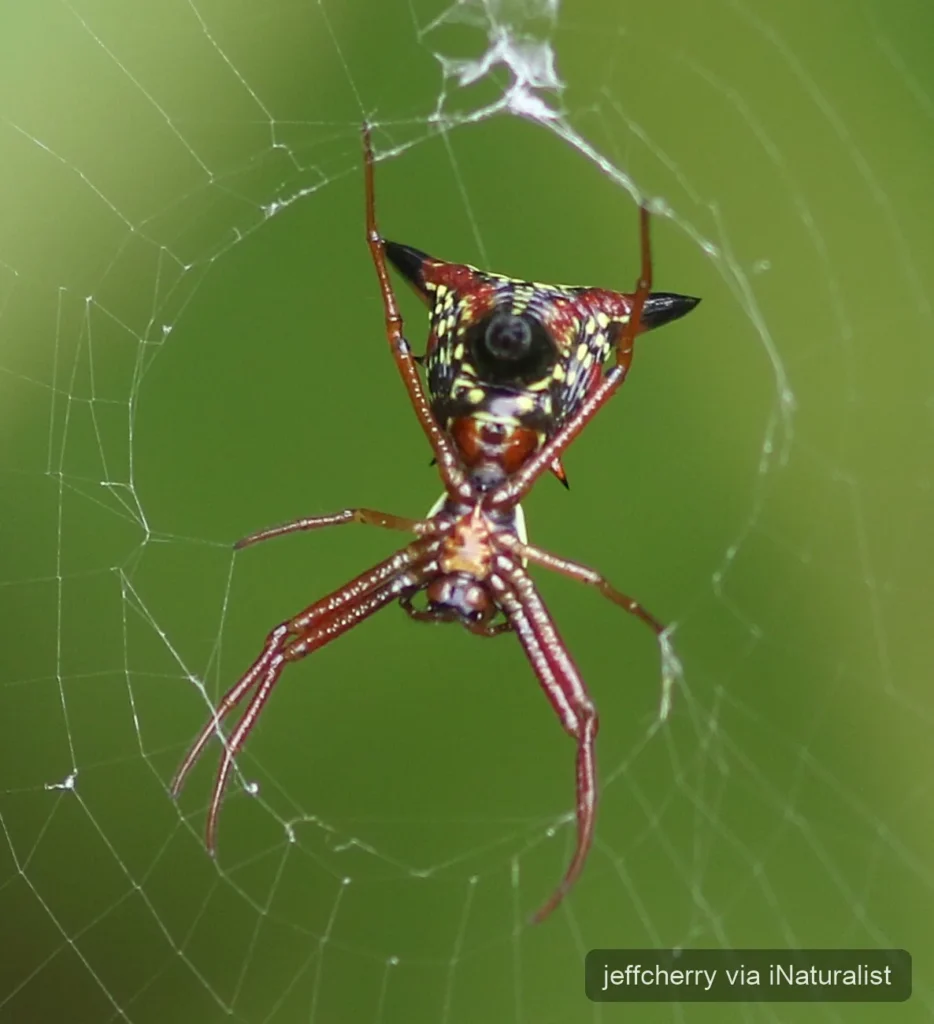
Arrow-Shaped Micrathena- Scientific name: Micrathena sagittata
- Family: Araneidae
- Rank: species
A bright yellow, arrowhead-shaped abdomen with dark margins is the best field mark of the arrow-shaped micrathena. Adult females have a hard, triangular abdomen with small black-tipped projections and reddish to dark legs. Females are about 0.25–0.35 in (6–9 mm) in body length; males are much smaller, about 0.16–0.20 in (4–5 mm), darker, and less conspicuously shaped.
In Texas, this orb-weaver is most often found in wooded areas, brushy edges, gardens near trees, and along shaded trails. Females sit in small vertical orb webs, often at about knee to chest height.
The bold arrowlike abdomen, compact spiny shape, and woodland web placement help separate this species from smoother-bodied orb-weavers.
An orb-weaver is a spider that spins a large, circular “orb” web to catch insects. Most orb weavers belong to the family Araneidae.
Page index
Banded Garden Spider- Scientific name: Argiope trifasciata
- Family: Araneidae
- Rank: species
Females are large, long-legged orb-weavers with an oval abdomen, about 0.6–1 in (15–25 mm) in body length. Males are much smaller, about 0.16–0.24 in (4–6 mm), slender, and less colorful. The female has a silvery carapace, banded legs, and many narrow black, yellow, white, and silver crossbands across the abdomen.
In Texas, the banded garden spider is common in sunny gardens, fields, roadsides, prairie edges, and weedy lots, especially from late summer into fall. It builds a large vertical orb web among grasses, shrubs, or garden plants, often with a white zigzag silk band in the center. The evenly striped abdomen and open, sunny web sites help separate it from the yellow garden spider.
Page index
Bold Jumping Spider- Scientific name: Phidippus audax
- Family: Salticidae
- Rank: complex
A stocky black silhouette with bright white abdominal spots is typical of the bold jumping spider. Adults are about 0.25–0.75 in (6–19 mm) in body length, with females usually larger and heavier-bodied than males. The abdomen often shows one large pale central spot and two smaller rear spots; juveniles may have orange spots. The metallic green or blue chelicerae are a strong close-up clue.
In Texas, this active daytime hunter is common on house walls, fences, tree trunks, garden plants, fields, and sunny edges. It does not use an orb web, but stalks prey with short jumps.
The species’ compact body, high front-facing eyes, pale abdominal spots, and iridescent mouthparts help separate it from many other black jumping spiders.
Page index
Brown Recluse- Scientific name: Loxosceles reclusa
- Family: Sicariidae
- Rank: species
In Texas, the brown recluse is most often encountered indoors in undisturbed, cluttered places such as closets, garages, attics, sheds, boxes, stored clothing, and behind furniture. Outdoors, it may shelter under bark, rocks, logs, or debris, especially in dry protected sites.
The Brown Recluse is known for its venomous bite, which can sometimes cause skin damage and other medical symptoms.
Adults are about 0.25–0.5 in (6–13 mm) in body length, with long slender legs and a plain tan to medium brown body. Key identification clues include a dark violin-shaped mark on the top of the cephalothorax, with the “neck” pointing toward the abdomen, and six eyes arranged in three pairs. The legs are unbanded, the abdomen is plain, and the body lacks bold spots or stripes. Its web is an irregular retreat rather than an open orb web.
Page index
Brown Widow- Scientific name: Latrodectus geometricus
- Family: Theridiidae
- Rank: species
An orange to yellow-orange hourglass on the underside of the abdomen is a key clue for the brown widow. Females are mottled tan, gray, and brown above, often with a geometric pattern, banded legs, and a rounded abdomen. Adult females are about 0.25–0.5 in (6–13 mm) in body length; males are smaller and slimmer, about 0.12–0.25 in (3–6 mm).
In Texas, this spider is often found around buildings, patio furniture, garages, eaves, fences, mailboxes, playground equipment, and shrubs. It makes an irregular tangled web in sheltered corners. The spiky, cream-colored egg sacs, covered with pointed projections, are one of the best identification signs and help separate it from black widows, which have smoother egg sacs.
The Brown Widow is venomous and can deliver a painful bite, but it is generally considered less dangerous to humans than the black widow.
Page index
Carolina Wolf Spider- Scientific name: Hogna carolinensis
- Family: Lycosidae
- Rank: species
The carolina wolf spider is a very large, robust ground spider with long, strong legs. Adult females are about 0.9–1.4 in (22–35 mm) in body length, while males are usually smaller and slimmer, about 0.7–1 in (18–25 mm).
This species is mottled gray, brown, and tan, with a broad pale stripe down the carapace and darker markings along the abdomen. Its low, running posture, large size, and reflective eyeshine at night help separate it from many other spiders. It does not build an orb web.
In Texas, the carolina wolf spider is often found in open ground, lawns, fields, prairies, sandy areas, and around burrows. Females may be seen carrying a round egg sac attached behind them or spiderlings on their back.
Page index
Common House Spider- Scientific name: Parasteatoda tepidariorum
- Family: Theridiidae
- Rank: species
A mottled tan to brown, rounded abdomen gives the common house spider its typical cobweb-spider shape. Females are about 0.2–0.25 in (5–6 mm) in body length, with slender, often banded legs and variable pale, dark, and gray markings. Males are smaller and slimmer, about 0.12–0.18 in (3–4.5 mm), with longer-looking legs.
In Texas, this species is common in homes, garages, sheds, barns, window frames, porch corners, eaves, and other sheltered places. It makes an irregular, messy tangle web rather than a neat orb web. Identification clues include the small size, rounded mottled abdomen, banded legs, and papery tan egg sacs kept in the web. It lacks the shiny black body and red hourglass of widow spiders.
Page index
Dark Fishing Spider- Scientific name: Dolomedes tenebrosus
- Family: Pisauridae
- Rank: species
In Texas, the dark fishing spider is usually encountered on tree trunks, fences, exterior walls, sheds, wooded edges, and rocky areas, sometimes near streams or ponds but often away from water. It is a large wandering spider that hunts without an orb web and may rest flattened against bark or walls.
Females are about 0.6–1 in (15–26 mm) in body length, with a leg span that may reach about 3 in (75 mm). Males are smaller and slimmer. The body is mottled gray, brown, and tan, with banded legs, a pale-edged carapace, and dark W-shaped or chevron markings on the abdomen.
Identification clues include its large size, flattened resting posture, long legs, camouflaged barklike pattern, and habit of running quickly when disturbed.
Page index
Grass Spider / Dark-Legged Grass Spider- Scientific name: Agelenopsis naevia
- Family: Agelenidae
- Rank: species
Long, fingerlike spinnerets projecting from the rear of the abdomen are a key clue for identifying this grass spider. Adults are slender, fast-running funnel weavers, usually about 0.35–0.75 in (9–19 mm) in body length. The body is tan, gray, or brown, with two dark lengthwise stripes on the carapace and a darker abdomen marked with pale chevrons or a herringbone pattern. Legs are long and often faintly banded.
In Texas, grass spiders are common in lawns, fields, low shrubs, groundcover, fence lines, porch edges, and around outbuildings. They make flat sheet webs with a funnel-shaped retreat, often visible with dew. Identification is helped by the web, long spinnerets, striped body, and lack of the stout build typical of wolf spiders.
Page index
Green Lynx Spider- Scientific name: Peucetia viridans
- Family: Oxyopidae
- Rank: species
Females are about 0.5–0.9 in (12–22 mm) in body length, with a slender, high-legged shape; males are smaller and slimmer, about 0.4–0.5 in (10–12 mm). The green lynx spider is usually bright leaf green, with long legs covered in conspicuous black spines. The abdomen is tapered and may show pale, red, or reddish-orange spots or markings, especially along the sides.
In Texas, this spider is often found on wildflowers, shrubs, tall weeds, garden plants, and crops, where it hunts by sight rather than using a prey-catching web. Identification clues include the vivid green color, spiny legs, agile jumping movement, and habit of sitting exposed on vegetation. Females may be seen guarding a round egg sac among leaves or flower heads.
Page index
Hentz Orbweaver / Spotted Orbweaver / Barn Spider- Scientific name: Neoscona crucifera
- Family: Araneidae
- Rank: species
Brown, rusty orange, gray, or tan coloring with a rounded, patterned abdomen is typical of the hentz orbweaver. Females are usually about 0.35–0.8 in (9–20 mm) in body length; males are smaller, about 0.2–0.5 in (5–13 mm). The abdomen often shows a pale cross-like or leaf-shaped pattern, though markings vary. Legs are hairy, spiny, and commonly banded.
In Texas, this orbweaver is often found in yards, gardens, woodland edges, porches, barns, and around lights where flying insects gather. It builds a vertical circular web, usually at dusk or night, and may hide in a nearby retreat during the day. Identification clues include the large nocturnal orb web, variable brownish coloration, banded legs, and rounded abdomen with pale dorsal markings.
Page index
Hogna Antelucana- Scientific name: Hogna antelucana
- Rank: species
On open ground in Texas, this wolf spider is most likely encountered at night in grassland, fields, sandy areas, woodland edges, or yards, often running over soil or hiding under stones, boards, and leaf litter. It does not make a prey-catching web.
Adults are medium to large, robust, hairy brown spiders, roughly about 0.4–0.8 in (10–20 mm) in body length. The carapace usually has pale lengthwise bands, and the abdomen is mottled brown to gray with darker chevrons or a central mark. Legs are long, spiny, and often faintly banded.
Identification clues include the large forward-facing eyeshine of a wolf spider, ground-running habits, and bulky build. Separation from similar Hogna species is difficult and may require close examination of adult reproductive structures.
Page index
Mabel Orchard Orbweaver- Scientific name: Leucauge argyrobapta
- Family: Tetragnathidae
- Rank: species
A shiny silver-white, oval abdomen with dark lengthwise lines is the best visible clue for the mabel orchard orbweaver. The sides often show green, yellow, orange, or reddish markings, and the long slender legs are greenish to yellow with dark joints. Females are about 0.20–0.30 in (5–8 mm) in body length; males are smaller and slimmer, about 0.14–0.18 in (3.5–4.5 mm).
In Texas, this small orbweaver is likely found in shaded gardens, shrubs, woodland edges, orchards, and moist areas near vegetation. It builds a small, usually horizontal or angled orb web and often hangs beneath it. Identification is aided by the metallic silver abdomen, delicate greenish legs, low vegetation web, and bright side markings. Similar orchard orbweavers may require close examination to separate.
Page index
Rabid Wolf Spider- Scientific name: Rabidosa rabida
- Family: Lycosidae
- Rank: species
About 0.5–1 in (13–25 mm) in body length, the rabid wolf spider is a long-legged, fast-running wolf spider with a low, hairy body. It is usually yellowish brown to tan, with two dark lengthwise stripes on the carapace and a darker central stripe or series of marks on the abdomen. The legs are long, spiny, and lightly banded.
In Texas, it is often found in grass, fields, pastures, gardens, yards, and woodland edges, especially at night. It hunts on the ground and does not use a prey-catching web. Identification clues include its paired dark carapace stripes, pale central banding, strong eyeshine under a flashlight, and active running behavior. Mature males are slimmer and may have darker front legs.
Page index
Silver Longjawed Orbweaver- Scientific name: Tetragnatha laboriosa
- Family: Tetragnathidae
- Rank: species
Silvery, narrow, and sticklike, the silver longjawed orbweaver has an elongated abdomen, very long legs, and projecting jaws. The abdomen is usually bright silver to pale gold with a dark lengthwise mark or stripe, while the carapace and legs are yellowish brown to tan. Females are about 0.24–0.35 in (6–9 mm) in body length; males are slimmer, about 0.20–0.28 in (5–7 mm), and often have especially noticeable jaws.
In Texas, this spider is common in grasses, shrubs, gardens, fields, woodland edges, and moist areas, often near water but not limited to it. It builds a delicate orb web, often angled or nearly horizontal. Identification clues include the metallic abdomen, long forward-projecting jaws, and habit of resting stretched lengthwise along stems or web lines.
Page index
Southern Black Widow- Scientific name: Latrodectus mactans
- Family: Theridiidae
- Rank: species
In Texas, the southern black widow is most often encountered in dark, sheltered places such as garages, sheds, crawl spaces, woodpiles, meter boxes, rock piles, and outdoor clutter. It builds an irregular, tangled web close to the ground or in protected corners.
The adult female is glossy black with a round, swollen abdomen and a red to orange hourglass mark on the underside. Females are about 0.3–0.5 in (8–13 mm) in body length, not including the legs. Some may have small red marks on the upper abdomen.
Males are much smaller, about 0.1–0.2 in (3–6 mm), slimmer, and often patterned with pale or reddish markings. Identification clues include the shiny black female, rounded abdomen, underside hourglass, and messy retreat web.
Page index
Southern House Spider- Scientific name: Kukulcania hibernalis
- Family: Filistatidae
- Rank: species
A flat, lace-like sheet web spreading from a wall crack, window frame, or crevice is often the best clue to a southern house spider. Females are dark brown to nearly black, with a velvety body, long sturdy legs, and an oval abdomen. Adult females are about 0.5–0.75 in (13–19 mm) in body length.
Males are slimmer, tan to brown, and longer-legged, about 0.35–0.5 in (9–12 mm) in body length. They are often seen wandering indoors and may be confused with brown recluses, but they lack a clear violin mark and have a different, more elongated build. In Texas, this spider is common around houses, garages, sheds, barns, fences, and tree holes, where it stays in cracks with its web.
Page index
Spinybacked Orbweaver- Scientific name: Gasteracantha cancriformis
- Family: Araneidae
- Rank: species
About 0.2–0.35 in (5–9 mm) in body length, the female spinybacked orbweaver is a small, flattened, crablike spider with a broad, hard abdomen often about 0.4–0.5 in (10–13 mm) wide across the spines. The abdomen is usually white, yellow, or orange, with black spots and six short, pointed spines along the edge. Spines may be red or black.
In Texas, this spider is often found in gardens, shrubs, woodland edges, and around houses, where it builds a circular orb web between twigs, branches, or outdoor structures. It often hangs in the web with the bright abdomen facing outward. Males are much smaller, about 0.08–0.12 in (2–3 mm), darker, and far less conspicuous.
Page index
Strip