
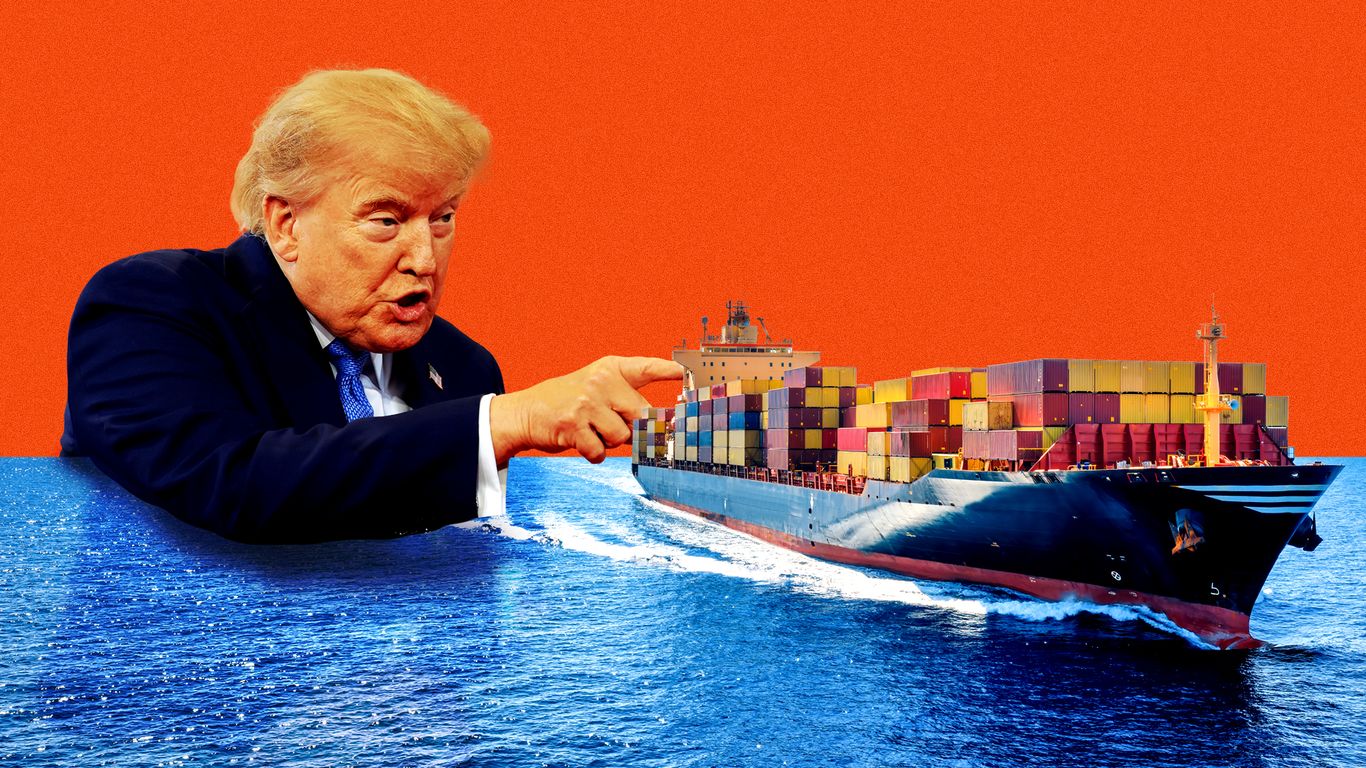
The Strait of Hormuz has been Iran's most powerful card since the start of the war in late February. But over the past two months, U.S. officials say the American military has steadily eroded Iran's leverage over the crucial waterway.
Why it matters: What began six months ago with the goal of degrading Iran's missile capabilities and destroying what remained of its nuclear program has evolved into an open-ended fight over the world's most important energy chokepoint.
- U.S. officials say they've turned the tide in the strait and believe it could be a watershed moment in the war that brings not only gradual relief to the world economy, but also a better deal with Iran.
- "That sucker is open. The Iranian response is very mild. They don't want us to go back at them. That's the whole ball game. The rest doesn't matter," President Trump told Axios in a phone interview on Thursday.
Flashback: When the war began, the Strait of Hormuz was open, oil was flowing without interruption to global energy markets and Brent crude oil was trading at about $72 a barrel.
Behind the scenes: Two Israeli officials say the move to close the Strait of Hormuz was initiated by then-commander of the Islamic Revolutionary Guard Corps Navy, General Alireza Tangsiri.
- In the first 72 hours of the war, Iran announced it was closing the strait and warned it would attack tankers that tried to transit.
- But behind the scenes, Tangsiri gave an order that dramatically escalated the situation: to deploy naval mines in the Traffic Separation Scheme (TSS), the main international shipping lane through the strait, Israeli and U.S. officials say.
- Tangsiri was killed three weeks later in an Israeli airstrike in Bandar Abbas, Iran.
Driving the news: Iranian attacks on ships and the threat of mines brought commercial shipping to a standstill.
- In the next two months, Brent crude skyrocketed to as high as $126 a barrel.
- Trump agreed to a ceasefire on April 8 partly in response to rising gas prices in the U.S. and pressure on energy markets — precisely the economic pain Iran wanted to inflict.
- The reopening of the strait was the linchpin of the U.S.-Iran memorandum of understanding (MOU) signed two months later.
- But the strait never fully opened and the deal soon collapsed.
Zoom in: After the MOU fell apart, the military worked to reopen the strait unilaterally. The effort included several elements:
- Together with the United Arab Emirates, a U.S. military task force started guiding ships through the southern channel of the strait while giving them air cover and intercepting Iranian drone and cruise missile attacks.
- A two-week U.S. bombing campaign significantly undercut the IRGC's capacity to attack ships crossing the strait.
- A mine-sweeping operation involved Navy divers, Navy SEALs, underwater and surface drones, and private contractors to detect and neutralize the mines.
- A blockade of Iranian ports was restored.
Zoom out: While the number of ships that cross the strait — and the amount of oil exported from it — remain well below pre-war levels, the reality on the ground has improved. Iran has lost much of its control over the strait and the U.S. military is effectively controlling most of it, U.S. officials said.
- Iran is still firing at ships but its ability to target them accurately is limited. Only 2% of the ships that transited through the strait over the last month were hit, a U.S. official said.
- More than 200 mine-like objects have been swept from the main lane of the strait. U.S. officials say only 11 of them were actual mines and just a few were properly deployed.
- In recent weeks, traffic through the southern channel has grown to 20 to 30 tankers every night, carrying an average of 9 to 10 million barrels, per U.S. officials. That's roughly half the pre-war volume.
- "We achieved a major milestone in the Strait of Hormuz. Internationally recognized sea routes in the strait are free of Iranian sea mines. Bottom line: Today international shipping lanes are open and momentum is building," CENTCOM commander Adm. Brad Cooper said in a video posted Thursday night.
Yes, but: Oil experts and tanker trackers are skeptical that the actual figures are that high. U.S. officials say they're undercounting.
- Periodic reports of oil tankers being struck by projectiles also raise questions about the safety of commercial shipping through the strait, despite U.S. assurances.
The big picture: The U.S. oil export operation shows signs of momentum. The UAE, Bahrain and Kuwait have already joined, and Saudi Arabia is also expected to. U.S. officials hope Qatar will soon start sending liquefied natural gas tankers through the U.S.-protected route.
- By mid-September, the U.S. hopes to widen the main channel of the strait so that at least 50 ships can transit in and out of the Gulf every night.
- The goal is to reach 60 to 70 percent of pre-war oil exports.
State of play: Two regional sources told Axios that in recent days Iran has shown renewed interest in negotiations.
- The commander of the Pakistani army visited Tehran on Sunday to try to revive the mediation between the U.S. and Iran.
- He was followed later in the week by the foreign minister of Oman, who came to Tehran to discuss the Strait of Hormuz.
- On Thursday, the prime minister of Qatar — a key mediator between Iran and the U.S. — arrived for talks in Tehran at Iran's request, the regional sources said.
- At least in public, Iran has stuck to the same positions, demanding that the U.S. implement the MOU and offer terms for reopening the strait.
The other side: At the moment, President Trump says he isn't interested in negotiating with Iran.
"I don't want to meet, they do. In fact, they are begging to make a deal," Trump wrote on Truth Social Thursday.
- But White House envoy Steve Witkoff is still talking to the Qataris and to other mediators.
- U.S. negotiators want to see if the U.S. blockade, economic pressure campaign and growing leverage in the strait will make Iran soften its positions.
- U.S. officials believe shifting conditions in the strait give the Trump administration a stronger hand in any future negotiations with Iran.
- They see the June 17 MOU, which focused partly on Hormuz, as no longer relevant. And they're treating negotiations between Oman and Iran on new arrangements for managing the strait as background noise.