
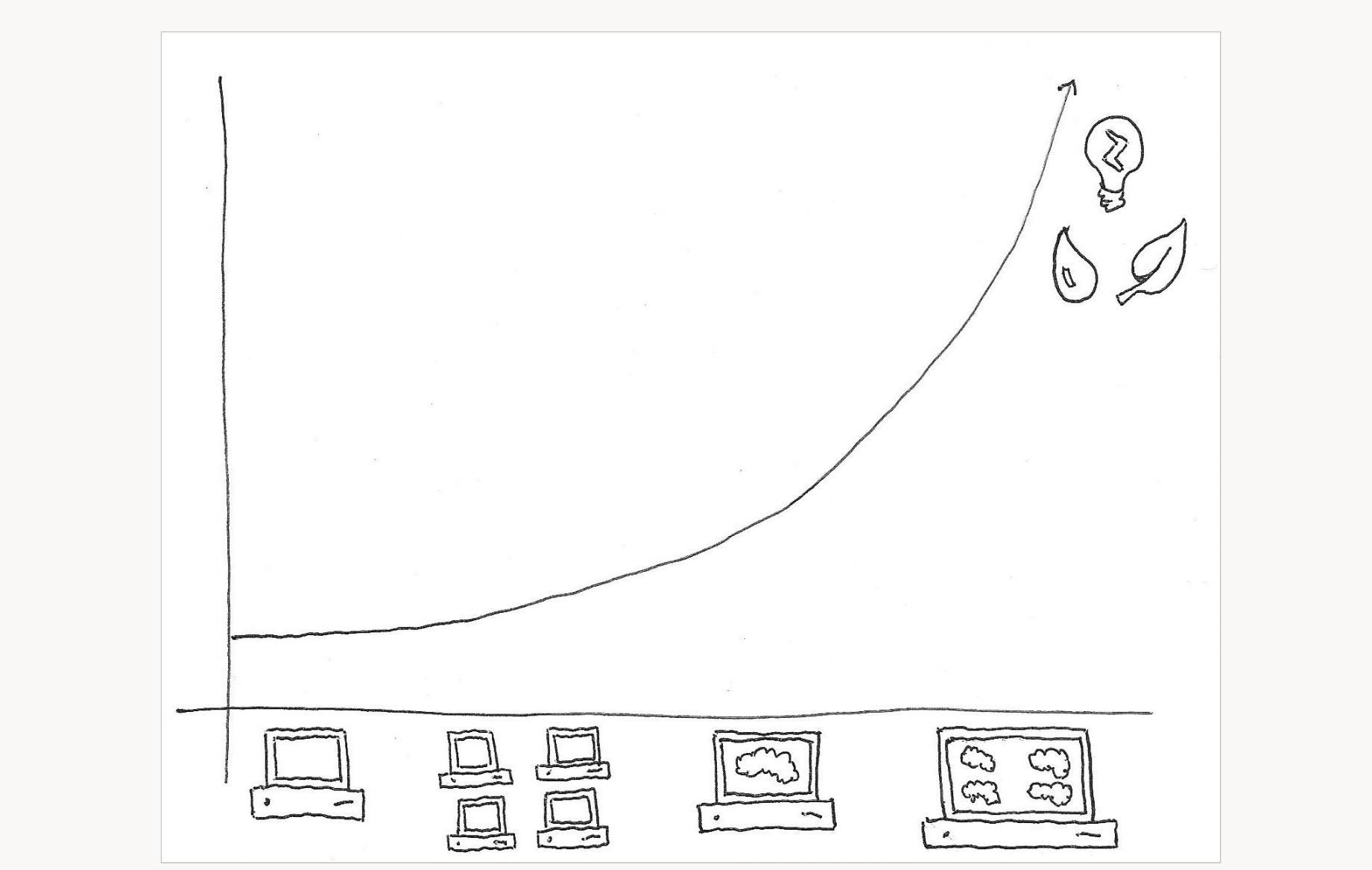
As computing use grows, so does its environmental footprint. While hardware and software have become significantly more efficient, AI demand is growing even faster, outpacing those efficiency gains and increasing the overall environmental impact of computing. What’s more, measurement standards are still playing catch up, making it difficult for companies to measure and reduce their environmental impact. We’ve grappled with this challenge for years (starting with cloud computing and now AI), and we know we’re not alone.
Environmental impact has been growing exponentially as computational power has grown in complexity.At Etsy, we believe taking responsibility for the environmental impact of powering our marketplace is part of keeping commerce human. Our approach to sustainable engineering has evolved as the world and our industry has changed, but our commitment has remained the same. Rapid AI development and adoption is the latest (and perhaps most consequential) industry shift, so we are rising to this new challenge.
In this article we'll discuss how we've managed the environmental impact of our computing in the past, how we've begun to approach it in this new world of AI, and how we think other companies can join us.
For more on our full Impact & Sustainability work see our 2025 Integrated Report.
Disclaimer and legend
No generative AI was involved in the making of this article: the images were hand-drawn by Emily Sommer, and the text was arduously written by Emily Sommer and Sam Brundrett. We both leverage AI frequently in our work, but this article warranted a different type of rigor and craftsmanship, so we decided to take a more manual approach.
The scope of this article is limited to Etsy employees’ compute and AI usage and does not include application of AI outside of internal tools, such as Etsy sellers' use of AI outside of Etsy-provided tools.
Despite looking so, the computers are not sad – just working hard. Where we've been: transition to the cloud We set a 2025 goal to improve our compute energy efficiency (kWh per site visit) by 25%.In 2015, Etsy formed an internal working group to address the environmental footprint of running Etsy's website and related systems. At the time, our servers were running in several co-located data centers, so we had a strong sense of how much energy our servers were using because we were billed for it directly. We were seeing meaningful increases in our energy use as we expanded our big data processing platform, so we set a goal to help improve our efficiency. We committed to improving our kWh per Etsy site visit (session) by 25% by 2025 – and we did!
In 2018, we began moving our compute workloads out of our co-located data centers and onto Google Cloud Platform (GCP). From a sustainability perspective, moving to GCP was a big win for several reasons:
- Google's data centers operate much more efficiently (as measured by Power Usage Effectiveness (PUE)) than colocated datacenters. The scale at which they operate enables them to invest in optimizing custom machines, racks, power distribution, sensors, etc.
- Google matched 100% of its energy consumption with renewable energy.
- In aggregate, overall server idle time is lower for cloud platform customers than colocated data center customers, because cloud providers often run customer workloads on shared platforms and are able to schedule virtual resources to optimize for efficiency. However, at the time, Google didn’t provide customers with data about how much energy their servers were using, meaning we were rapidly losing the ability to measure ourselves against our goal.
Without compute energy use data, we worked with what we had: billed usage data by machine type. We used public data about the energy efficiency of typical large-scale servers as well as industry research about the energy efficiency of hard drives. From these, we developed a set of coefficients for estimating the energy consumption of compute and storage use. We called it Cloud Jewels, a play on cloud computing, the joule, and crown jewels.
We published this work and collaborated with Thoughtworks, a technology consultancy, which used Cloud Jewels in the early development of their Cloud Carbon Footprint. We also heard from several companies that Cloud Jewels had inspired them to take action!
Cloud Jewels opened the door to meaningful measurement and efficiency wins:
- We worked with our auditors to review the approach, and we used it to report on our energy use and progress towards our 2025 goal in filings.
- By estimating the energy used by our cloud services, we were able to apply renewable energy certificates (RECs) from our long-term solar agreement to that energy use, reducing our market-based cloud emissions.
- We used Cloud Jewels to estimate the impact of a few significant efficiency projects like snoozing developer virtual machines (VMs) at night (Cloud Snooze). But Cloud Jewels had practical limitations. We explored tying data into our experimentation platform, but it proved challenging: it was hard to communicate what our partial data represented and what it omitted.
Cloud Jewels worked well as we migrated onto GCP: for the first few years, a lot of our workloads ran directly on cloud VMs and storage. However, as we adopted more managed services (like BigQuery and Dataflow), Cloud Jewels became less and less applicable – we had no way to apply concepts like "BigQuery slots" to server wattage coefficients. The proportion of our total energy that we were able to measure was declining.
In part thanks to our influence, in 2021, Google launched the first iteration of its Carbon Footprint tool, providing customers with energy and carbon emissions data associated with their GCP use. This was incredible. They were first in the industry to release granular customer environmental data! This tool provides customers with location-based (LB) and market-based (MB) Greenhouse Gas (GHG) emissions, broken down by scope, aggregated by month, service, project, and region. The tool has a few shortcomings that limit its actionability: data is not broken down by day or SKU, and lag time can be up to 45 days. Still, its release has been a game-changer for Etsy’s emissions measurement, and this year (2026), Google added energy and emissions data from AI model inference -- another industry-leading feature we’re excited to leverage!
But challenges persist. As our adoption of AI has expanded beyond Google products, we’re working with fewer insights: many suppliers don’t provide energy or emissions data, and there’s no standard approach to accurately estimate this impact. We find ourselves in a familiar bind!
We're focused on what we CAN do We're tackling environmental responsibility up the supply chain, internally within our services, and outward amongst our peers.This is an unprecedented age, and AI is an extraordinary tool. We're leaning into adoption and exploration: how can these tools support our buyers and sellers and unlock internal productivity? As we grow our use of AI, we're developing a sustainability strategy in real time, without all the answers or decisions in place. To do so, we're observing our adoption and considering:
- How are we currently leveraging AI? (In flux!)
- What data is available for measuring AI's environmental impact? (Not much.)
- What are others in the industry doing about their footprint? (Also stumped.)
- What options exist for influencing environmental impact closer to the source? (Some!)
Instead of being paralyzed by all that we don't know, we're using it as a call to action: how can we mobilize ourselves and the industry to learn more about measuring and managing the environmental impact of AI? To tackle this, we developed a new sustainable engineering strategy centered around three levers: Catalyze the industry, Influence the supply chain, and Optimize our internal resource use.
You can read more about our work to activate on the first two levers and how it fits into Etsy’s larger sustainability efforts in this post on the Etsy News Blog. Below, we dive into the third lever: the ways we’re driving more sustainable AI use inside Etsy.
Optimizing our internal resource useWe're approaching resource optimization from three directions: engaging our engineers, educating all employees, and holding ourselves accountable for our use.
Engage our engineers Educate all employees Hold ourselves accountable Sustainable Engineering Council Effective AI use Efficiency target where we have reliable data Amplifying existing tooling Environmental (and monetary) resource efficiency Impact accounting per model and tokenEngaging our engineers
Etsy’s values are deeply embedded in our culture: many Etsy engineers care about the environmental impact of AI and computing and proactively look to participate in efficiency initiatives. The challenge is in harnessing that interest into actionable initiatives. Our efforts currently underway include:
Sustainable Engineering Council
We've formed a new internal group with rotating members from across Engineering who have a mix of expertise, including both product and platform teams. We're working with this group to identify and act on opportunities for enhanced tooling and data to better inform decision making around cloud and AI use.
Amplifying existing tooling
We’re improving how teams across Etsy discover, evaluate, and adopt tools that can increase efficiency and reduce environmental impact. For example:
- We're exploring the effectiveness (e.g., performance improvement and energy reduction) of tools that automatically direct a user's prompts to appropriately-sized models based on keyword matching.
- We're enhancing the granularity of Google's Carbon Footprint data with regression modeling and surfacing the estimated data alongside teams' cost data.
- We're designing accessible tooling to guide all employees in choosing the most appropriate AI and workflow tools for their tasks.
Educate all employees
AI has lowered the barrier to entry for automating work and coding. From a sustainability perspective, this expansion means guidance about resource use must be accessible and applicable to a broad audience of varying technical expertise. To that end, we've developed internal guidance to address effective AI use and resource efficiency – both of which relate to sustainability.
Effective AI use
We have many AI tools available to us, many engineering tools that can amplify AI's utility, and a wide array of options for models, reasoning effort, and speed. It's hard to know what to use for what, and decisions about models and tools can have a large impact on resource use. Our guidance seeks to assist employees who lack engineering experience make decisions that minimize engineering concerns – such as safety, maintenance, and reliability – while encouraging engineers to right-size models and tools for the task at hand. It contains several sections:
- Guidance on selecting an appropriate model and reasoning effort for the task at hand, including a matrix of model tier and reasoning effort combinations with example tasks with the aim of directing users to the lightest-weight model and effort applicable to their task.
- A decision tree that maps example categories of tasks to appropriate AI tools, optimizing for the lightest weight tool and recommending products with the most impact transparency and commitment to renewable energy.
- Tooling that recommends the most effective engineering options for a given objective. This is important because engineers, non-engineers, and especially agents are often unfamiliar with the basic workflow automation tooling that we already have available, thus agents often generate needlessly complex solutions.
Resource efficiency
Our recommendations for using AI efficiently aim to be specific enough to be useful and generic enough to be broadly applicable. We organized the guidance around two audiences: individuals using AI in the workplace including coding tools (many) and employees building products powered by AI (some engineers).
We've published an external version of our guidance in the sustainable-ai-guide GitHub repo in the hopes that it’s useful to other teams navigating this journey.
Hold ourselves accountable for AI use
Incomplete data is better than no data! We want to hold ourselves accountable for our environmental impact and be able to measure and validate our successful optimizations – even if we know we're missing some information. So we're setting a carbon efficiency target using the data that we have, noting that it will (hopefully) need to change as we expand our coverage. And to that end, we're partnering with industry experts to develop a more comprehensive AI impact measurement methodology.
Efficiency target where we have reliable data
GCP provides us with reliable emissions data covering the vast majority of our cloud and storage use and some of our AI applications via Gemini. For these compute resources, we’ve set an efficiency target: keep our GCP emissions intensity flat through 2027, with intensity defined as metric tonnes of LB (location-based) emissions per $M in sales. We use LB emissions as a way to track real-world pollution that more clearly reflects our decision making, such as machine and region selection. This goal is intentionally set for a short timeline: technology and our usage patterns are changing quickly, making it difficult to reliably predict beyond 2027. As the landscape and research evolves, we'll continue to adapt our approach.
Impact accounting per model and token
Our goal is to account for all of our energy and emissions impact across compute and AI vendors at a level of granularity that our teams can action on. Until all vendors provide this, we need a way to more accurately estimate our AI emissions. To address this, we’ve partnered with Sustainable AI Group to expand, refine, and pilot an open-source methodology for estimating energy and emissions per LLM token, using Etsy as the initial test case. The SAIG emissions coefficients are mapped to our internal AI usage data to surface emissions alongside token usage and costs – at the model level. This means employees can see the estimated environmental impact of using different models across providers and make informed decisions about when the complexity of a task they're tackling is worth a specific increase in carbon emissions!
We're thrilled to be collaborating on this groundbreaking methodology and to have the opportunity to shape its future through our partnership with SAIG. We hope to inspire other companies to adopt this approach and thereby urge AI providers into disclosing more granular impact data.
In parting and partnershipWe aspire to remain optimistic and action-oriented in a time of uncertainty. In line with Etsy's mission to keep commerce human, we're leaning into creativity and problem solving to conscientiously embrace AI and take responsibility for our adoption of it. We seek to be transparent in our work and would love to partner with other companies and individuals.
Join us!We're actively seeking collaborators, both formal and informal! We invite you to:
- Partner with us to test and adopt a standard AI emissions approach
- Share insight on sustainable software engineering practices and AI deployment
Reach out to us at sustainability@etsy.com.
Forward-Looking Statements: This post contains forward-looking statements about our sustainability strategy, goals, targets and planned initiatives. These statements are based on current expectations and assumptions and are subject to risks and uncertainties.