
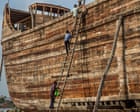
It takes three years for shipbuilders in the 16th-century port of Mandvi to complete a commission, in a trade that is as cultural as it is technical
In the 16th century, the port city of Mandvi on India’s west coast was founded by the rulers of the kingdom of Kutch, and quickly established itself as one of the most dynamic ports in the western Indian Ocean. Its strategic geographical position, along the estuary of the Rukmavati River, which flows into the Arabian Sea in the Gulf of Kutch, and mastery of monsoon wind navigation enabled it to become part of vast maritime networks connecting India to the Gulf, the Arabian peninsula and east Africa.
Mandvi prospered through trade, exporting cotton textiles, indigo, cereals and handicrafts, while importing dates, pearls, Arabian horses and luxury goods.
A stemson, a piece of supporting timber in the bow of a boat, is carved from teak in a Mandvi shipyard under supervision by the master shipwright, or mistri, who designs boats without written plans. All photographs: Frédéric Noy
Continue reading...