
There is little doubt that the establishment of agriculture and the domestication of wheat production in Mesopotamia between 12,000 and 14,000 years ago represented one of the most significant shifts in human history. However, wheat’s American analog receives substantially less attention. Nearly 8000 years ago corn was domesticated in North America in Mexico. The Native Americans who domesticated corn established multiple different breeds and hybrids which spread throughout the entirety of North America and South America as a staple crop which provided substantial nutrition. Corn was ground into cornmeal with the simple tools of a mortar and pestle which provided the capability to create breads which were easier to store, preserve, and absorb nutrients.
With the introduction of European and African food and cultural customs, cornbread as a food of North America experienced significant changes and adaptations. This article does not seek to provide an exhaustive history of the history of corn and its cultural significance. However, this article does seek to display the significant adaptations and changes cornbread has gone through as a dynamic and important centerpiece of life in North America. Through its origins as a staple of Native American diets to its introduction into Euro-American, and African American cuisine, the recipes for cornbread experienced significant changes due to the unique and dynamic nature of the Columbian Exchange. The Columbian Exchange refers to Alfred Crosby’s revolutionary thesis in arguing that the most consequential aspects of contact between the old world and new world were not social or cultural but biological in nature with the massive interchange of disease, plants, and animals primarily between the Americas, Europe, and Africa.[i]Additionally, cornbread experienced changes in recipes due to the collapse of home-based subsistence agriculture during the Great Depression and the end of the process of stone mills in the production of cornmeal for the rise of industrial cornmeal separation with steel roller mills. Food provides perhaps one of the most significant windows into the soul of a people. This article provides a longue durée approach to the history of cornbread as a food within North America through multiple narratives, recipes, and technological changes.
Roy Williams explains.
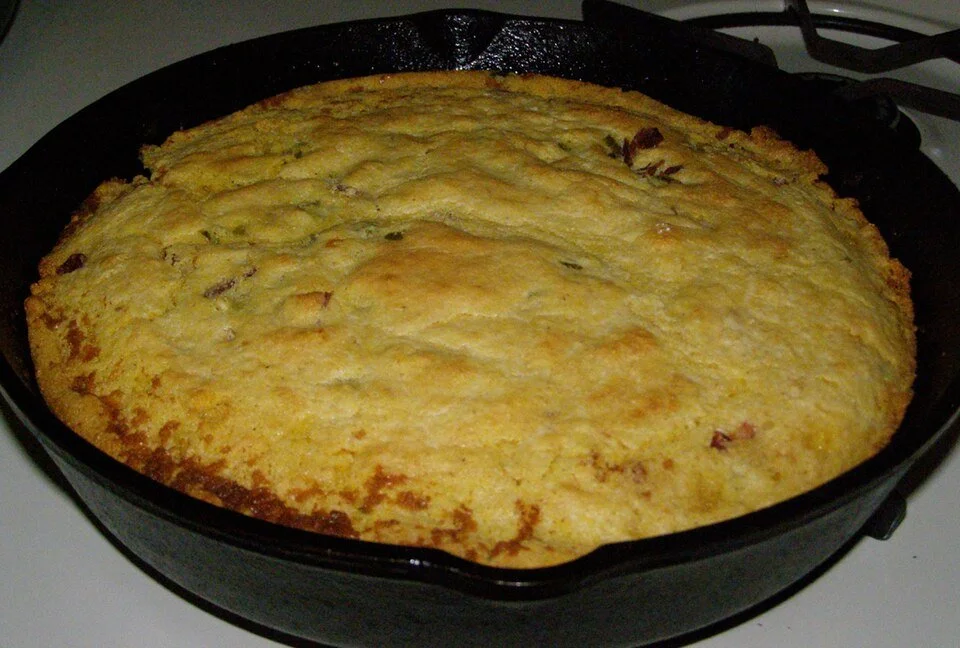
Skillet cornbread. Source: Creative Commons license 3.0, Zankopedia, available here.
Part I: Prehistory to the American Revolution
Corn was domesticated in Mexico between 6000 and 9000 years ago from a grass plant called teosinte native to Mesoamerica. While teosinte’s seeds were too hard to eat, its husks could be used for crafting material. Over the next 4000 to 5000 years, teosinte was bred to become a staple food across the Americas, spreading outward from Mexico both to the North and the South.[i] By the time Europeans reached the Americas, corn had been domesticated across wide swathes of both the North American and South American continents. For multiple groups of Native Americans, corn had become a way of life and the concept of a deity the “Corn Mother” had spread across multiple different Native American cultures.[ii] Corn varied in breeds as well with different breeds being domesticated to grow and produce in their respective climates. From the desert to the rainforest and all the way up into modern day Canada, corn was bred to serve the people that depended upon it.
When Europeans reached the Americas, they encountered corn early and did not want to consume it as a staple food in their new colonies. These Europeans attempted to grow wheat in the new world but ultimately failed and had to resort to changing their diets to accept corn as a new part of their lives. They learned to accept the agricultural practices of Native Americans and adapt for their own cuisine. Native Americans practiced companion planting to increase harvests and maintain soil health. One such example of companion planting is the Three Sisters method. The Three Sisters method included growing corn in mounds with squash and beans. The corn provided a structure for the beans to grow, and the squash provided shade for the beans to stop the potential of sun damage. In addition, the beans fixed the nitrogen in the soil which corn is known notoriously for consuming copious amounts of nitrogen.[iii] The Three Sisters method of companion planting represented perhaps one of the greatest feats of agricultural engineering among Native Americans of the New World. In addition to the planting of corn in mounds via the Three Sisters method, Native Americans also utilized the method of planting corn in rows in large fields. Corn is a unique plant in that it is a grass that requires wind pollination. Corn must be planted near other corn plants so that the pollen put forth by the male tassels can pollinate the female part of the plant: the silks and the ears. Without proximity of other corn plants, corn will not properly pollinate, and the ears of corn will either not develop properly, or they will develop inconsistently. One method to counter the issue of wind pollination is the process of hand pollination by removing the male tassels of the plant and spreading them evenly throughout the female silk and ears. This method however is too time consuming and only works in methods of intensely watched subsistence agriculture, the more effective method remains in planting corn in close proximity via mounds and rows to ensure that the wind can do the job of pollination without human intervention. In addition to corn’s ravenous appetite for fertile soil and nitrogen, corn requires substantial amounts of water. The soil must remain damp in the initial stages of germination which range from 7 to 14 days from planting. Without proper rainfall and irrigation corn has a high likelihood of drying out and being unable to produce fruit.[iv] The North American continent has multiple different planting zones ranging from zone 1 in the freezing upper reaches of Canada to the hottest regions in southern Mexico of Acapulco de Juarez with Zone 13b.[v] Astonishingly, corn can be grown in each of these regions at different starting points. In the southeast United States, which encompasses a range of zones 6 to 9, corn can be grown in two crops, one starting in early spring in March and April and another starting in late July or early August. In many regions of North America which are hotter or colder, corn can only be harvested once due to shorter growing seasons. Corn is a relatively fast producing crop with harvests estimated between 60 and 75 days from planting.
As corn became a staple of the colonist’s diets, recipes changed from the introduction of ingredients such as milk, eggs, pepper, and other regional additions. This introduction and exchange of ingredients represented one of the most important and long-lasting aspects of the Columbian Exchange. Corn as crop also moved across the Atlantic back to Europe and Africa where some estimates place the introduction of corn to West Africa in the early 1500s by the Portuguese.[vi] If this is true, many West Africans would have been familiar with maize as a food staple long before their forced capture and journey to the Americas as enslaved workers. Michael Twitty, a culinary historian argues that an early cornbread dish was prepared in West Africa from the interaction between Portuguese and Africans, “This was a grainy type of corn dish, made either from meal or crumbled cornbread. In both cases, its origins lie in Senegambia and the Sahel, where Islamic West Africa was born. Kusha is the Hausa name for one of many dishes that reflected a dual transfer of cuisine and culture between North and West Africa. We are still unclear who got there first, but it was most likely West Africans—who once shared the green Sahara with their cousins to the North—that came up with the idea for couscous-type dishes. Kusha (or "kush" in the mouths of their descendants in the United States) was shorthand for "couscous," the steamed or boiled grains of millet or sorghum eaten as a staple in savanna areas of West Africa, where the influence of Islam was felt.”[vii] Nevertheless, corn moved in multiple dynamics as a newfound food staple for European colonists in the Americas as well as for Africans and Europeans in the old world. Early recipes differentiate cornmeal from flour, referring to it as “Indian meal” or “Indian flour” rather than referring to it as the contemporary term of cornmeal.
At this point corn was still processed into meal via simple analog methods of mortar and pestle but European colonists also introduced the process of stone milling which used mills to grind and separate corn into meal. This meal would generally consist of a mix of dried corn ground into meal with an occasional leftover kernel which would give the cornmeal a mild sweet flavor. Early recipes were extremely simple compared with the massive varieties of cornbread present throughout north America in the modern era. Native American recipes generally followed two different trajectories, a mix of cornmeal and water either boiled or cooked over a fire. Sometimes this mixture of cornbread would include beans within the dough to increase protein content making the cornbread a wholly sustainable food but other times it would just include cornmeal and water. One such early instance of cornbread stood in the example of the Oneida people’s recipe for cornbread which was provided to Washington’s Continental Army at Valley Forge to prevent the army from succumbing to starvation.
The harsh winter of 1777 to 1778 at Valley Forge proved to be a particularly challenging time for the Continental Army during the American Revolutionary War. Without supplies and food, many of Washington’s conscripts began starving to death as they waited out the winter. Fortunately, about 50 Oneida-Iroquois people including Polly Cooper travelled many miles bringing a large supply of white corn to feed the Continental Army. Many of the soldiers attempted to eat the corn immediately but the Oneida taught them that the white corn was not edible until it had been processed properly.[viii]Through a process known as nixtamalization, the white corn was processed in an alkaline solution of wood ash boiled until the hulls were removed from the corn and the nutrients were made easier to digest by the human body. After boiling, the corn became Massa which could be ground and processed into a dough which could be effectively used to cook bread. Once the nixtamalized corn was rinsed multiple times, the hulls could be ground into Massa by a simple method of mortar and pestle until it was fine and soft enough to be held together.
George Washington wanted to pay Polly Cooper for her help in saving the Continental Army, but she refused, claiming that it was her moral duty to help her allies. Instead, Martha Washington took Polly Cooper shopping in Philadelphia after the ordeal where she bought a shawl that became a symbol of the cooperation between the United States government and the Oneida-Iroquois people.[ix] The cornmeal dough from the white corn was combined with beans into a large dough and boiled.[x] This combination of cornbread and beans provided all the essential amino acids and protein for survival and ultimately allowed the Continental Army to survive the brutal winter of 1777-1778. The cornmeal dough was shaped into disks and boiled in water for about 45 minutes until it was firm and cooked thoroughly. The cornbread was finally done when it began to float in the water which signified that it was fully cooked through and not doughy on the inside.
The Oneida-Iroquois cornbread recipe represents perhaps one of the earliest and most purely Native American recipes for cornbread. Rather than being baked in an oven or over a fire, this recipe combined white corn, water, and beans to create an essential food item which saved the Continental Army from certain starvation. Over the next few centuries cornbread would continue to adapt and change with the addition of European and African ingredients and cultural elements to become a significant food item throughout the Americas with a particular emphasis upon the culture of the American Southeast. The significance of the Oneida people’s contribution to United States history cannot be understated, however. Without the addition of Native American recipes and the knowledge passed down from Polly Cooper to Washington’s troops, the army would have surely perished, and the experiment of the American Revolution would have collapsed. Therefore, although cornbread has experienced massive adaptations and changes over the years through the additions of European, American, and African culture, the significance of this food item in the genesis of the United States and the connection between the Native Americans who subsisted on it for years stands as a consequential unifier between multiple diverse cultures.
Part II: The Columbian Exchange: Cornbread Recipes over Three Centuries
The different incarnations that cornbread went through during the colonial era stands as one of the most significant and insightful windows into understanding the genesis of modern cornbread. Cornbread is consumed throughout North America in different forms but ultimately garners the most attention in the Southeast. Here the varieties of cornbread vary in whether they are sweet, spicy, or savory, and to what level flour is combined in the cornmeal. By examining early colonial recipes and following a longue durée approach to these recipes a greater understanding of the processes and changes that led to modern cornbread and the divergences in recipes can be determined. The earliest North American cookbook to include cornbread as a recipe is the 1796 recipe book American Cookery by Amelia Simmons. This cookbook includes many recipes that were both European and American as well as a few which were a synthesized mixture of European and Native American ingredients. Beginning on page 33 and 34, The American Cookery lists recipes for Hoe cakes, Indian Slapjacks, and Johnny Cakes using the ingredient referred to as Indian Meal. The Johnny Cake or Hoe cake Recipe from The American Cookery reads as follows, “Scald 1 pint of milk and put to 3 pints of Indian meal, and half pint of flour-bake before the fire. Or feald with milk two thirds with boiling water, add salt, molasses, and shortening, work up with cold water pretty stiff and bake as above.” The Indian Slapjack recipe reads as follows, “One Quart of milk, 1 pint of Indian meal, 4 eggs, 4 spoons of flour, little salt, beat together, baked on griddle, or fry in a dry pan which has been rubbed with lard or butter.”[xi]
The 1798 recipes from the American Cookery by Amelia Simmons shows a significant divergence from the early recipes used in pre-colonial America. The additions of flour, salt, eggs, shortening, and milk change the recipe for cornbread show the massive changes that occurred due to the Columbian exchange between the old world and new world. Interestingly, the racialization of cornmeal as a food is present within this cookbook. The mentions of cornmeal as Indian meal provides an insight into the othering of corn and cornmeal in the new world from typical colonial and European palates. The fact that these recipes were included shows an adaptation and a reluctant acceptance of the abundance of corn as a food but also shows the relative ambivalence towards it as a staple food source. The addition of multiple European derived ingredients also shows an approach to diminishing cornmeal as a begrudging alternative to flour rather than one of the most appropriate carbohydrates available in the new world.
The 1889 recipe book Aunt Babette’s Cookbook was the first Jewish American cookbook published in the United States. It quickly became a bestseller and contained multiple non-kosher recipes as a tendency of assimilation of Jewish people who had emigrated to the Americas. Aunt Babette’s Cookbook also includes multiple recipes for cornbread and cornbread derivatives corn muffins showing the importance of cornbread as an American food by this point. Aunt Babette’s Cookbook, however, still uses the racialized language of Indian meal rather than cornmeal which further others the vegetable of corn and the processed product of cornmeal over the more familiar European ingredient of wheat flour. Aunt Babette’s recipe for corn muffins on page 170 reads as follows, “One cup of Indian Meal, and a half cupful of flour, in which you have sifted two teaspoonfuls baking powder. Wet this with two cups of sweet milk, add one teaspoonful of butter, one teaspoonful of salt and one of sugar. Beat the yelks of two eggs light and add and last the stiff-beaten whites; bake in muffin rings. Eat cold.”[xii] Aunt Babette’s 1889 cookbook adds what many in the southeastern region of the United States would consider the most controversial ingredient considered in cornbread, sugar. While early recipes for cornbread in the pre-contact Native American period and early colonial period certainly did not include sugar as an ingredient, cornbread evolved to include a sweet taste among certain regional palates throughout the United States. The Aunt Babette’s Cookbook cornbread recipe is detailed as follows, “One pint of Indian meal, one pint of buttermilk, two eggs, whites and yelks beaten separately, whites to be put in the last thing; two tablespoonfuls of sugar; one tablespoonful of melted butter, a little salt and a teaspoonful of baking powder.”[xiii] This recipe in particular resembles many of the contemporary recipes throughout the modern south with varieties including the addition of pepper, green peppers, and the addition or subtraction of sugar in different varieties. Some Southwestern varieties of cornbread also include the introduction of cheese to cornbread as a regional derivative.
Marion Cabell Tyree’s 1878 Housekeeping in Old Virginia mentions multiple recipes using cornmeal but begins the transition from the racialized language of Indian meal towards cornmeal as well as changing the larger naming conventions of cornbread recipes. This change represents the historical paradigm shift as corn and cornmeal became accepted as a regional food staple of the south away from its previous incarnation as a begrudgingly accepted food stuff of Native Americans that lived in the southeastern United States before Euro-American colonizers. By the 1870s the last vestiges of Native Americans on the east coast had been pushed westward after the Trail of Tears between the 1830s and 1850s and the only remaining Native Americans not subjected to state-controlled reservation governance had adopted sole reliance upon the bison of the Great Plains in the American West. Marion Cabell Tyree’s Housekeeping in Old Virginia represents the change from cornbread as a Native American food reluctantly accepted by Euro-American colonizers to a regional delicacy. The recipe for Old Virginia Batter Cakes, another variety of cornbread is as follows, “Beat two eggs very light in a bowl. Add one teacup of clabber, one of wate