
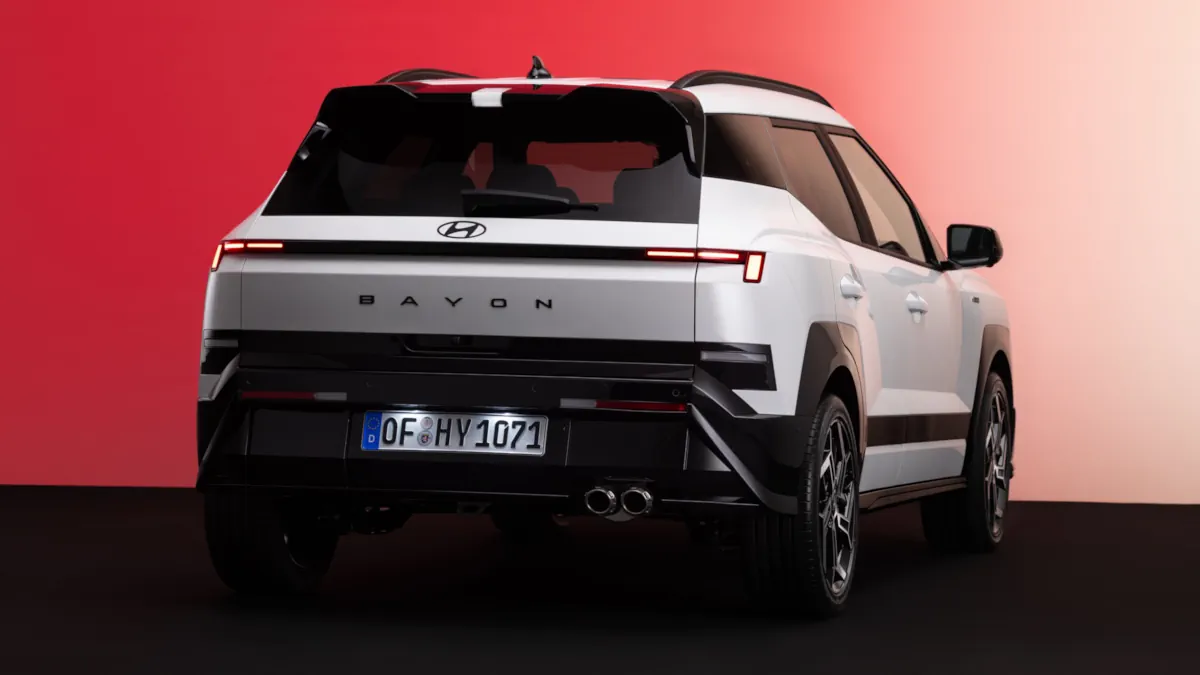
Be still, thine beating hearts: The eminently sensible Hyundai Bayon has been updated and transformed from a weeny humdrum hatchback into an angry little SUV.
The headline here is the Bayon’s newfound ambition to punch above its weight, bringing stuff you’d normally find on posher, more expensive wares down to the ‘compact’ class. Also the whole ‘bigger and angrier’ thing.
PHOTO BY Hyundai
That’s largely thanks to Hyundai’s latest ‘Art of Steel’ design language, which offers up sharp, blocky, and angular looks. Definitely more aggressive than the last car, with a lot of bold angles and straight lines (the Korean carmaker must’ve kept hold of that ruler it used on the all-new Tucson). There are definitely some Ioniq 5 undertones here, too. Interesting treatment.
OTHER STORIES YOU MIGHT HAVE MISSED:
Would the China-exclusive Hyundai Ioniq V be a good fit for PH?
Hyundai confirms specs for all-new Tucson’s ICE and hybrid variants
From launch, the Bayon comes with a 1.0-liter three-cylinder turbopetrol engine offering anywhere from 89hp to as much as 114hp, all delivered to the front wheels through either a six-speed manual or a seven-speed automatic gearbox.
PHOTO BY Hyundai
A 136hp 1.6-liter hybrid version will arrive in 2027, and that car gets a fancy adaptive regen braking system controlled through a set of paddle shifters, as featured in other Ioniqs and Tucsons.
The Bayon has all the standard techy stuff you’d expect, like Apple CarPlay and Android Auto as well as wireless phone charging and some fairly hefty 12.3-inch curved displays for the infotainment and instrument cluster.
There’s a nifty (or perhaps gimmicky) Digital Key 2, which allows drivers to unlock and start the Bayon from a smartphone or smartwatch. This sounds good as long as you don’t run out of charge and lock yourself out.
PHOTO BY Hyundai
The cargo area is about your average for this size of car, and if you tick the right boxes and open your wallet, you’ll be able to get an eight-speaker Bose sound system, heated seats front and back, and even a panoramic sunroof.
Open thine wallet further still and you can bag yourself an N-Line version (pictured here), which Hyundai says offers a “more performance-oriented expression.” For that, read: 19-inch alloys, a black roof, some subtle winglets, a diffuser, and twin exhausts. On the inside, you’ll find some fancy N-Line seats to let your passengers know you’ve forked out the extra cash.
PHOTO BY Hyundai
“The all-new Bayon is much more than an update,” said Hyundai Motor Europe boss Xavier Martinet. “We have strengthened its SUV character with a bolder design, more space, more comfort and technologies that customers would normally expect from larger vehicles.”
Hyundai is yet to reveal official pricing for the new Bayon; however, we expect it to land around the £25,000 to £30,000 (P2 million to P2.5 million) mark, with the Kia EV3 and the Renault 4 shaping up to be its likely competitors.
NOTE: This article first appeared on TopGear.com. Minor edits have been made.