
My friend Jorge Fitz once told me a story about his childhood visits to the town where his grandfather grew up, Juliantla, just outside of Taxco, Mexico. He remembers many particular things about the way the town celebrated festivities and holidays, but one thing that stuck out in his memory was a special braided bread they made called pan de Juliantla.
As an adult, Jorge said he started making Jewish friends, and when he saw pan de Juliantla on their tables, he wondered how they knew about it.
The Jewish community in Mexico City is estimated to be between 40,000 and 50,000, with many kosher choices when it comes to restaurant dining. (Klein’s)“Jorge, that’s challah bread,” they would respond.
He later learned that Juliantla is believed to be the first Jewish settlement in the Americas, complete with a spiritual cleansing bath known as a mikveh that dates back to the 16th century.
As far as Jorge could tell, a majority of the townspeople didn’t realize where many of their customs and food came from. He and his parents definitely didn’t know about their Jewish ancestry until much later.
Hearing this story illuminated just how deeply rooted Jewish food is in Mexican culture, so much so that even when origins have been forgotten, they remain an integral part of community life.
Waves of migration and a culinary legacyThe first Jews to grace Mexican shores sailed in on the ships of Spanish conquistadors during the 1500s and 1600s. They were fleeing the Catholic Inquisition of the Iberian Peninsula, but found little solace in the New World as the Inquisition migrated across the ocean.
Many of these early Jews “converted” to Catholicism while continuing to practice their own religion in secret. In Spanish, they are called “conversos,” or the converted. In English, we often refer to them as Crypto Jews.
Mount Sinai is one of several synagogues found in Mexico City. (Gobierno de Ciudad de México)With these Sephardim came cinnamon, grapes, figs, dates, almonds, cherries, apricots, olives and olive oil, nutmeg, ginger, cardamom and mustard, as well as black pepper, thyme, basil, clove, fennel, oregano, cumin and other Mediterranean spices.
They also had a strong tradition of pickling what they brought to the New World. In northern Mexico, cabrito, slow-roasted baby goat, is a traditional dish among the Sephardic Jews of the Iberian Peninsula. Similarly, the region’s dessert bread known as pan de cemita and la capirotada, a kind of bread pudding, are also attributed to those early Iberian Jewish immigrants.
The second wave of Jewish immigrants to Mexico arrived at the end of the 1800s from the failing Ottoman Empire. Jews who were part of the diaspora from Spain and Portugal, now living in the countries of the Levant, came because of economic opportunities in Mexico. They arrived from what is today Lebanon, Syria and Turkey, and because they were not fleeing persecution, their culture, religion and food were much more visible.
Preserving culture in the neighborhood ovenA third wave of Jewish immigrants came to Mexico during and between the two world wars. Some had plans of continuing on to the United States but were turned away at Ellis Island because of the Immigration Act of 1924, which severely limited the numbers of Southern and European immigrants allowed into the country.
These immigrants brought the Ashkenazi dishes of Eastern European countries like Poland, Ukraine and Germany — hearty soups and stews made with root vegetables like borscht, matza ball soup, gefilte fish, schmaltz (rendered chicken fat), tzimmes, gribenes and braised meats like brisket.
Food is paramount for any immigrant community trying to preserve their identity. The Jewish community was no different.
Mendl in Mexico City’s Condesa neighborhood is one of the best Jewish delis in the city … and in the country. (Mendl)When Syrian Jews moved into Colonia Roma at the beginning of the 20th century, they not only built one of the city’s oldest synagogues but also opened a community oven down the street where special traditional breads were baked and sold to worshipers coming from services. At the local market were kosher butchers, while elderly folks sat in neighborhood cafes sipping thick, Turkish-style coffee and eating the sweets of home.
Unlike some of the immigrant groups I have researched, the diverse Mexican-Jewish community not only preserved the traditional dishes of their culture, but also, over the generations, adapted and innovated with local ingredients and cooking methods, creating a distinct Judeo-Mexican cuisine.
The fusion kitchen and home recipes“Sabor Judío,” published in 2024, is a recipe collection by two authors whose Jewish grandmothers passed down handwritten recipe books. They gathered together a comprehensive archive of recipes from kitchens across the Mexican-Jewish community. Among the book’s pages are traces of many cuisines — Mexican mestizo, Spanish, Sephardic-Iberian, Sephardic-Middle Eastern and Ashkenazi.
Yiddish blintzes with huitlacoche (Mexican corn smut considered a local delicacy), matza chilaquiles, a variation of shakshuka with poblano peppers and Mexican oregano, and brisket tacos with three-chile salsa are all included in the collection. Irma Appel’s stuffed poblano peppers with guacamole include a smattering of gribenes (often referred to as Jewish bacon), and Pati Jinich, of PBS’s “Pati’s Kitchen,” provided her recipe for jalapeño-mushroom matza ball soup.
Then there are traditional Mexican recipes that the Mexican-Jewish community has adopted as their own, cooking them for high holidays and other festivities. That includes nopal and tomato salad made in advance to eat cold during Shabbat, or ceviche with prepared horseradish on top, supposedly invented during a Passover Seder.
Not everything is kosher, but the community’s many identities are on full display.
Yes, there is a cookbook featuring recipes for Jewish Mexican cuisine. It’s called “Sabor Judío,” and was published in 2024. (Sabor Judío)Scanning through the menus of Jewish restaurants in Mexico City, however, it’s hard to find the fusion dishes represented in “Sabor Judío.” For whatever reason, these dishes hold sway in family kitchens, but haven’t yet made it to commercial dining rooms.
Where to find Jewish food in Mexico CityMaybe the world isn’t ready for spicy gefilte fish?
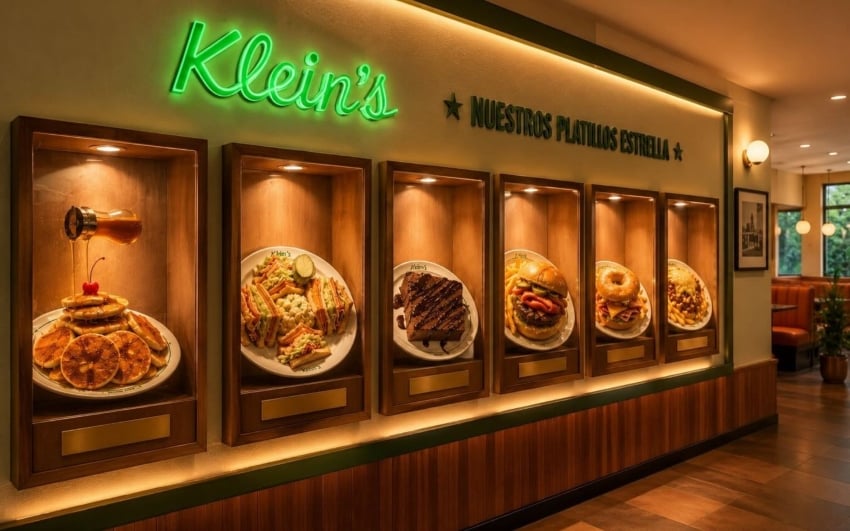
That’s not to say that you can’t get glimpses of them — the salami chilaquiles at Klein’s in Polanco is a delicious example. You’ll also find chiles making guest appearances in the Israeli dishes at Merkava, and kosher cafe Guacho Grill has al pastor tacos made with fish and chicken, as opposed to the traditional pork.
So maybe fusion is yet to take off in restaurants, but at places like Klein’s or Niddo, which once described itself in an interview as Jewish-Mexican-Canadian, diners will at least find Jewish and Mexican dishes coexisting on the table.
Plenty of other expressions of Jewish food can be encountered throughout the city — Mendl, for instance, has incredible U.S.-style deli sandwiches and bagels with lox. And at Pat Patz, chef Mijeal Seidel has a labneh recipe that he adds dill to as a shout-out to his Eastern European side, along with tons of other dishes worth exploring.
You may have to make some fusion dishes at home, but a taste of Jewish-Mexican heritage is definitely available across Mexico City.
Lydia Carey is a freelance writer and translator based in Mexico City. She has published extensively both online and in print, sharing her insights about Mexico for over a decade. She lives a double life as a local tour guide and is the author of “Mexico City Streets: La Roma.” Follow her urban adventures on Instagram and see more of her work at mexicocitystreets.com.
The post The Jewish-Mexican food traditions hiding in plain sight appeared first on Mexico News Daily