
A wave of Democrat support in the midterms swept across the U.S. in the beginning of November marking a change of power in politics—not just from the flipping of red to blue, but also from old to young: non-boomer politicians in Congress are at their highest point since the turn of the century. But even as the Baby Boomers are losing their hold on political power, their economic influence remains considerably more difficult to dislodge.
Americans born between 1946 and 1964 still control more than half of the nation’s wealth, despite representing a continuously shrinking share of the population. And their financial advantage has implications for younger generations struggling with housing costs, student debt and the rising cost of living—especially as the transfer of wealth from older generations to their children remains sluggish.
Reshaping the political landscapeThe shift away from Baby Boomer leadership in government has been building for years, but the 2026 midterms accelerated the transition. For the first time in decades, the generation that dominated congressional leadership and policymaking is losing its grip.
The House already moved past the point of Boomer dominance. According to Pew Research Center, Boomers accounted for 39% of House members at the beginning of the 119th Congress, down from a majority just two Congresses earlier. Gen X became the largest generation in the chamber, representing 41% of lawmakers while Millennials accounted for another 15%. The Senate has been slower to change. Boomers still represent 60 of 99 senators at the beginning of the 119th Congress, or roughly 61%.
But that imbalance is beginning to change. According to Quorum’s analysis of newly elected lawmakers, Gen X and Millennials account for 87% of the incoming 120th Congressional class. Of the 120 new members, just 13 are Boomers—while 56 Gen Xers and 48 Millennials will occupy the new seats.
The change is also visible in the pipeline of candidates seeking office. Future Caucus found that Millennials and Gen Z accounted for roughly one-third of congressional candidates in 2026, up from one-quarter in 2024 and one-sixth in 2022. According to the report, Millennials also became the largest generational group running for Senate for the first time in the report’s history.
Still, the political transition is not complete as the Senate continues to be a stubborn stronghold for older Americans. The incoming chamber’s median age will fall to 63 from 64, but will still remain among the oldest Senates in American history, according to Reuters.
The wealth divideAccording to the Federal Reserve’s Distributional Financial Accounts, Baby Boomers held approximately $97.4 trillion in household net worth in Q2 2026. That represents 52.5% of all U.S. household wealth, despite Boomers accounting for just 27% of the country’s adult population.
In contrast, Millennials and Gen Z together represented 22.4% of real estate but only held 11.2% of household wealth—about $20.8 trillion. Generation X held another 25.7%.
And while the great wealth transfer is coming, younger Americans are waiting. Visa’s Business and Economic Insights report in July estimated approximately $36 trillion of Baby Boomers’ $93 trillion in assets could transfer to younger generations over the next 20 years—after accounting for liabilities, taxes, fees, retirement spending and other exclusions.
“Imagine you are sitting on a winning lottery ticket. You hit the jackpot, but you immediately lose half by— smartly—taking the lump sum,” the report read. “Next, you lose another 30–40 percent through taxes and fees. The advertised jackpot is enormous, but after the lump-sum haircut, taxes and fees, the take-home number is much lower. A similar dynamic applies to the great wealth transfer.”
But that doesn’t mean the younger Americans will now get access to that same financial security. The transfer is likely to be uneven, with most of the wealth being concentrated among families that already have substantial assets.
According to Visa’s research, nearly 75% of inheritance recipients already have higher net worths than the average household. That means much of the inherited wealth from the transfer will be saved or invested, not immediately spent. Visa also estimated that one in four millennial homeowners received financial assistance from their parents for a down payment.
But perspective matters. A 2025 analysis by the Federal Reserve Bank of St. Louis found that Millennials and Gen Z households actually had more inflation-adjusted wealth at approximately age 34 than Boomers did at that same age.
According to the analysis, Millennials and Gen Zers owned $1.23 for every $1 of wealth owned by Gen Xers at the same age—and $1.35 for every $1 of wealth owned by baby boomers.
The next generational fightThe generational war has a six-year deadline, set by Social Security and the national debt.
According to the 2026 Social Security trustees report, the combined retirement and disability trust funds are projected to be depleted by 2032. At that point, incoming revenue would only cover 83% of scheduled benefits unless Congress changes the program.
Boomers have held the presidency since 2001, spanning George W. Bush to Donald Trump, with the exception of Joe Biden—who is part of the Silent Generation. In that time span, the national debt climbed from $5.81 trillion to over $40.17 trillion through September 2026, according to the Treasury’s fiscal data, during which time, they have passed a series of tax cuts leaving their own generation’s retirements endangered.
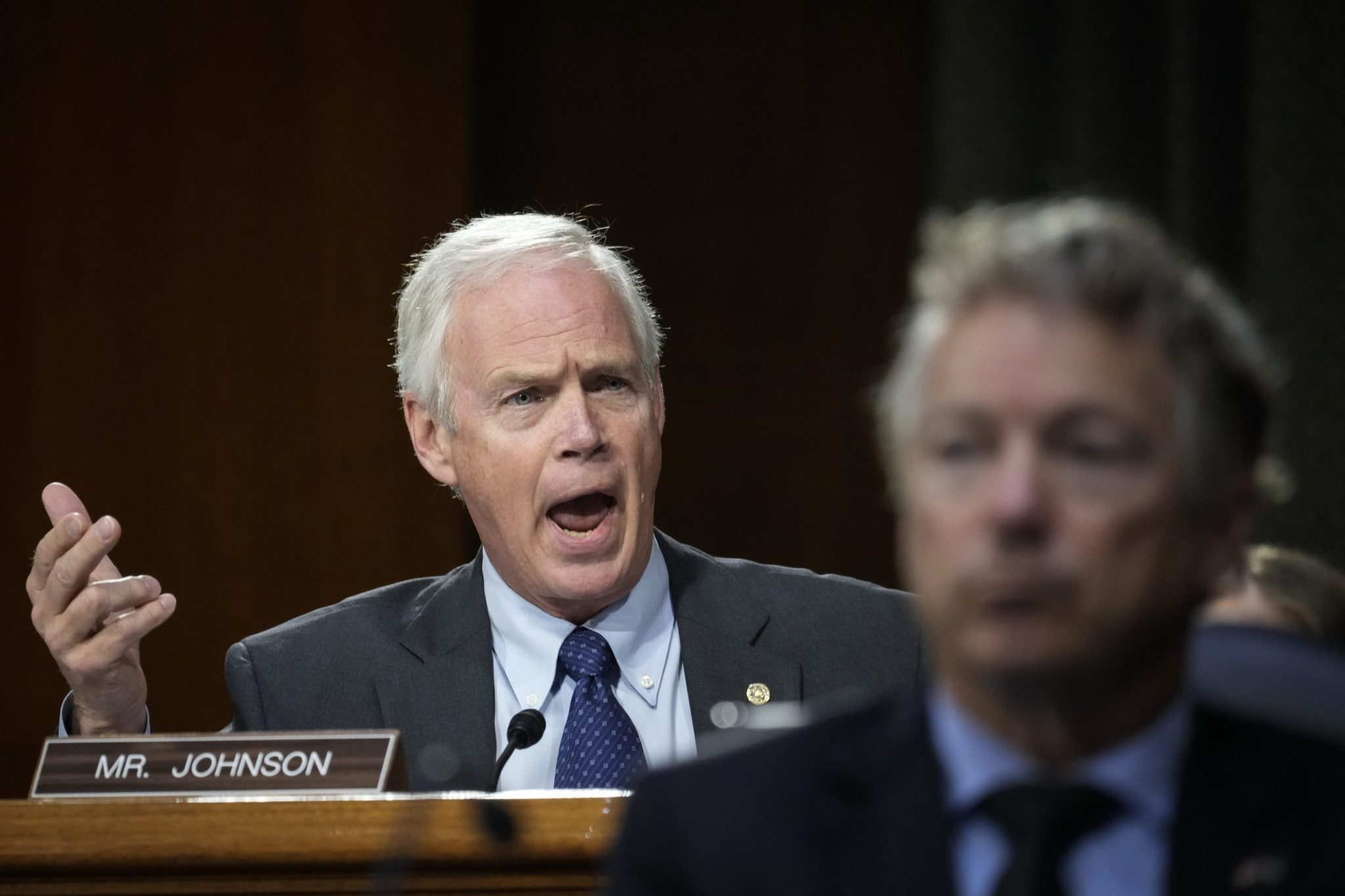
Democrats have argued for increasing revenue by raising the cap on earnings subject to Social Security payroll taxes, while Republicans mostly emphasized economic growth. But Sen. Ron Johnson—the Wisconsin Republican who chairs the Senate Budget Committee and is a Boomer himself—has a typically Boomerian fix: make other generations pay for it.
Social Security is funded primarily through payroll taxes paid by today’s workers, meaning younger Americans now are financing the benefits for current retirees. But once the funds are depleted, covering the shortfall would mean borrowing more from other federal priorities. In effect, the government would be putting the cost of maintaining the retirement benefits on the national credit card, leaving younger taxpayers to help service the debt through future taxes or spending cuts.
On Nov. 18, Johnson called Social Security a “legal Ponzi scheme” on Fox Business. The following day, he said Congress should first pass legislation preventing benefit cuts and then address what he described as the country’s massive debt. He also introduced the Stop Scaring Seniors Act, allowing the Treasury’s general fund to cover Social Security benefits after it becomes insolvent. The Committee for a Responsible Federal Budget estimates the approach would add $190 trillion to the federal debt over 75 years.
This story was originally featured on Fortune.com