
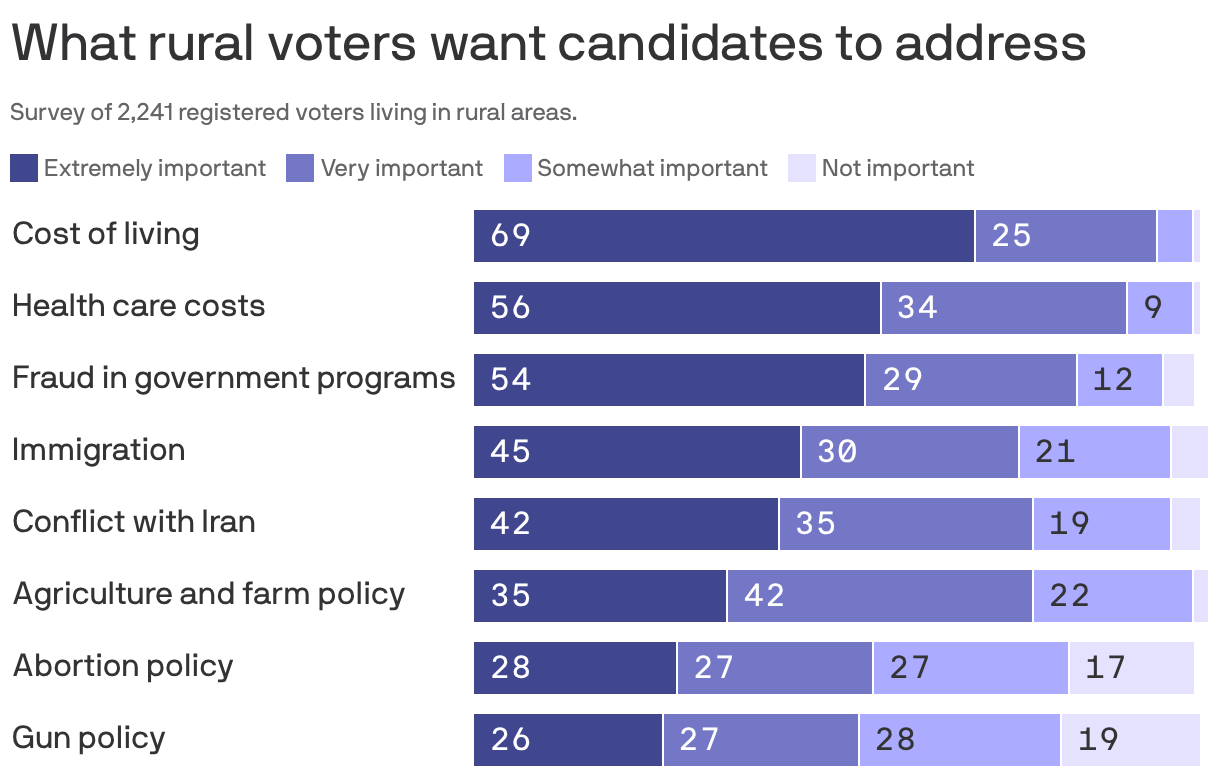
Cost of living and health care costs top the list of issues rural voters want 2026 midterm candidates to address, according to a new AP/KFF poll.
The big picture: Ahead of the midterms, rural voters rank pocketbook concerns above immigration, the conflict with Iran and several major domestic policy debates.
By the numbers: 69% of rural voters said it is 'extremely important' for candidates to talk about the cost of living, followed by health care costs (56%) and fraud in government programs (54%).
Context: The AP/KFF poll asked 2,241 registered voters living in rural areas how important it was for 2026 candidates to talk about each of eight issues.
Cost of living concernsZoom in: Affordability concerns extend across a wide range of everyday expenses.
- 57% of rural voters cited an economic concern — including rising costs, jobs, wages and housing affordability — when asked about the biggest issue facing their local community.
- 67% said they were at least somewhat worried about affording gas or transportation, while 66% said the same about health care and 60% about food and groceries.
- Three-quarters rated the cost of living in their area as either "fair" or "poor," up 25 percentage points from 2017.
Reality check: Rural voters' unhappiness with costs doesn't necessarily translate into support for Democrats.
- According to the poll, 40% trust Republicans more to handle the cost of living, compared with 25% who trust Democrats and 27% who trust neither party.
- Rural voters in the survey leaned Republican: 54% identified as GOP voters or Republican-leaning independents, while 32% identified as Democrats or Democratic-leaning independents.
What we're watching: Whether economic frustration affects voter enthusiasm among rural Republicans.
- 27% of rural Republican voters disapprove of Trump's handling of the economy, per the poll. Among them, 59% say they're absolutely certain to vote in the midterms.
- Still, 98% of rural Republicans say they're more likely to vote for a Republican than a Democrat.
The fine print: The KFF/AP poll surveyed 2,241 registered voters living in rural areas nationwide from Aug. 12-24, 2026, online and by phone. The margin of sampling error is ±3 percentage points.