
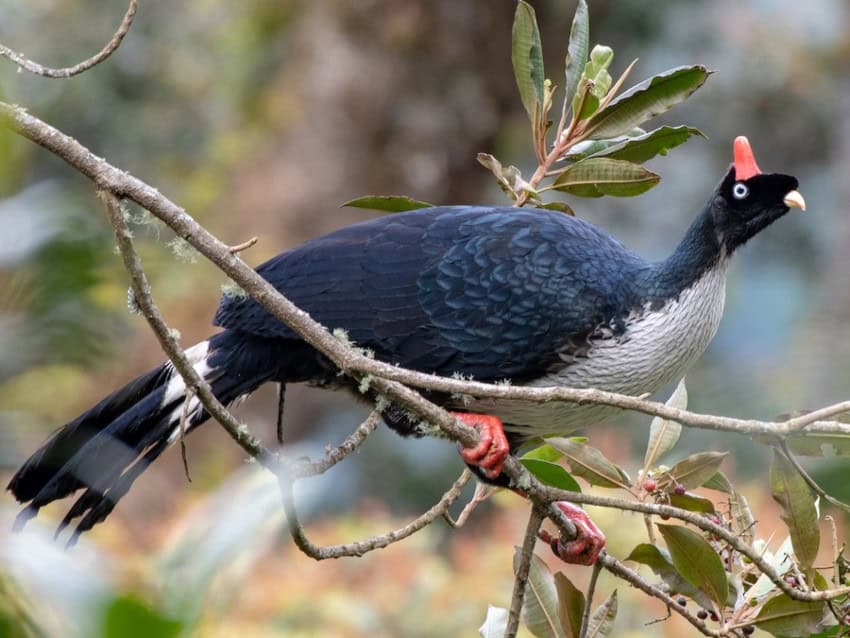
Almost two centuries ago, an otherworldly bird was found deep in the Guatemalan jungle. From its physical characteristics to its mating habits and limited natural habitat, the horned guan has long puzzled ornithologists.
Over the years, scientists have made various breakthroughs, including unpacking the horned guan’s unique genetic profile, dietary habits and social tendencies.
Sightings of the horned guan are rare due to the species’ limited numbers and limited geographic range. (eBird)Now, faced with climate change and dwindling habitats, researchers are ramping up efforts to protect the horned guan, 26 years after it officially landed on the endangered species list.
An odd discoveryAs the story goes, sometime during the 1840s, a man named Don Joaquín Quiñones collected the body of a strange bird from the forested slopes of Volcán de Fuego in Guatemala. It’s unclear whether he hunted it himself or obtained it from villagers, as shortly after this one contribution to science, Don Quiñones passed into oblivion.
However, he knew enough about wildlife to recognize that his specimen was something unusual.
The resplendent quetzal is a gem of Mexican birds
Don Quiñones is said to have passed it to Edward Smith-Stanley, the 13th Earl of Derby, an enthusiastic naturalist and a sponsor of the British Museum. Smith-Stanley, in turn, loaned the specimen to George Robert Gray, head of the British Museum’s ornithological section, who recognized it (inaccurately, as it would turn out — more on that later) as a new member of the group of birds known as guans. These chicken-sized, social, tree-living birds were found from Mexico to northern South America, with a few species having established themselves on Caribbean islands.
All guans are strange-looking birds, and this one was particularly ridiculous. It had a dark back, white chest and, most notably, a striking red, fleshy “horn” on its forehead.
Gray listed the discovery in his 1844 publication “The Genera of Birds.” He named it Oreophasis derbianus, honoring both its mountain home and the Earl of Derby, though colloquially it would come to be known as the horned guan.
Spotting the elusive horned guan The horned guan is only found in Guatemala and in the Mexican state of Chiapas. (Cephas/Wikimedia Commons)The horned guan is a rare bird, existing in meager colonies limited to forests on the mountain slopes of Chiapas and southern Guatemala. This combination of a small population and remote forest habitat makes the horned guan a difficult bird to see.
Even if a tourist travels to these forests, sighting the bird is far from certain. It requires a knowledgeable local guide and a trek that begins before daybreak.
The journey will likely start with a couple of bumpy hours in a four-wheel-drive vehicle followed by a hike through the mountains, ending in an area where the birds have recently been spotted. Then, it is a case of waiting and hoping. Perhaps a horned guan will show itself, perhaps not.
Even scientists spending a prolonged period on these slopes are excited when they make a sighting.
For example, Dr. Fernando González-García, a leading expert on the horned guan, wrote a study of the birds’ mating habits in 1995, based on two months of observations in one area. During that time, just five individual birds were spotted.
However, as our understanding of these birds increases, the task has become a little easier. The field station at El Triunfo Biosphere Reserve offers a good chance of spotting guans. The odds improve in the mating season when the birds become notably noisy.
It is also worth remembering that these forests are alive with colorful and exciting birds — seeing a guan should be considered a bonus to any trip, not the sole reason for it.
What we know about the horned guanAfter nearly a century, we know a fair bit about the horned guan.
They feed on a variety of fruit, flowers and leaves gathered from the forest canopy, but might also come down to the ground in search of food. In fact, although they are largely regarded as solitary creatures, they do gather in numbers while feasting.
Details of their nests remained a mystery until the 1980s, but we now know they use leaves and roots to build a simple and relatively small structure in the lower to upper forest canopy.
While every new discovery is illuminating in its own right, it is the mating habits of the horned guan that scientists have found particularly surprising.
Mating and courtship ritualsThe most energetic period of the mating season stretches from January to March and, unlike many birds, the males use this time to move between several females. Mating involves fanciful displays including wing-beating, neck-stretching and tail-spreading.
Has the horned guan expanded its range to Oaxaca and Honduras? Rumors remain unconfirmed. (10,000 Birds)What was unexpected was the role dust-bathing plays in courtship rituals. The male selects a dust bowl and then calls to attract a female. They will stay together in the dust for up to 30 minutes, a ritual that cleans their plumage and eliminates parasites before they start nesting.
Other questions remain unanswered. Horned guans have occasionally been seen on the lower slopes of a mountain, and ornithologists are uncertain how common this behavior might be. It’s an important question because a bird’s ability to make altitudinal shifts might increase its long-term survival.
The lifespan of the horned guanThe bird’s exact lifespan in the wild is unknown, as is the juvenile mortality rate. Nor is there a precise record of the division of labor between parents during incubation and chick-rearing.
The trouble with finding the horned guan makes estimating its numbers a hit-and-miss exercise. Like so many creatures living in Central American forests, it is declining in numbers as its habitat shrinks.
The International Union for Conservation of Nature’s Red List of Threatened Species estimates the horned guan population to be between 600 and 1,700 mature individuals. The bird was also designated endangered in 2000.
Not only are the numbers low, but the surviving birds are scattered between increasingly isolated patches of forest.
Another challenge on the conservation front is determining the exact distribution of the horned guan along the Sierra Madre de Chiapas, which would give a better understanding of the extent to which the populations have become fragmented.
There is some good news, however. Efforts to stop illegal poaching have been successful, while the tropical bird has been protected across nature reserves in Chiapas and Guatemala.
Guans in other parts of Central AmericaDespite the challenges, scientists are hopeful that there might be small populations of horned guan in Oaxaca and Honduras.
While not confirmed during limited searches, the possibility of discovering additional populations in these areas rests on stories from locals.
There was a rumor that a villager had the head of a horned guan, though it’s yet to be produced as evidence.
The risks and challenges of conservationView this post on Instagram
A post shared by Ignacio Yúfera (@ignacio_yufera)
Two great unknowns will dictate the future of the cloud forests that the horned guan depends on — climate change and forest fires.
Essentially, as the climate warms, there is an expectation that fires will become an increasing problem. At one time, this wouldn’t have been such a concern, as wildlife often adapts by moving into new areas. However, with the birds occupying a reduced and fragmented environment, migrating away from fire-damaged areas might prove more difficult.
Considering this uncertain future, there have been discussions as to whether the guan could be raised in captivity.
The most successful breeding program was carried out by Africam Safari in Puebla, which took over the pioneering work of Fundación ARA A.C. For several years, they ran a program dubbed the Cloud Forest Ambassadors, which loaned a pair of horned guans to various zoological institutions around the world in exchange for a fee that was used to support field research in Mexico and Guatemala.
There was some excitement back in 2016 when Saint Louis Zoo in Missouri announced the hatching of new chicks. The parents were too inexperienced to raise the chicks on their own, so zookeepers took on the task of hand-raising them. However, breeding a few chicks in captivity is many difficult steps away from releasing birds back into the wild.
An ancient lineage in our modern worldAn important study, completed at the turn of the century, looked at the bird’s DNA and came up with a surprising conclusion: The horned guan, despite its appearance, is not a true guan at all.
The hunt for Mexico’s rarest bird — that might not even exist
Instead, it was recognized as an independent evolutionary lineage that broke away from other guans somewhere between 20 million and 40 million years ago.
According to González-García, it’s just one of the many things that makes the species so compelling.
“I find this bird fascinating for several reasons,” González-García said. “It represents an ancient lineage that originated in and is strictly endemic to the Mesoamerican region. Observing a horned guan emerging through the cloud forest mist and listening to its vocalizations transports the observer to ancient times.”
Bob Pateman lived in Mexico for six years. He is a librarian and teacher with a Master’s Degree in History.
The post The strange, ancient bird hiding in Mexico’s cloud forests appeared first on Mexico News Daily