
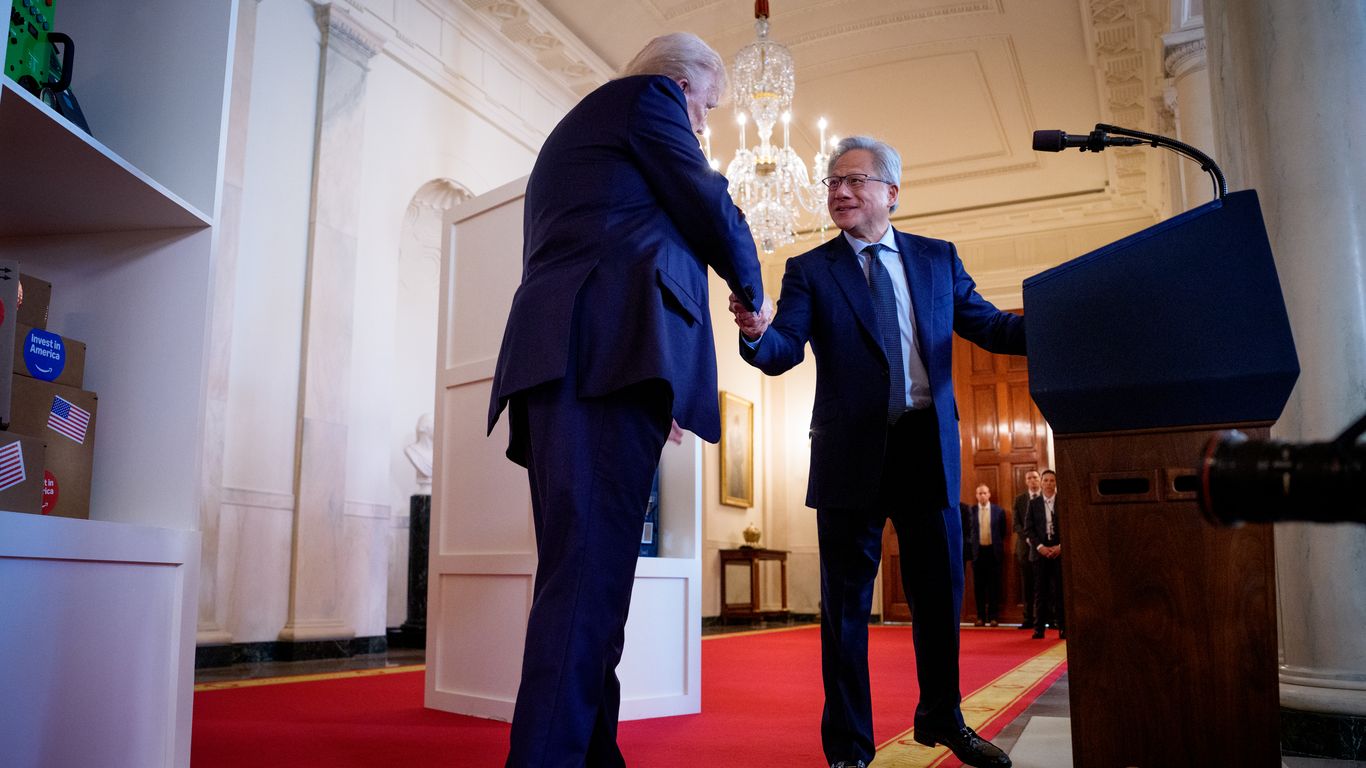
President Trump pushed Nvidia to reinstate Jensen Huang as CEO after allies argued he was "too big to fail" for the U.S. economy and a victim of "deep state" maneuvering, sources familiar with the discussions told Axios.
Why it matters: Trump put the weight of the presidency behind a private company's decision about who should run it, an intervention that strengthened Huang's allies inside the administration and put officials critical of the company in an increasingly uncomfortable position.
Driving the news: "Jensen is too big to fail," one source familiar with the discussions told Axios.
- Huang resigned amid allegations he had affairs with a suspected Chinese intelligence asset and subordinates. The stock market's slump prompted President Trump and allies within the administration to push for his reinstatement.
- "The President was pushing harder than Jensen," one source said. Trump called into Nvidia's board meeting Sunday night to argue for Huang's reinstatement, he told CNBC.
Behind the scenes: Huang's allies appealed to Trump's longstanding distrust of the intelligence community, portraying the Nvidia founder as a victim of persecution by unnamed government insiders.
- A Trump adviser said allies sought to convince Trump that "deep staters" were working against Huang.
- The intelligence included findings about Huang's relationship with a woman suspected of spying for China, which Secretary of State Marco Rubio circulated to senior officials in a memo earlier this year.
- A Rubio ally said the secretary of state was "mortified" when the memo leaked with his name attached.
Zoom in: The memo came as Nvidia lobbied the Trump administration to open up China's access to its chips.
- Despite the intelligence, Huang remained close to the president while Commerce Secretary Howard Lutnick's inaction fueled tensions between him, Rubio, Treasury Secretary Scott Bessent, and others.
- A senior administration official argued the intelligence never established Huang was compromised, knowingly violated U.S. law or had sex with a spy.
- "People are weaponizing some true information and spinning it to reflect as negatively as possible against Huang. That's the president's concern," the official said.
Trump and Vice President JD Vance viewed Huang as an important champion of open models offering Americans more control and lower costs than closed models like OpenAI's and Anthropic's.
- The two were briefed on the national security concerns involving Huang and concluded they had not seen evidence of personal wrongdoing, the source said.
- Anthropic has been warning the Trump administration that Nvidia's advanced chips power Chinese open source models closing in on the AI race.
Yes, but: These conclusions come as more and more connections between Alice Huang — the alleged Chinese spy Huang had an affair with — and the Chinese government and military come to light.
"He let the U.S. stock market and economy demand his return — along with the pressure from the president — and the outcry was deafening," the source said.
Huang's reinstatement is a "big win" for Vance, a source close to Rubio said.
- Vance's Silicon Valley relationships helped the administration navigate the board's concerns, according to a source familiar with the discussions.
- Keeping Huang as CEO was seen as the best option for national security, a source close to Vance said.
What we're watching: Huang's opponents in the administration now risk backlash from the president.
- Bessent has been the loudest, criticizing Lutnick's inaction on TV and calling for the Nvidia board to find a new outside CEO and a "dramatic shakeup," but on Sunday softened his stance.
What's next: Trump's intervention settled the immediate fight over Nvidia's leadership but raised questions about the U.S. government's role in the board's decision.
- Sen. Elizabeth Warren (D-Mass.) wants to know which officials provided the national security input that Nvidia cited in reinstating Huang.
- Three Republican-led House committees have scheduled interviews with Huang on Dec. 1 and Nvidia general counsel Tim Teter on Dec. 2.
- Nvidia says its independent investigations and cooperation with government inquiries will continue.