
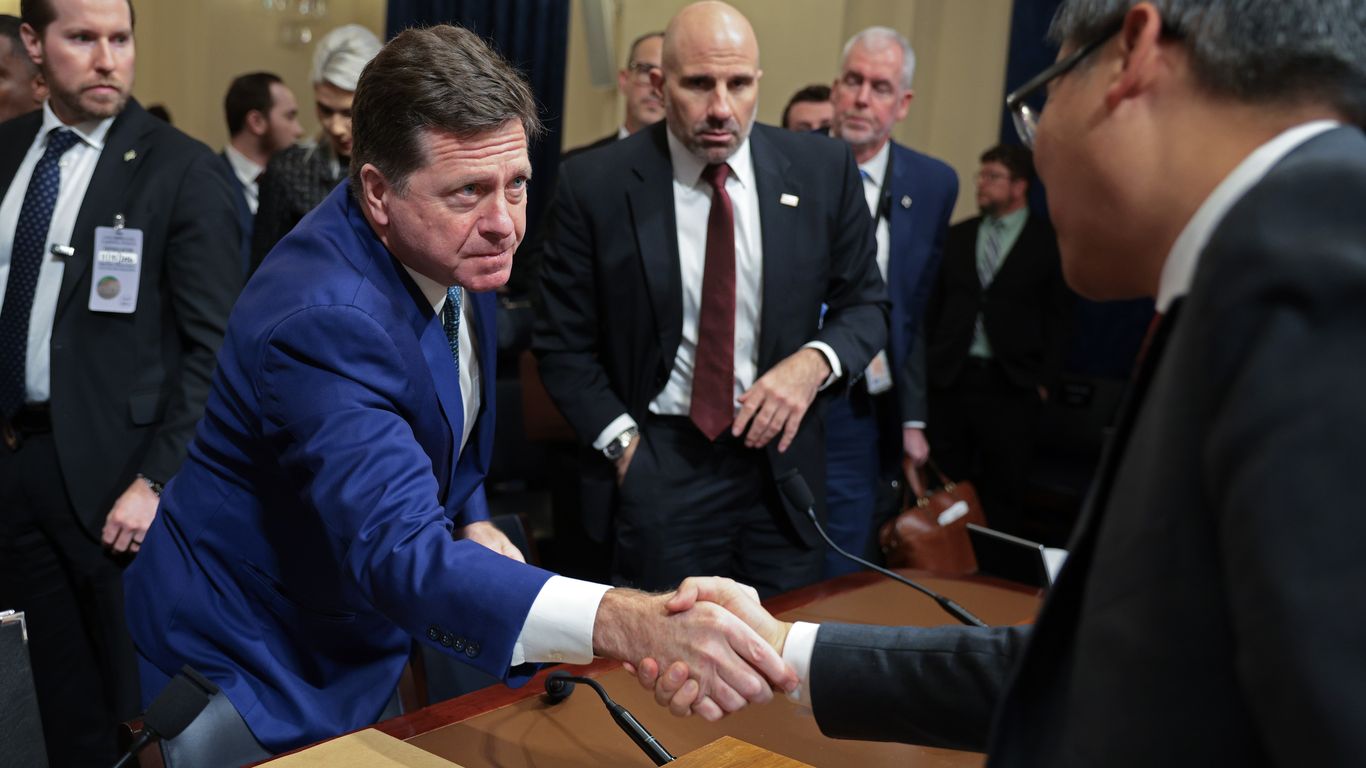
Director of National Intelligence Jay Clayton will also serve as acting national cyber director while Kirsten Davies awaits Senate confirmation to lead the office, Axios has learned.
- A White House official said the strong support Davies received convinced Trump to nominate her to lead the office permanently rather than keep her in an acting capacity.
Why it matters: Clayton, the nation's top intelligence official, will now coordinate cybersecurity policy as outages and reported cyberattacks expose vulnerabilities in America's digital infrastructure.
Catch up quick: President Trump announced Thursday he was tapping Davies, the Pentagon's chief information officer, to replace Sean Cairncross as national cyber director.
- Davies will assist Clayton as a senior adviser in the Office of the National Cyber Director until she is confirmed.
- Trump has increasingly turned to Clayton. He became director of national intelligence in August, and then Trump named him AI czar coordinating the government's approach to AI. Now he will temporarily lead the office responsible for coordinating cybersecurity policy.
What they're saying: "I'm excited to work more with Kirsten, who has the experience and capabilities needed to help America navigate our increasingly complex and powerful digital infrastructure as our next National Cyber Director," Clayton said in a statement to Axios.
- "I look forward to working with the ONCD team to ensure Kirsten has a seamless transition into the role upon her confirmation by the Senate."
The big picture: Two critical national security roles will temporarily fall under one official as President Trump shakes up his cybersecurity team amid the growing threat of AI-powered attacks.
- The disruptions have raised concerns about the vulnerability of the nation's digital infrastructure, although administration officials say there is no evidence they were caused by coordinated cyberattacks.
- Clayton himself has played a prominent role in the administration's response, telling lawmakers Wednesday that the outages appeared to stem from unrelated technical problems and system upgrades.
Driving the news: Clayton spent Sunday morning on CNN's "State of the Union," ABC's "This Week" and "Fox News Sunday," explaining recent technology disruptions and national security concerns.
- On CNN, he warned that Americans should expect more "glitches, gaps, interruptions in service" as government agencies and businesses modernize their systems.
- On ABC, Clayton maintained that recent widespread outages were neither coordinated nor state-sponsored, but declined to discuss reported cyberattacks on the FBI and Department of Agriculture.
- On Fox News, he said AI is giving malicious actors more powerful tools and warned that critical infrastructure will need upgrades.
Zoom in: Davies oversees the Pentagon's information technology and cybersecurity strategy, including efforts to modernize aging systems and protect military networks.
- She has nearly two decades of technology experience, including senior roles at Unilever, Estée Lauder, Barclays Africa, Hewlett Packard Enterprise and Siemens.
Behind the scenes: Clayton has already worked closely with the Office of the National Cyber Director, National Security Council, National Security Agency and other agencies through his AI leadership role, according to the White House official.