
Sure, you’ve seen a dead body before, but have you ever seen a thumb preserved in salt? How about a saint’s heart shrouded in gold?
Beyond the normal displays of skeletons in medical museums and holy leaders’ bodies in churches and temples, there’s a whole world of bits and pieces to explore. Throughout history, body parts have been taken as trophies during wartime, worshipped as miraculous healing agents, cut off and displayed to honor their owners, or simply saved incidentally by natural processes.
If seeing a whole body feels banal, we recommend delving from the complete corpse to its components. Here are some of our favorites from around the world.
1. National Museum of Health and Medicine - Silver Spring, Maryland
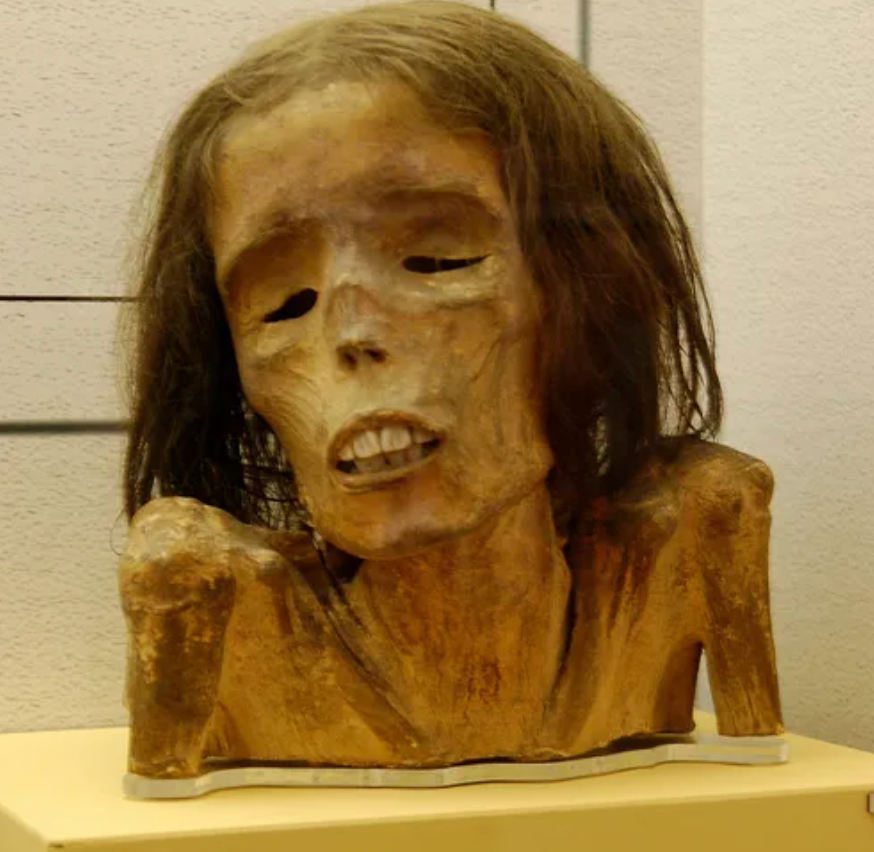
Among the 24 million medical instruments and anatomical specimens housed here are portions of Abraham Lincoln’s skull (and the attached hair), as well as Gen. Daniel Sickles’ amputated leg and the unusual skull of a Civil War soldier who was shot across the top of the head. Other displays include small skeletons showcasing the different stages of a child’s development, a conjoined twin preserved in alcohol, and the mummified head and shoulders of a girl from the late 19th century. The museum is also home to one of the world’s largest neuroanatomical collections, consisting of normal and pathological human brains and comparative mammalian brains.
2. The Sourtoe Cocktail - Dawson City, Yukon
Many moons ago, miner and rumrunner Louie Linken had his frostbitten toe amputated and preserved in a jar of alcohol ... for posterity. Decades later, it was discovered by a local Yukon captain, who brought it to a saloon (now the Downtown Hotel bar) and started plopping it into folks’ drinks as a surprise garnish. The original toe lasted seven years before a replacement was needed, and since then, a whole foot’s worth of toes have been donated to the bar. For those who dream of joining the Sourtoe Cocktail Club, there’s only one rule: “You can drink it fast, you can drink it slow, but the lips have gotta touch the toe.”
3. Lindow Man - London, England
Scientists believe that this 25-year-old man died somewhere between 2 B.C. to A.D. 119. The bog he was found in left him remarkably well preserved, allowing for close study of his skin, hair, and internal organs. (The last meal in his stomach? Unleavened bread made from wheat and barley.) Examination of the man also revealed that his death was quite brutal, with head indentations, broken ribs, and a slashed throat indicating a prolonged struggle. It’s unclear whether his death was cold-blooded murder or part of a ritual sacrifice; either way, he clearly drew the short straw. Today, you can visit him at the British Museum to investigate his untimely demise yourself.
4. Preserved Head of Diogo Alves - Lisbon, Portugal
The head of Portugal’s first serial killer and one of its last men to ever be hanged now bobbles in a jar, passed by the unfazed medical students and professors of the University of Lisbon. When Alves met his demise in 1841, phrenology was an exciting, up-and-coming field, and Portugal’s eager phrenologists pleaded for his head to be preserved for study. By examining his skull, they believed they could determine why he killed so prolifically and ruthlessly. Did this pan out? Not really. (By 1843, phrenology was formally labeled a pseudoscience.) However, it’s a unique addition to an otherwise standard anatomical theater, sitting right next to a diaphanized hand.
5. Mütter Museum - Philadelphia, Pennsylvania
This collection inside the College of Physicians has everything: 2,000 objects removed from people’s throats, conjoined twin skeletons, the remains of a 7-foot-6-inch man, and, most notably, slivers of Albert Einstein’s brain. Displayed across 46 microscope slides, these strands have been studied extensively over the years, with some scientists suggesting that Einstein’s brain architecture gave him the “combinatory play” of image he claimed was essential to his discoveries. Others look at it and see ... just regular old brain matter, in less-than-ideal condition after its multiple trips across the country.
6. St. Anthony’s Tongue - Padua, Italy
St. Anthony was a renowned speaker during his lifetime, traveling across France and Italy preaching the word of God. Thus, it’s fitting that the one nondecomposed part of his body (exhumed in 1263) was his tongue. The saint’s tongue and jaw are now housed at his namesake basilica in Padua, displayed in ornate gold reliquaries that allow him to keep spreading the Gospel, even in death. The building itself is also a marvel, combining Romanesque, Byzantine, and Gothic architectural styles and housing artwork by Giotto and Donatello.
7. Transi de René de Chalon - Bar-le-Duc, France
Before Prince René de Chalon passed away at the age of 25, he specified that he did not want his dead body to look beautiful. Au contraire: René wanted to be remembered as a rotting corpse, with dried skin flaps and a hollow carcass. His wishes were granted in this grotesque, white-stone statue inside the Church of Saint-Étienne-le-Vieux, created by Ligier Richier in 1547. The heart-shaped reliquary in the statue’s hand once held the shriveled remains of René’s own heart; however, the heart was lost (or stolen...) during the French Revolution. Nevertheless, the ghoulish artwork is a dark reminder that all of us will go from “dust to dust.”
8. Chopin’s Heart - Warsaw, Poland
Composer Frédéric Chopin’s dying wish was that his heart be sent back to his native Poland rather than buried with the rest of his body in his adopted home of Paris. And what is family for if not to deliver on such requests? Chopin’s sister, Ludwika Jędrzejewicz, plucked out his heart before his interment, then smuggled it to Warsaw in a jar of booze. Placed beneath the city’s Holy Cross Church, the heart became a point of pride for Polish nationalists, so much so that the Nazis took it during World War II to weaken the country’s morale. (Thankfully, Germany returned it after the war.)
9. St. Valentine’s Shoulder Blade - Prague, Czechia
The shoulder bone of St. Valentine was supposedly brought to the Saints Peter and Paul Basilica in the 1300s by Holy Roman Emperor Charles IV, though it was not discovered until 2002, when church members found it while organizing the basement. Ever since, the shoulder blade has been on permanent display, with a special Mass honoring it on Valentine’s Day. Since many churches have claimed parts of St. Valentine over the years, there is some doubt about the authenticity of the bone. Whether this decorated shoulder belonged to the real saint or an imposter will likely remain a mystery forever, but regardless, it’s a wonderfully weird symbol of love.
10. Museum of Sin - Tambov, Russia
Forensic pathologist Yuri Shchukin has put his decades of morgue experience into this passion project: over 700 body parts and organs showing the ruinous effects of vice. Within his collection you’ll find such novelties as embryos from drinking and drug-taking mothers, the severed finger of an unfaithful husband, and a horn that supposedly sprouted from the head of a robber. A Latin inscription at the entrance reads: “This is a place where the dead teach the living.”
11. Galileo’s Middle Finger - Florence, Italy
Almost a century after Galileo was laid to rest, an antiquarian and an anatomist removed his middle finger, along with two other fingers and a tooth (why, exactly, is anyone’s guess). The finger was soon handed over to Florence’s Laurentian Library and, eventually, the Museo Galileo, where it is still on display today in an egg-shaped glass case with a marble base. A commemorative inscription by astronomer Tommaso Perelli reads: “Spurn not the remains of the finger by which the right hand measured out paths of the sky, pointed to orbs never before seen by mortals.” In 2009, Galileo’s middle finger had a heartwarming reunion with his newly authenticated index finger, thumb, and tooth.
12. St. Catherine’s Severed Head - Siena, Italy
When Saint Catherine died in 1380, her hometown of Siena wanted to keep her body but knew that Rome wouldn’t give it over willingly. So, the Sienese got creative: cutting off her head, putting it in a paper bag, and sneaking it past the Roman guards (praying for Catherine’s protection all the while). Upon their safe arrival back in Siena, these smugglers placed the head inside an ornate reliquary in the Basilica of San Domenico, where it remains today. Catherine’s thumb, too, is on display at the basilica, though her foot is all the way in Venice.
13. Buddha Tooth Relic Temple & Museum - Singapore
This enormous complex in Singapore’s Chinatown was erected for a single reason: to display one of the Buddha’s chompers, supposedly recovered from a collapsed stupa in Myanmar in the 1980s. (Never mind that some experts have called the tooth “definitely not human.”) Whether you believe in the tooth’s authenticity or not, it’s worth a visit to the temple just to take in its surroundings: multiple floors of Buddha statues, dragon snakes guarding sacred relics, and a stunning front prayer hall.
14. Kingship and Sacrifice - Dublin, Ireland
This permanent exhibition inside the National Museum of Ireland is devoted to Iron and Bronze Age human sacrifices that were deposited in bogs along tribal boundaries, a.k.a. “bog bodies.” The collection includes the Cashel Man, the oldest fleshed bog body ever unearthed, as well as the Gallagh Man, who was strangled by a willow twig rope. Along with the bodies themselves, visitors can view Iron Age artifacts like horse trappings, weapons, utensils, boundary markers, and votive deposits of butter known as “bog butter.”
15. Grave of Captain Jones’ Leg - Washington, New Hampshire
Capt. Samuel Jones, a beloved tavern proprietor in rural New Hampshire, was doing construction work one day in 1804 when his leg got pinned between a building and a fence. The resulting injury was so bad that Jones had to have the leg amputated, but he did not despair. Instead, he decided to hold a funeral for his lost limb and bury it in the local cemetery, in part as a precaution against phantom limb pain. When Jones passed away years later, his body was interred elsewhere (theories range from Boston to Rhode Island to the Bronx), but his leg remains here, marked by a simple gravestone.